


Nintendo (TSE:7974) Could Be 12% Undervalued Following Switch 2 Direct Reveal
How the latest Nintendo Direct reshapes the Switch 2 pipeline
Nintendo (TSE:7974) just packed its September Direct with fresh titles for Switch 2 and current Switch owners, headlined by new Metroid and Kirby entries plus refreshed versions of existing franchises.
Those announcements sit alongside a 40th anniversary push for The Legend of Zelda, including an overhauled Ocarina of Time for Switch 2 and themed hardware that targets engaged fans heading into the holiday period.
Nintendo’s recent Direct and Zelda anniversary push arrive after a mixed run for investors, with the share price gaining 19.76% over 90 days, while the year-to-date share price return is down 20.43% and the 1-year total shareholder return has declined 33.91%. However, the 5-year total shareholder return of 81.44% points to a stronger longer-term record.
Scan how Nintendo’s latest Direct compares with other gaming-focused plays by checking which companies made it into our 74 high quality undiscovered gems list with strong fundamentals and room to surprise.
Nintendo now trades at a discount to both analyst targets and intrinsic value estimates after a sharp 90 day rebound. Is that a cautious market misread, or a fair response to the recent 1 year drawdown?
Most Popular Narrative: 11.9% Undervalued
Nintendo closed at ¥8,474, while the leading narrative values the stock at ¥9,615.72, which points to a gap that some investors see as an opportunity rather than a warning.
Nintendo currently holds a competitive advantage because the unit price of the Switch 2 undercuts the Steam Deck significantly. Apparently, supplier arrangements have secured the supply of LPDDR5X 12 GB modules. The absence of GTA VI on the console during the holiday poses a significant risk. Currently, the Switch 2 is not serving the casual audience. Casual players might not opt for a Switch 2 and stay with their Switch 1. The Switch 2 seems to target a more dedicated audience which overlaps with its competitors, namely PS5 and Xbox. PlayStation 6 launch in 2027 may pose a risk. In the handheld and hybrid division, Nintendo is described as holding more than 90% of the market share. Sony and Microsoft have announced price increases higher than the price increases of Nintendo, which puts Nintendo at the lowest barrier of entry, having not only the cheaper Switch 2 but also offering the Switch 1, which is presented as the only console at a reasonable price value. The 4 GB of RAM in the Switch 1 helps to keep costs low. Households seem to purchase multiple devices. The software lineup for 2026 is characterized as rather weak, with its only blockbuster being Ocarina of Time. New entry Tomodachi Life caters to the female audience with reportedly good sales. In 2027, however, Pokemon Wind and Waves as well as some unannounced mainline titles are expected by this narrative to drive sales. According to this view, sales and revenue will increase in 2027. The effects of Nintendo being significantly cheaper than its competitors through supply chain management and product design still have to be quantified and, in this narrative, are expected to become clearer during the first two quarters of 2027. Total installed base across Switch 1 and 2 is projected in this account to reach 200 million devices in 2027. The movie production is seen as a complementary marketing tool that could also lead to increased sales of software and hardware. Further research needs to be done to pinpoint the exact numbers.
See why 7 investors see Nintendo as 12% undervalued.
Result: Fair Value of ¥9,615.72 (UNDERVALUED)
Still, a weaker 2026 software slate and any stumble in Switch 2 adoption could quickly challenge this view that Nintendo is 11.9% undervalued.
Find out about the key risks to this Nintendo narrative.
Another View: What Nintendo’s P/E Ratio Is Saying
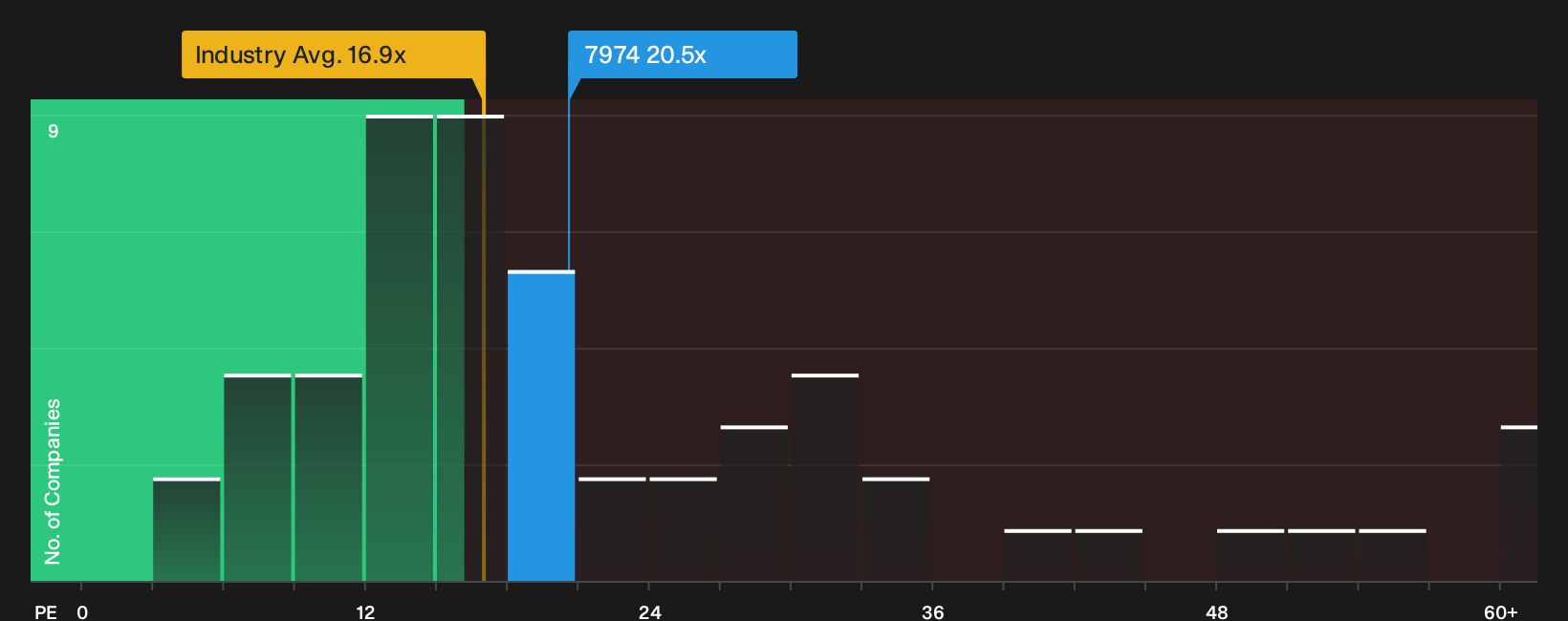
Nintendo might look cheap against its own fair value at ¥9,615.72, but the market is still paying 20.5x earnings, which is higher than the JP Entertainment sector on 16.9x. The same P/E sits below peers at 25.1x and under the fair ratio of 28.1x. The question is whether that gap signals caution or a window before sentiment shifts.
For a closer look at how this price compares with earnings power, See what the numbers say about this price — find out in our valuation breakdown..
Next Steps
Mixed signals on Nintendo can either feel like noise or a prompt to act quickly and test the story against your own expectations. To weigh the concerns against the positives side by side, start with the 3 key rewards and 1 important warning sign.
Looking for more Nintendo investment ideas beyond this Direct?
You do not need to stop at Nintendo. Use these screeners to pressure test your thesis, spot fresh ideas, and avoid watching others move first.
- Target resilient income by reviewing companies in the 15 dividend fortresses that focus on meaningful yield backed by solid financial profiles.
- Scan for mispriced opportunities by working through the 17 high quality undervalued stocks where quality fundamentals and discounted valuations come together.
- Prioritize peace of mind by checking the 12 resilient stocks with low risk scores that filters for sturdier balance sheets and lower overall risk scores.
This article by Simply Wall St is general in nature. We provide commentary based on historical data and analyst forecasts only using an unbiased methodology and our articles are not intended to be financial advice. It does not constitute a recommendation to buy or sell any stock, and does not take account of your objectives, or your financial situation. We aim to bring you long-term focused analysis driven by fundamental data. Note that our analysis may not factor in the latest price-sensitive company announcements or qualitative material. Simply Wall St has no position in any stocks mentioned.
Have feedback on this article? Concerned about the content? Get in touch with us directly. Alternatively, email editorial-team@simplywallst.com