


Energy inflation has yet to subside, and food inflation is about to “take over”! Global bonds are likely to face a new round of shock
The Zhitong Finance App learned that since this year, concerns about inflation caused by soaring energy prices and the combined market's concerns about the debt burden of the US and Europe have always been the “root cause” of the bond market, and have pushed bond yields to levels only seen before the global financial crisis. Today, investors are worried that the next round of inflation may come from food.
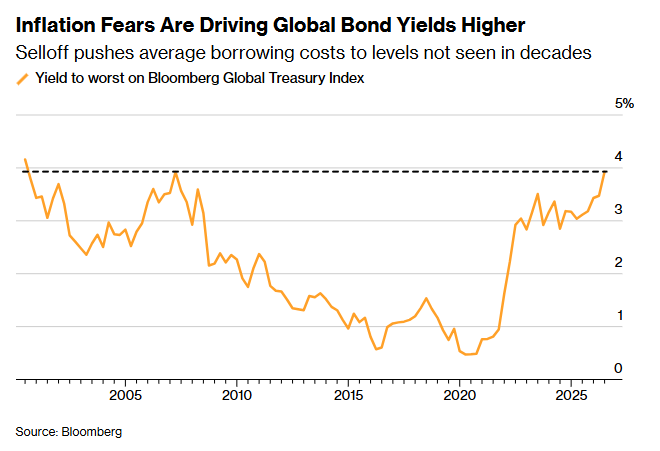
Inflation concerns drive higher global bond yields
Thanks to the good harvest in 2025, food prices had been “putting the brakes on” inflation until now. However, Barclays economists have determined that this situation may change in Europe as early as the fall of this year; if crop production and exports continue to be affected, this change may expand to a wider region next year. Economists at J.P. Morgan predict that the global food inflation rate will jump to 5% in the first half of 2027, up from 2.8% in the same period this year.
Super El Niño, tight fertilizer supplies, disrupted shipping, and the subsequent effects of Europe's record hot summer will drive up the cost of everyday food. A United Nations food commodity index has risen to its highest level since the end of 2022. Even if the Federal Reserve has raised interest rates and vowed to curb inflation, the continued rise in food prices could cause new problems for bond portfolios.
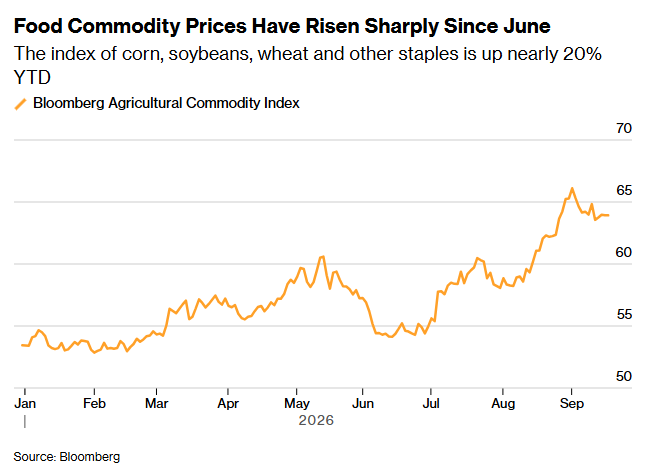
Food commodity prices have risen sharply since June
Asset managers such as Carmignac, Fidelity International, and Troy Asset Management are buying protective assets or cutting their exposure to countries likely to be hit the hardest. Among them, Marie-Anne Allier, investment manager at Carmignac, said, “I think the next supply shock will occur in the food sector, and the market has yet to price it, especially considering that we expect this process to be slow but continuous.”
In response to this risk, Carmignac has been buying inflation-linked government bonds from the US and Europe. Marie-Anne Allier believes that every time the 5-year break-even inflation rate (an indicator that reflects the market's expectations for future price trends) falls, it is an opportunity to increase these positions.
Central bank officials are closely watching this issue, as the impact of food supply shocks on household inflation expectations may be greater than energy shocks, and may spread to the wider economy by triggering demands for higher wages. Bank of England Governor Bailey said this month that the risk of inflation brought about by food prices “is tilting in an upward direction.” The Bank of England will further share its latest views on prices when it announces interest rate decisions later on Thursday.
Mark Dowding, chief investment officer at RBC BlueBay, said: “We think inflation in both the US and the UK is underestimated by the market.” The company closed a 12-month UK interest rate futures position last month due to deteriorating food and energy prospects.
Macro strategist Skylar Montgomery Koning said, “Unlike energy, food has less impact on production costs in the second round. Since demand for food is relatively inelastic, the impact of this shock on inflation is greater than the negative impact on economic growth. It's an unsettling combination for government bonds that are already under pressure.”
Troy Asset Management's investment manager Charlotte Yonge also predicts that food price inflation will gradually increase over the next 6 to 12 months, and indicated that the 5-year break-even inflation rates in the UK and the US have not yet reflected this factor. Charlotte Yonge said she is hedging food prices and broader inflation risks through short-term inflation-linked bonds between the UK and the US.
Laurence Mutkin, head of interest rate strategy for Europe, Middle East and Africa at Bank of Montreal in Canada, said that concerns about rising food prices next year have further strengthened his view that 10-year British Treasury bonds will continue to be shorted and the yield will rise to about 5.75%.
Daniel Wood, fixed income portfolio manager at William Blair International, said that Eastern European bond yields have risen more sharply to reflect the impact of the Russian-Ukrainian conflict on exports in the region. He said that in Hungary, the drought boosted imports, but a stronger local currency exchange rate and falling demand helped contain the impact of inflation.
“Countries that are highly dependent on imports, such as Egypt and Turkey, are also sensitive, especially when rising food prices are accompanied by a weakening of the local currency,” Daniel Wood said. “In Asia, countries such as India and the Philippines, where food accounts for a relatively high consumer price index (CPI) basket, are also vulnerable to adverse weather patterns.”
Philip Fielding, fixed income portfolio manager at Fidelity International, said that due to this year's El Niño phenomenon, Asia and Latin America are likely to be hit the hardest by hotter, drier weather, and agriculture is expected to be disrupted to a certain extent. He pointed out that the company still believes there is an opportunity for good returns in emerging markets, but it has “cut interest rate exposure in Latin America to allocate countries that may be less affected.”
Others believe that the higher the price of food and other necessities of life, the greater the suppression of economic growth, making it more difficult to obtain a reasonable basis for raising interest rates. Karen Ward, chief market strategist for Europe, Middle East and Africa at J.P. Morgan Asset Management, said that the labor market in Europe and the US is not strong enough to support “continuous wage transmission.” However, given the recent signs of economic resilience in the face of global headwinds, many bond traders are unwilling to take this risk.