


The “CPU Renaissance” is on! Arm (ARM.US) is more confident to deliver on its $2 billion forecast, and AI agents are setting off a huge wave of CPU demand
The Zhitong Finance App learned that Rene Haas, CEO and CEO of ARM (ARM.US), the owner of the ARM instruction set architecture, said in an interview with the media on Wednesday that as AI agents infiltrate various industries and bring stronger CPU demand, he is increasingly confident that the dedicated CPU CPU for AI data centers — AGI CPUs exclusively launched by this chip design company can obtain sufficient supply to meet the needs of customers up to 2 billion US dollars or higher than this data. The popularity of ARM architecture CPUs in AI computing power infrastructure clusters, and the start of direct sales of self-developed versions of complete chips with Arm, are forming two mutually reinforcing growth paths.
A $1 billion forecast was proposed in March 2026, and corresponding supply arrangements were in place at that time; customer demand increased to more than 2 billion US dollars in May, but the revenue forecast of 1 billion US dollars was maintained; in July, he said he was more confident in expanding supply and achieving more than 1 billion US dollars in revenue; by the time of this interview with Jim Cramer in September, ARM CEO Haas further stated that his confidence in achieving 2 billion US dollars or even stronger than this figure was much stronger than in July. Arm's $2 billion demand forecast for the AgI CPU business is scheduled to be realized within the 2027-2028 fiscal year (spanning the 2026-2027 calendar year).
In the past two years, AI narratives were almost monopolized by GPUs, and CPUs once seemed like “supporting actors” in the AI arms race; however, with the open source OpenClaw type of proxy AI workflow (AI agent) dominated by inference workloads, data orchestration, task scheduling, memory access, network communication, and multi-tool calls, the market can be described as fully aware that without a powerful CPU as the backbone of the system, GPU clusters cannot operate efficiently.
The CPU has returned from “underrated infrastructure” to the center of the chip stage, with a very clear “renaissance” retro wave meaning. According to the results previously announced by AMD, the company's second-quarter data center revenue reached 6.7 billion US dollars, up 107% year on year. Driven by ePyc and Instinct, Intel Xeon further extended from the existing enterprise computing infrastructure to intelligent execution and heterogeneous inference infrastructure. The company's data center and AI business revenue for the second quarter was about 6.3 billion US dollars, up 59% year over year, and has demonstrated rack level inference and intelligent systems based on Xeon with partners.
Arm's stock price has risen 120% since this year amid the surge in CPU demand brought about by the AI agent frenzy focusing on agent-based AI workflows. The simplified instruction set computing architecture adopted by ARM makes server CPUs based on its design have great advantages in terms of high energy efficiency and low power consumption compared to the Intel x86 architecture when performing AI inference and training tasks. This characteristic makes the ARM architecture particularly suitable for use in data center servers, and can efficiently cooperate with AI GPUs to meet almost endless AI inference and training computing power requirements.
Arm can be called one of the biggest winners in the global artificial intelligence craze. Grace CPUs developed by Nvidia and Vera CPUs, which have been in high demand recently, are based on ARM architecture. Amazon's self-developed data center Graviton server processors also use ARM architectures. Similarly, Google's self-developed ARM data center CPU Axion based on ARM architecture and Microsoft Azure Cobalt 100/Cobalt 200 is based on high-performance Arm NeoVerse's self-developed ARM architecture data The central CPU and ARM architecture can be described as evolving from the “king of smartphones” to one of the computing power infrastructure bases in the AI cloud era.
Arm CEO: More confident to meet the $2 billion CPU chip demand
Arm CEO Rene Haas said in an interview with the famous financial channel CNBC's “financial celebrity” Jim Cramer on Wednesday that he is increasingly confident that the company can meet Wall Street's higher revenue expectations for its new data center chip called the AGI CPU.
“We feel good about it. We feel really good about this,” Haas said while attending Jim Cramer's “Mad Money” program in San Francisco.
These remarks are significant because demand has never been the main question surrounding Arm's first self-designed data center central processor. Instead, investors are concerned about whether the company can obtain sufficient supply to turn this demand into revenue during the AI boom, when various chip makers compete for limited manufacturing capacity.
This ability to execute is particularly important because Arm's CPU marks a major expansion in its business model. In the past, the company mainly made money by licensing chip designs to customers, and this CPU represents the beginning of the business of selling its own complete chips.
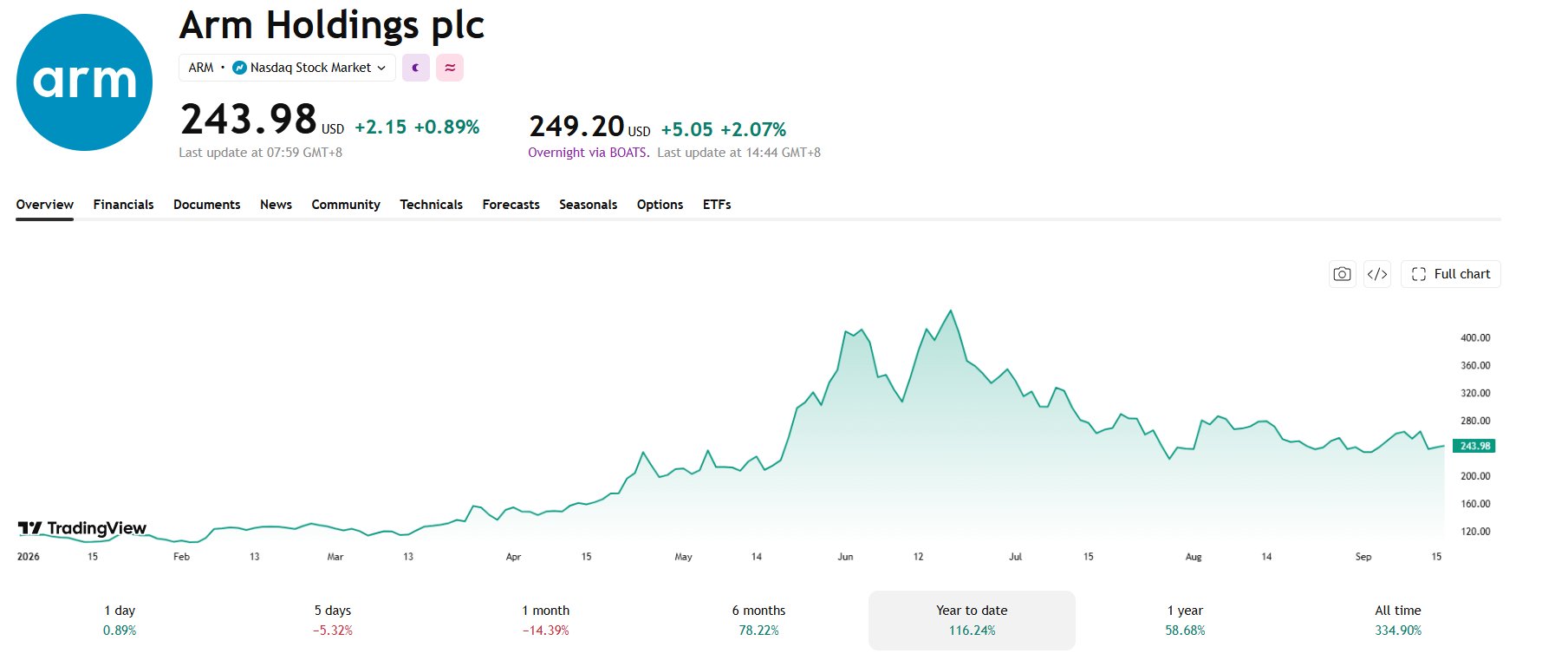
Arm first revealed during an earnings call in May that it was already able to see the $2 billion demand for the AGI CPU, which is double the $1 billion previously proposed when it announced its first custom CPU in March. However, as Arm strives to obtain sufficient supply to meet new demand while maintaining an official revenue forecast of 1 billion US dollars, its stock price fell 10%.
During the July earnings call, management said that its confidence in obtaining the necessary supplies had increased. Shares rose more than 7% on the following trading day.
On Wednesday, Haas further told Kramer that his confidence could be described as having increased significantly.
“So, I remember we said in the earnings call around May that we were able to see a demand of 2 billion US dollars; and in the most recent earnings call, we said that from May to July, our confidence in achieving the figure of 2 billion US dollars has increased,” Haas said in the interview. “It's already September, Jim. What I can tell you is that I'm more confident today than when the earnings call in July was held.”
Arm's stock price maintained the increase after the July earnings report was announced, but after experiencing a parabolic surge in the first half of this year, it is still about 45% below the June high of $452. Kramer's charitable trust previously held Arm, but sold the position after its stock price rose sharply to preserve profits. The stock is still on the Club's Bullpen Investment Club's “waitlist” watch list.
AI agents drive CPU demand, and Arm accelerates expansion of data center chip business
Arm revealed in September that Google is already running an agent sandbox on the Axion-based Google Kubernetes Engine. Microsoft Azure uses Cobalt 200 to speed up execution of tools in the sandbox, and Nvidia Vera is also targeting intelligent workloads; in ARM's own AGi CPU product line, Meta is the primary partner and co-developer, and ByteDance's Volcano Engine is bringing the smart sandbox based on this chip to the market. The former path expands the application base of the Arm architecture, while the latter path allows Arm to directly participate in the commercialization of complete CPU products.
In the context of the actively growing AI computing power industry, the most important positive sign of Haas's interview is that confidence in the ability to guarantee supply continued to increase from May and July to September. As a result, customer demand of 2 billion US dollars can be seen to have clearer prospects for revenue fulfillment.
According to an interview on “Crazy Money” hosted by Jim Cramer, Arm proposed a revenue forecast of 1 billion US dollars in March, and saw customer demand reaching 2 billion US dollars in May, but it still retained its official revenue forecast of 1 billion US dollars at the time to wait for more supply to be implemented. The new development revealed in the September interview is that confidence in supply delivery continues to rise. Therefore, the focus surrounding ARM's bullish logic is progressing from “whether new chips can attract customers” to “how can continuously blowout CPU demand be converted into actual delivery and revenue”, while expanding Arm's business model from design licensing and royalties to selling its own complete chips.
The global expansion of AI computing power is expanding from tens of billions of dollars of cloud procurement to infrastructure lockdown spanning more than ten years, and CPUs have also entered a new cycle of demand expansion. In April of this year, Meta and CoreWeave signed an expansion agreement of about 21 billion US dollars. The supply of computing power continued until December 2032, focusing on supporting inference workloads; Anthropic also reached a multi-year agreement with CoreWeave to obtain additional computing power for Claude's development and deployment. The related capacity is scheduled to be launched this year. On September 16, Blockfusion further announced that its subsidiary has signed an official lease agreement with CoreWeave for the Niagara Falls AI Park in New York, with an initial lease period of 15 years, with two five-year lease renewal options, and simultaneous expansion agreements; the park is being transformed into a high-density liquid-cooled AI infrastructure, using existing grid access, water and electricity supply and redundant optical fiber resources to meet long-term needs.
These orders and park arrangements show that the new cloud platform is taking on more than a short-term computing power gap, but part of the long-term deployment plans of model companies and tech giants. At the same time, Astra has strengthened programming, browsing, computer operation, and complex task execution capabilities, and expanded the scope of actual work that AI can participate in. The exponential increase in complex task capabilities represented by Astra can be described as further expanding the prospects for CPU demand in data centers; due to too strong demand for complex computing power, OpenAI has announced that it will suspend new registrations and upgrades for the $200 monthly Pro 20X package starting September 10. Derived from the demand mechanism, existing multi-year data center orders lay the foundation for capacity expansion, and next-generation models such as Astra add catalysts to continuous reasoning by expanding the scope of tasks and depth of use — growth opportunities spread further from GPU clusters to complete AI data center infrastructure chains such as CPUs, data center memory/NAND storage components, and high-performance Ethernet network equipment.
The underlying driving force of the “CPU Renaissance” is AI moving from generating answers to executing tasks: accelerators are responsible for model calculation, while CPUs are increasingly responsible for actual work around models. In a typical heterogeneous agent system, accelerators such as GPUs run large model reasoning, and the CPU is responsible for workflow orchestration (orchestration), tool calling (tool calling), code execution, database access, data preprocessing, and isolated sandbox (sandbox) and permission management; every time the model proposes an action, it often requires actual software program and business system execution, and then the results are returned to the model for processing.
Arm's description of smart infrastructure, as well as the Xeon, SambaNova, and Nvidia GPU collaborative architectures announced by Intel all reflect this division of labor. Derived from engineering logic, branch judgment, serial dependency, memory access, and input/output operations in tasks make the system not only require more parallel computation, but also general execution capabilities with low latency and stable response; as the number of agents, concurrent tasks, and tool call rounds increases, CPU core time, memory capacity, and network processing requirements will also expand. Based on this, Arm predicts that when smart applications are scaled up, data centers may require at least four times the CPU processing capacity per gigawatt. This is the company's latest capacity demand forecast.
Its AGI CPU provides up to 136 NeoVerse V3 cores, 12 channels of DDR5 memory, and 300 watts of preset thermal design power consumption. The design focuses on coordinating core density, memory supply, and power consumption constraints to support more concurrent execution tasks. As a result, CPU demand no longer only comes from the host computer supporting the GPU, but also from the independently expanding execution resource pool of agents; the more AI can complete a series of real and complex tasks, the wider the market that can be served by general computing.