


Damo has put a new label on SpaceX (SPCX.US): a “safety cushion” in the midst of AI turmoil. The target price is as high as $300
The Zhitong Finance App learned that since last Friday, a debate over whether cutting-edge AI model development should “actively slow down” has rapidly spread from the technology community to the capital market. Anthropic CEO Dario Amodei (Dario Amodei) announced a three-step plan on September 12 calling for “setting the pace for the development of cutting-edge AI,” and OpenAI's Sam Altman (Sam Altman) later stated that he would adopt Amodei's “independent evaluator with employee-level access” scheme. Even Elon Musk (Elon Musk), who has always been known for being aggressive, has rarely joined this camp. On the first trading day after the news spread, global technology stocks fell sharply.
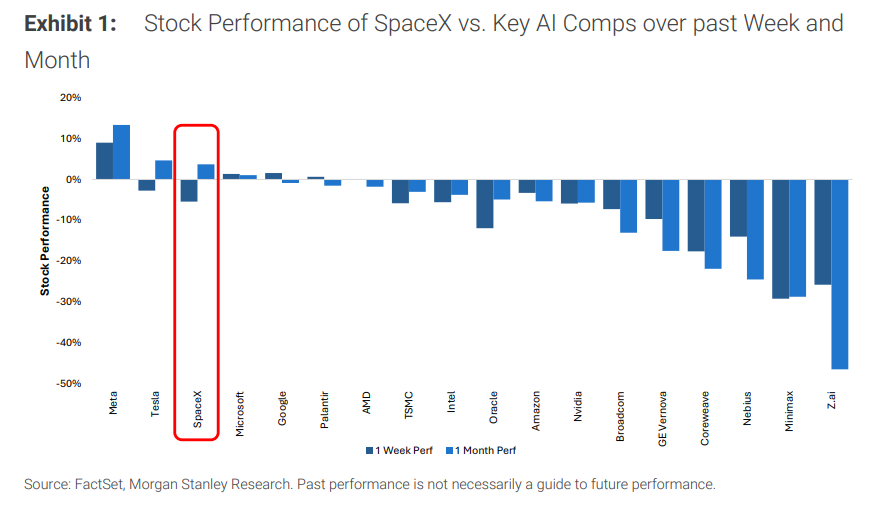
However, in the midst of a panic sell-off of AI concept stocks, Morgan Stanley analyst Adam Jonas conveyed an alternative judgment to customers: SpaceX (SPCX.US) is probably the AI target with relatively strong defensive properties in this round of turmoil. In the research report released on September 15, Jonas reiterated SpaceX's “gain” rating and $300 target price, and gave the following reasons.
The undertones of diversification: More than just “AI concept stocks”
Jonas made a very candid statement at the beginning of the report. “You can't both want and want,” he wrote. The implication is that most of SpaceX's capital expenditure and forward profit growth is indeed driven by the corporate AI business, and any substantial slowdown in AI transactions is a headwind for this stock. But the other side of the problem is that SpaceX's revenue structure is not simply betting on AI computing power narratives.
According to the company's financial report for the second quarter of 2026 released on August 4, the number of Starlink subscribers worldwide has reached 12 million, double the 6 million in the same period last year, with a net increase of 1.7 million in a single quarter. The continued expansion of corporate and government customers has made Starlink the largest source of revenue for SpaceX today. Jonas believes that the driving force behind the growth of this cash cow business comes from the market penetration of satellite communications itself, rather than the industry-specific AI capital expenditure cycle.
Meanwhile, SpaceX's Starship project is progressing at its own pace. According to the latest notice from the US Federal Aviation Administration, the 14th Starship test flight has been adjusted to launch from Starbase in Texas as early as September 22. This mission will be the first attempt to enter orbit and deploy a real Starlink satellite. More noteworthy is the 15th flight — if the 14th mission is successfully completed, SpaceX plans to carry out the next launch in less than 30 days, and during the 15th mission, try to use the launch tower's “chopstick” robotic arm to simultaneously capture a super-heavy booster and a starship spacecraft, which will be a key verification step for a fully reusable system.
Jonas believes that the pace of the launch of the Starship is a typical engineering-driven milestone and has little to do with the AI model's training progress or regulatory game.
Forward options: collaboration between orbital AI and robots
If Starlink and Starship form the “non-AI fundamentals” of SpaceX, then the space computing power project is a long-term option in Jonas's eyes. At the beginning of 2026, SpaceX applied for permission from the FCC to launch up to 1 million data center satellites. In July, the company officially revealed the orbital data center project called “Starmind”. The first AI satellite AI1 has a peak computing power of about 150 kilowatts, and is equipped with a 70-meter solar windshield to expand its wingspan and liquid radiator cooling system. SpaceX also collaborated with Nvidia (NVDA.US) to customize a space-optimized AI computing system based on the Vera Rubin NVL72 architecture for the orbital environment. The first launch targets are set for the fourth quarter of 2027.
Jonas admits that the large-scale implementation of this vision is likely to take place after 2030, which is essentially “an option for a considerable period of time.” But at the same time, he suggested that the market currently hardly values the collaboration between SpaceX and Tesla (TSLA.US) in the fields of robotics and local chip manufacturing.
According to public information, the two companies are jointly advancing the “Terafab” semiconductor manufacturing project, which aims to integrate logic chips, storage, packaging, and testing in the same facility to provide chips for Tesla's Optimus humanoid robot and Cybercab, and also supply components for the space data center being developed by SpaceX. Tesla has taken a stake in SpaceX, and the two sides have also signed an agreement covering joint projects such as Terafab and “Digital Optimus.” Musk himself described the relationship as a “shared dependency” and warned that “without Terafab, Tesla's ability to expand Optimus production capacity will be limited.”
Financial flexibility: plenty of cash, borrow how much to spend
At the balance sheet level, Jonas placed special emphasis on the capital allocation initiative of SpaceX management. By the end of the second quarter, the company held approximately $100 billion in total cash and approximately $6 billion in net cash.
Jonas expects the company to raise heavily through the debt market in the future to push the debt/EBITDA ratio to 1.5 to 2 times, but the key point is that the pace and scale can be flexibly controlled by management — “it only costs what it can borrow, and only if the business plan works.” SpaceX has received investment-grade credit ratings from the three major international rating agencies after its IPO, and has issued $20 billion in short-term unsecured notes to repay bridge loans due next year. This ability to finance forms an additional layer of buffer under the AI deceleration scenario.
Valuation: The market hardly prices the AI business
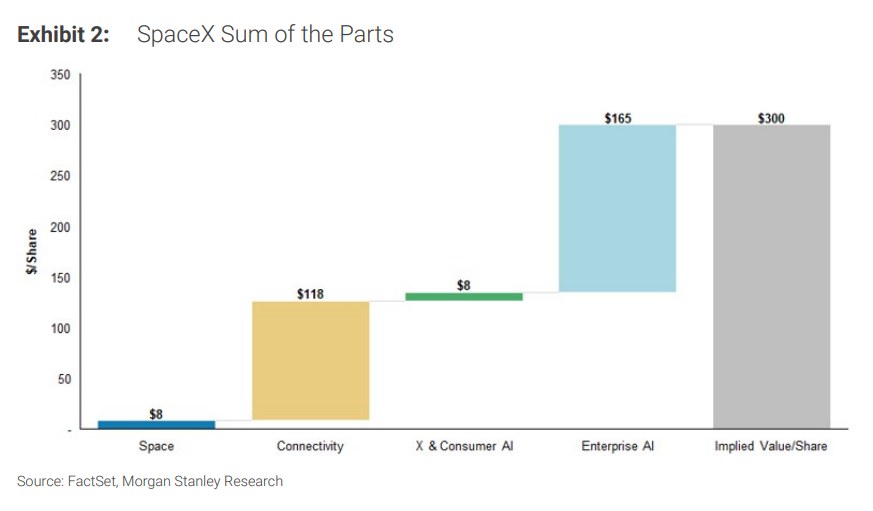
From a valuation perspective, Jonas estimates SpaceX's market capitalization of about 2 trillion US dollars, about three-quarters is contributed by space and communications businesses. Excluding the stock price of about $125 for the AI business — that is, about $8 per share for the space business and $118 per share for the satellite communications business — looking at the current stock price, the AI business (enterprise AI plus X and Grok) only received an implied valuation of about 10%, that is, about $17 per share (based on its AI business valuation of 183 dollars). Jonas made the assertion in July that “SpaceX at $100 means the value of AI returns to zero.”
He made a further sensitive estimate: each additional 1GW of nameplate computing power (based on 50 US dollars per watt, 70% incremental profit margin, 10 times EBITDA capitalization) can increase the value per share by about 27 US dollars, which is equivalent to 15% to 20% of the current stock price. Morgan Stanley's AI computing power forecast for the 2027 fiscal year is 4.9 GW, while the company's own goal is “close to 10 GW.”
The “Musk Factor”
Jonas's fifth reason went back to Musk himself. In his report, he wrote that in his observation of the CEO's management style over the past 20 years, “he's not the kind of person who would waste a good crisis.” Tesla's performance during the “production capacity hell” period from 2018 to 2019 and the COVID-19 pandemic from 2020 to 2021 was viewed by Jonas as historical evidence that the company achieved both operational and stock price breakthroughs in a high-pressure environment.