


Legal Settlement Could Be A Game Changer For Accenture (ACN)
- Accenture agreed to pay US$25 million to settle a U.S. Department of Justice case alleging discriminatory hiring and promotion practices in its federal contracting work, closing a legal dispute that dated back to 2017.
- This resolution allows Accenture to redirect management focus and financial resources toward core priorities such as large transformation projects and generative AI services, rather than ongoing litigation risk.
- We will assess how Accenture's investment narrative aligns with this legal settlement that clears a compliance overhang on federal contracts.
Accenture Investment Narrative Recap
To own Accenture, you need to believe it can keep winning large digital and Gen AI transformation work, while managing margin pressure from subcontractor costs and competitive pricing. The key near term catalyst is whether bookings and revenue growth pick up in coming quarters as clients commit to bigger AI and cloud programs. The recent DOJ settlement looks manageable in size, so the bigger operational swing factor still sits with demand and delivery quality, not legal risk.
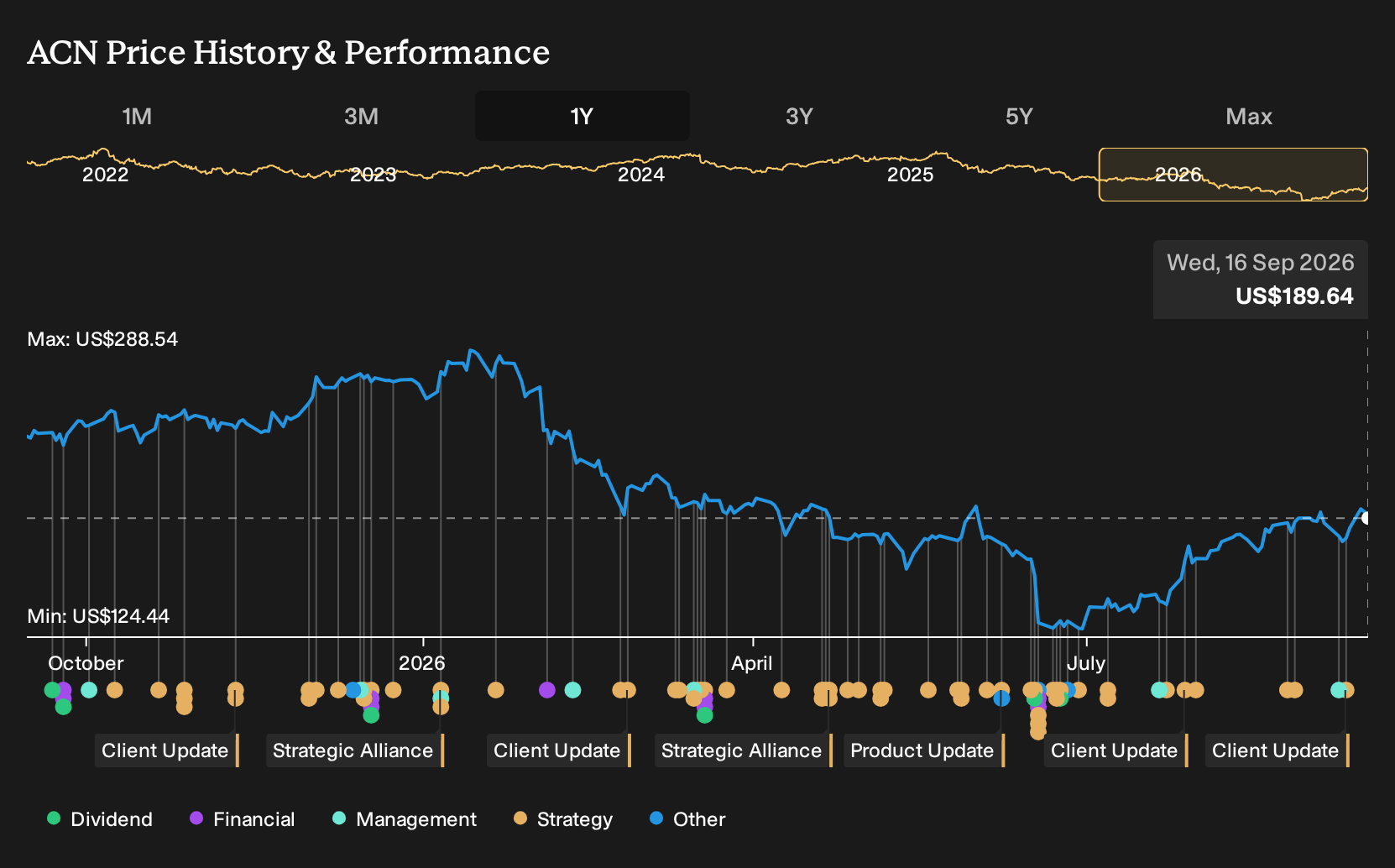
The main risk right now is that slower federal spending, longer decision cycles and foreign exchange headwinds keep growth and profitability muted. Any further hit to operating margin would matter, given net profit margins already sit below last year and the stock has lagged the market over one and five years. Acquisitions and Gen AI projects need to execute cleanly to justify the planned US$9b capital deployment for fiscal 2026.
The MotoGP OTT deal is the announcement that best connects to this story. It puts Accenture in a visible, consumer facing media project that leans directly on its Media Engage platform and wider AI tools. For you as a shareholder, the interest is less about MotoGP itself and more about proof that Accenture can land and run complex, global streaming builds where uptime, personalization and data handling are tested in real time.
This type of engagement also speaks to the catalyst side of the thesis. It reinforces Accenture’s push into Gen AI enabled media solutions, where it is already booking Gen AI revenue and deploying capital into related acquisitions. Execution risk is real, especially with tight margins and intense competition in media and sports streaming, but projects like this give investors a concrete way to track whether those AI and cloud ambitions are translating into durable, higher value client work.
Accenture's narrative projects US$84.2b revenue and US$10.5b earnings by 2029. This implies 4.8% yearly revenue growth and an earnings increase of about US$2.7b from US$7.8b today.
Uncover why Accenture's fair value indicates a 3% potential downside to its current price, which leaves little room for error.
Exploring Other Perspectives
Some of the lowest Accenture analysts focus on a different catalyst. They worry that fixed price and outcome based contracts, now about 60% of work, could squeeze profitability if AI tools do not fully offset delivery risk. Those same analysts were pencilling in US$81.8b revenue and US$9.8b earnings by 2029 before this DOJ settlement and MotoGP OTT news, so you should expect their views may evolve as the story shifts.
Explore 7 other Accenture fair value estimates, including one that suggests as much as 17% downside from the current price.
Form Your Own Verdict
Disagree with existing narratives? Extraordinary investment returns rarely come from following the herd, so consider your own research and judgment.
- A great starting point for your Accenture research is our analysis highlighting 4 key rewards that could impact your investment decision.
- See our latest analysis for Accenture. The report includes a comprehensive fundamental analysis summarized in a single visual, the Snowflake, making it easy to evaluate Accenture's overall financial health at a glance.
Looking for more Accenture sized investment ideas?
If the Accenture story has sharpened your thinking, use that momentum to scan a wider field of opportunities that fit your own risk, income, and quality preferences.
- For investors who want potential upside with a quality filter, start with a focused set of 33 high quality undervalued stocks that pair fundamentals with a margin of safety.
- If capital protection and stability sit higher on your list, narrow your search to a 11 resilient stocks with low risk scores that screen well on resilience and downside control.
- Income focused portfolios can anchor around reliable payouts, so consider a curated pool of 6 dividend fortresses that clear a 5%+ yield hurdle while aiming for durability.
This article by Simply Wall St is general in nature. We provide commentary based on historical data and analyst forecasts only using an unbiased methodology and our articles are not intended to be financial advice. It does not constitute a recommendation to buy or sell any stock, and does not take account of your objectives, or your financial situation. We aim to bring you long-term focused analysis driven by fundamental data. Note that our analysis may not factor in the latest price-sensitive company announcements or qualitative material. Simply Wall St has no position in any stocks mentioned.
Have feedback on this article? Concerned about the content? Get in touch with us directly. Alternatively, email editorial-team@simplywallst.com