


The Federal Reserve raised interest rates for the first time in three years! Walsh releases hawkish signals during the year or an additional 25 basis points
The Zhitong Finance App learned that the Federal Reserve raised the benchmark interest rate by 25 basis points to the 3.75%-4.00% range on Wednesday, the first rate hike since July 2023. Newly appointed Federal Reserve Chairman Walsh stressed after the meeting that recent inflation data did not show a substantial improvement in potential price pressure. The latest “bitmap” is also clearly moving in the direction of hawks. Most officials expect interest rates to be raised at least once this year.
The interest rate hike was unanimously approved by the Federal Open Market Committee (FOMC). The Federal Reserve said in its policy statement that US economic activity continues to expand at a steady pace, domestic spending remains resilient, productivity growth is strong, capital investment is steady, employment growth is basically in sync with labor force growth, and the unemployment rate has not changed much. At the same time, inflation is still high, and this policy action will help push inflation back to the 2% target in a more timely manner.
Walsh said at the press conference that the Federal Reserve has “withdrawn some of its easing policies” this time to make the financial and credit environment more consistent with achieving the ultimate policy goals. In particular, he stressed that prices for too many categories of goods and services are still rising at an annualized rate of more than 3%, and said that this summer's inflation data did not convince him that potential inflation trends had improved meaningfully.
A series of recent inflation data has strengthened the rationale for the Federal Reserve to re-tighten its policy. Core inflation rose higher than expected in August, triggering market concerns that price pressure may be spreading from factors such as tariffs and energy price shocks to a wider range of sectors. The Federal Reserve's latest forecast shows that the median PCE inflation rate in 2026 is 3.7%, and the core PCE inflation rate is expected to be 3.4%. More importantly, officials currently expect overall PCE inflation to return to 2% until 2029, which is further delayed from previous expectations.
The “bitmap” will change to Eagle or raise interest rates by another 25 basis points during the year
Compared to the interest rate hike itself, the market is paying more attention to the subsequent policy signals released by the Federal Reserve.
According to the latest economic forecast, the Federal Reserve official's median forecast for the federal funds rate at the end of 2026 was raised to 4.1% from 3.8% in June. Judging from the bitmap, of the 18 officials who submitted interest rate forecasts, 16 expect interest rates at the end of this year to be higher than the level after this rate hike. Of these, 12 expect the mid-point interest rate at the end of the year to 4.125%, rising to the corresponding target range of 4.00%-4.25%; 4 others expect interest rates to rise even higher.
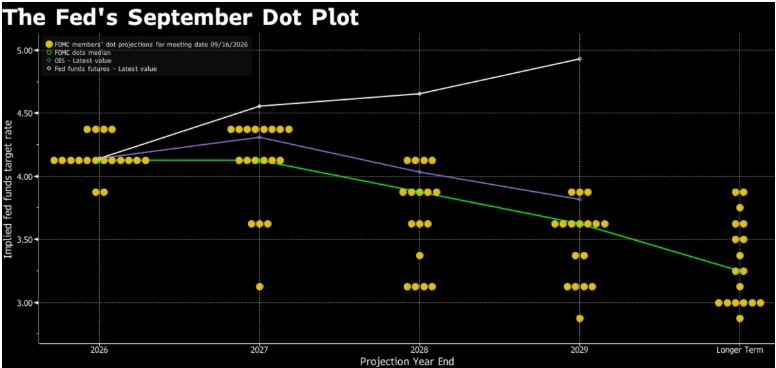
This means that after raising interest rates by 25 basis points this week, support within the Federal Reserve for at least one more rate hike this year has increased markedly. In contrast, in June, only 6 officials expected to raise interest rates at least twice throughout 2026. This time, like in June, Walsh did not submit his own interest rate forecast.
For 2027, the median interest rate forecast is 4.1%, which means that from a median perspective, the Federal Reserve may keep interest rates unchanged next year. However, there are still major differences among officials, and some policymakers believe that further policy tightening may still be necessary.
Noah Buffam, capital market strategist at the Canadian Imperial Bank of Commerce, said that the latest bitmap is clearly hawkish. Federal Reserve officials expect interest rates to return to a neutral level slower than the market's previous expectations. This is also an important reason why the US dollar is supported.
Higher US dollar and US bond yields put pressure on risky assets
Hawkish policy signals quickly spread to financial markets. After the Federal Reserve announced its resolution, the two-year US Treasury yield, which is most sensitive to monetary policy, rose rapidly. At one point, it rose to 4.71%, up more than 10 basis points from before the resolution was announced; the 10-year US Treasury yield hovered around 5%. The US dollar strengthened at the same time, and the Bloomberg Dollar Spot Index rose 0.5% at one point, hitting its highest level since August 14.
There was also a clear reaction in the foreign exchange market. The pound once fell 0.7% against the US dollar, becoming one of the weakest G10 currencies; the yen once fell 0.5% against the US dollar to 155.94. Valentin Marinov, head of foreign exchange research and strategy at Crédit Agricole G10, said that Walsh's speech was also hawkish, further boosting the dollar.
US stocks, on the other hand, extended their decline during the Walsh press conference. According to the data, the Dow Jones Industrial Average closed down about 1.2% on Wednesday, the S&P 500 index fell about 0.45%, and the Nasdaq index erased its decline at the close of the day and almost settled; the two-year US Treasury yield eventually rose to around 4.73%, while the 10-year yield hit around 5%.
The market is actually already highly anticipating this rate hike. Prior to the announcement of the resolution, traders expected that the probability that the Fed would raise interest rates by 25 basis points had exceeded 90% since the August inflation data did not show a significant cooling of price pressure. However, as the bitmap shows that further interest rate hikes are still possible during the year, investors are beginning to re-evaluate the risk that US interest rates may remain high for a longer period of time.
“Debt King” Gunlak: The Federal Reserve should have raised interest rates by 50 basis points at a time
It is worth noting that some well-known Wall Street investors believe that the current 25 basis point rate hike by the Federal Reserve is not even strong enough.
Gunlak, founder of DoubleLine and known as the “King of New Debt,” said that the Federal Reserve should actually raise interest rates by 50 basis points at once on Wednesday before deciding the next steps based on subsequent economic data. He believes that a larger interest rate hike can bring the federal funds rate more quickly into line with the interest rate level reflected in the bond market.
Gunlak pointed out that the two-year US Treasury yield was previously more than 100 basis points higher than the federal funds rate. Since two-year US bond yields usually highly reflect market expectations for short-term policy interest rates, he believes that the bond market has actually sent a signal to the Federal Reserve in advance that it needs to further tighten its policy.
At the same time, Gunlak said he is worried that the market and policy makers may still not pay enough attention to the inflation problems facing the US. He was not surprised that US stocks extended their decline during the Walsh press conference.
Inflation is still the core of policy The Fed's austerity cycle may not be over
This resolution also means that Walsh ushered in the first major policy shift since taking over as chairman of the Federal Reserve at the end of May. Although US President Trump has continued to call for lower interest rates and publicly stated that US borrowing costs should be among the lowest in the world, the Federal Reserve has now unanimously decided to raise interest rates. When asked by reporters what message he wanted to convey to Trump, Walsh did not comment further on the discussions between the two.
Judging from the signals released by the Federal Reserve itself, the current policy focus is clearly still on controlling inflation. The official statement emphasized that inflation is still high, while economic activity remains steady, capital investment is strong, and the job market has not deteriorated significantly, which means that the Federal Reserve still has room to contain price pressure through higher interest rates.
More importantly, unlike the previous market that expected Walsh to push for interest rate cuts after taking office, the latest bitmap shows that the Fed's policy path is being adjusted in the direction of “higher and longer”: the median federal funds rate forecast to rise to 4.1% at the end of 2026, and most officials support raising interest rates at least once more during the year; at the same time, the return of inflation to the 2% target has been delayed until 2029.
This means that this week's 25 basis point rate hike may not be an isolated policy adjustment. The next data on inflation, employment, and energy prices will be a key factor in deciding whether the Federal Reserve will continue to tighten its policy later this year.