


Could Japan Sleep Drug Approval Alter The Investment Case For Viatris (VTRS)?
- Viatris reported that Japan's Ministry of Health, Labour and Welfare approved WAKIX (pitolisant) for excessive daytime sleepiness in obstructive sleep apnea and for type 1 and 2 narcolepsy, supported by domestic Phase 3 and international trials.
- The decision makes WAKIX the first histamine H3 receptor antagonist or inverse agonist cleared in Japan for these sleep disorders. This adds a differentiated branded therapy to Viatris' portfolio in a market where excessive daytime sleepiness remains an unmet clinical need.
- We will now look at how Viatris' investment narrative could be influenced by Japan's approval of WAKIX for sleep disorders.
Scan how Viatris compares with other healthcare players pushing into under-served niches by reviewing our curated list of 16 high quality undiscovered gems before you decide where this theme fits in your portfolio.
Viatris Investment Narrative Recap
To own Viatris, you need to believe management can gradually shift the mix away from pressure on older generics toward higher margin complex products, biosimilars, and branded therapies like WAKIX. The Japan approval fits that story, but on its own it does not change the fact that the group is still unprofitable on US$14.7b of revenue and pays a dividend that is not covered by earnings.
The key near term swing factor remains execution on cost savings, integration and remediation work at facilities such as Indore and Nashik. The biggest risk is continued price erosion and reimbursement pressure in large markets like the US and Japan, which could offset benefits from new launches if generic competition stays intense.
The WAKIX approval in Japan ties directly into one core theme for Viatris. The company is trying to lean more on differentiated therapies in under-served conditions while using its global footprint in regions such as JANZ, Greater China, and Emerging Markets to broaden the base beyond slower developed markets. That fits with the focus on late stage assets in chronic disease, pain, and eye care.
For potential catalysts, the key question is whether launches like WAKIX, complex generics, and biosimilars can build enough higher margin contribution to support a path toward profitability over the next three years and a forecast 20.6% return on equity. Execution risk stays high, especially with ongoing competition in generics and a balance sheet that still leans on higher risk funding sources.
Viatris' narrative projects US$15.6b revenue and US$765.4 million earnings by 2029. This assumes 1.8% yearly revenue growth and a very large earnings improvement of about US$1.18b from a current loss of US$410.7 million.
Uncover why Viatris' fair value indicates a 9% potential upside to its current price before other investors close the gap.
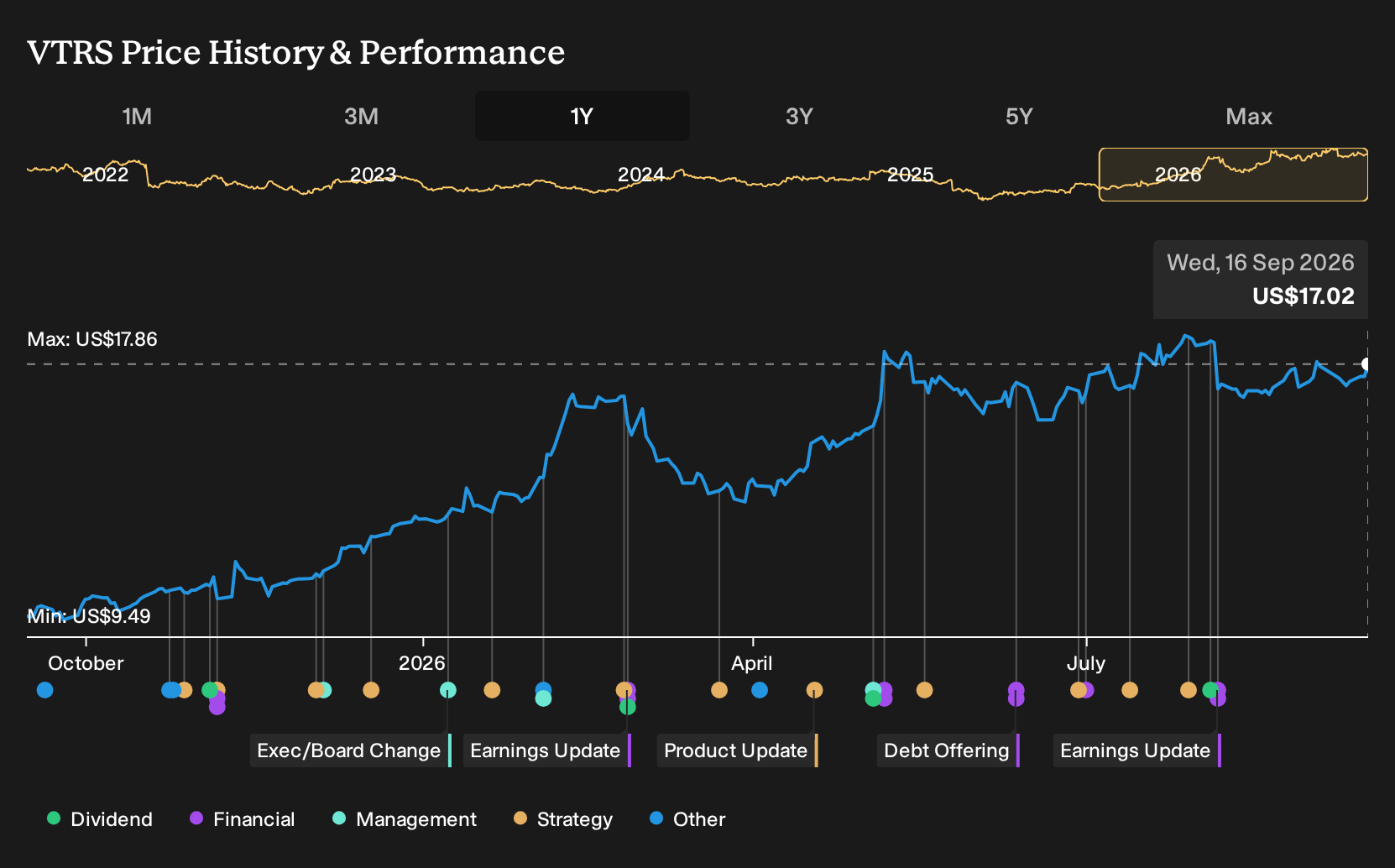
Exploring Other Perspectives
Some of the most optimistic analysts focus on a different catalyst for Viatris. They expect aggressive cost cuts and portfolio moves to matter more than any single drug. Before this news, that group was already modeling roughly US$15.6b of revenue and up to US$1.9b of earnings by 2029. You can now judge how WAKIX in Japan might reshape those expectations and compare them with more cautious views.
Explore 6 other Viatris fair value estimates, including one that suggests as much as 232% potential increase from the current price.
Reach Your Own Conclusion
Don't just follow the ticker. Dig into the data and build a conviction that's truly your own.
- A great starting point for your Viatris research is our analysis highlighting 3 key rewards and 1 important warning sign that could impact your investment decision.
- See our latest analysis for Viatris. The report includes a comprehensive fundamental analysis summarized in a single visual, the Snowflake, making it easy to evaluate Viatris' overall financial health at a glance.
Looking For More Investment Ideas Beyond Viatris?
If the Viatris story has sharpened your thinking around risk, income, and balance sheet strength, it can be useful to compare it with other companies that fit clear, rules based criteria. The Simply Wall St Screener lets you do that quickly.
- For investors who want potential upside without stretching on quality, check out a curated group of 33 high quality undervalued stocks that pair stronger fundamentals with what our models flag as discounted prices.
- If capital preservation and steadier profiles matter more to you than headline growth, filter for 11 resilient stocks with low risk scores that score well on volatility, debt metrics, and earnings consistency.
- When balance sheet resilience is non negotiable, benchmark Viatris against a list of solid balance sheet and fundamentals (22 results) and see how its leverage and liquidity stack up.
This article by Simply Wall St is general in nature. We provide commentary based on historical data and analyst forecasts only using an unbiased methodology and our articles are not intended to be financial advice. It does not constitute a recommendation to buy or sell any stock, and does not take account of your objectives, or your financial situation. We aim to bring you long-term focused analysis driven by fundamental data. Note that our analysis may not factor in the latest price-sensitive company announcements or qualitative material. Simply Wall St has no position in any stocks mentioned.
Have feedback on this article? Concerned about the content? Get in touch with us directly. Alternatively, email editorial-team@simplywallst.com