


Crude Oil: Superstar of Commodities
Hello All:
We are restarting the News Reports by Alpine Trading on the hot topics. The major one is Crude Oil and all its related markets, which seems to be ALL MARKETS. Obviously, that has been
in the news for several months now as the war in Iran continues for the 7th month. Everybody is concerned about sustained high prices, inflation, for consumer goods, groceries, energies
and others. As far as the charts are concerned, those folks that are concerned have every right to be.
We first start out by looking at the continuous chart of the CL market, going back to late 2021.
As we can see the support for the market is there, as the threat of less consistent supply is always there in recent months. One step forward, two steps back it seems lately.
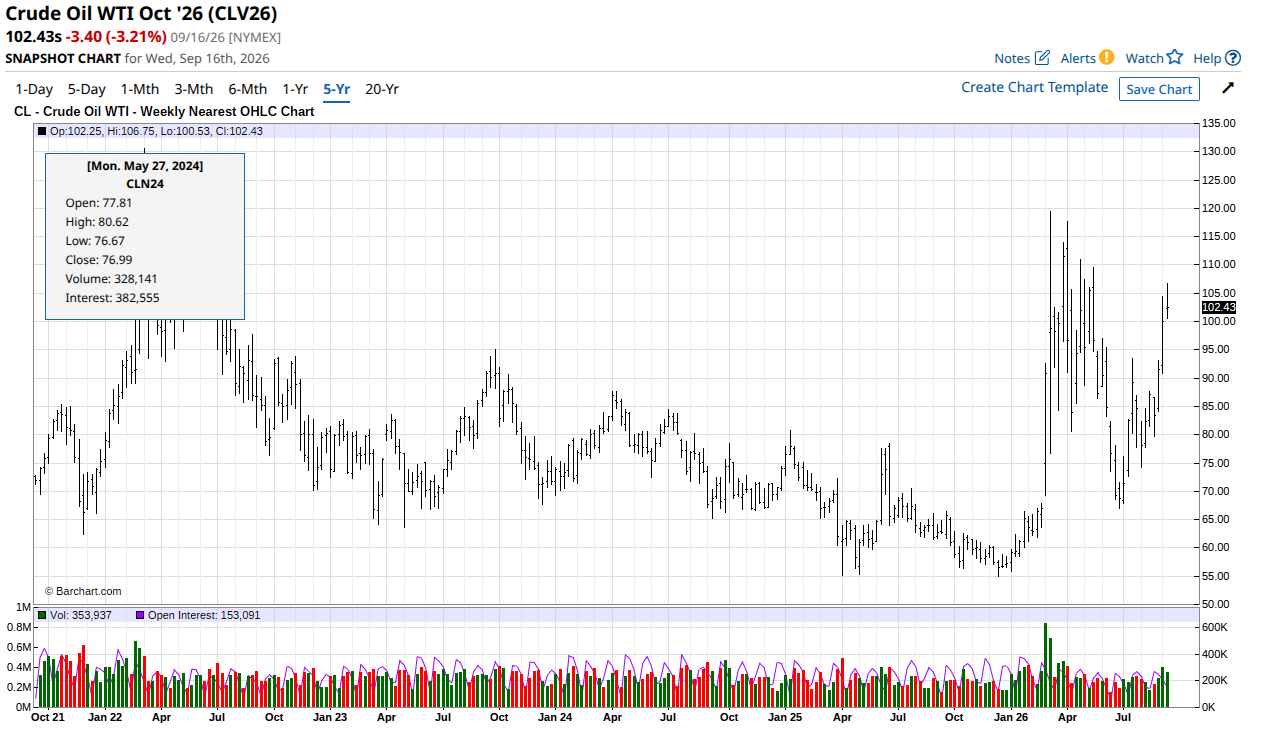
It is clear that the market is trying one last leg up towards the recent highs of 115-120 usd per barrel (based on WTI US market). From there if it doubles top, then that will be the
end of that market for the long-term. If it breaks through the 118-120 levels in the next few weeks, then easily we will surpass 135-140. Then, we have to look at much bigger
numbers, if the market consistently trades above 135 for several days/ weeks. My main number is for December Crude Oil futures to hit 147-149 levels within the next 2 months.
There are 2 spreads that I continuously like to watch to show us the underlying fundamentals of the Crude Oil markets. One of them is the intra-month spreads, i.e. December / March 2027
and also the Crack Spread 3:2:1 for nearby months like November or December 2026.
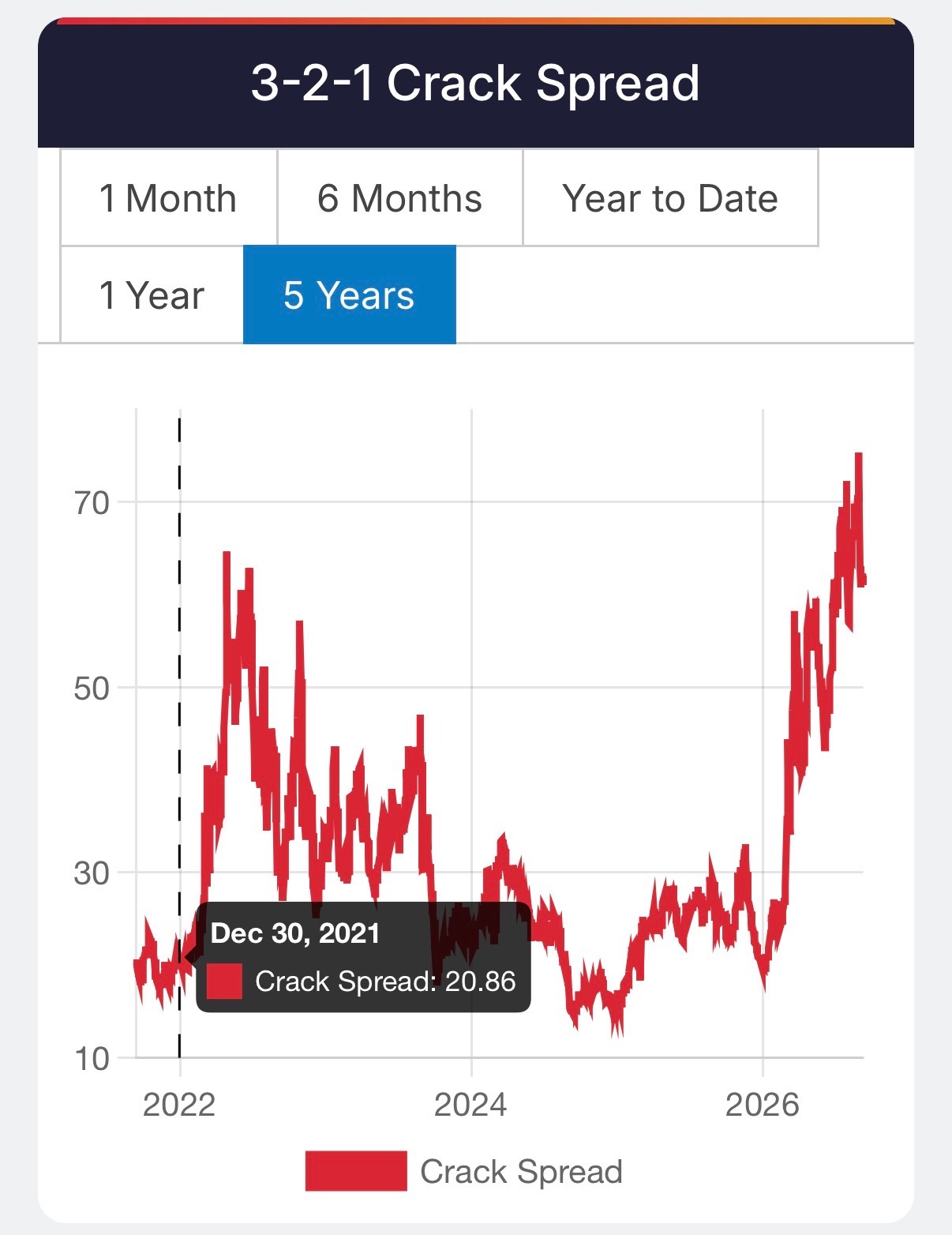
As you may see, crack spread on a 3:2:1 basis (3 parts CL, 2 x RBOB and 1 x HOil) is quite wide at the moment. With refining capacity not expanding and aging infrastructure not being
addressed, the U.S. industry is, in my opinion, at a crossroads. The U.S. crude oil production is anywhere from 70 to 80 % light, sweet crude oil and 20 to 30 % is heavy sour crude oil.
However, the country has refining capacity for heavy sour crude oil (generally speaking with high sulfur content vs. light sweet WTI grade) at about 60 % while the rest up to 40 % being
for light, sweet crude oil. You might ask why is the U.S. refining market so inefficient? Well, it would take billions of dollars to align the refineries with the type of crude that we most
produce in the U.S., WTI grade/ sweet, light oil. The big guys are not spending the money right now.
The challenge that the U.S. has is that is driven by its refining capacity to import oil, and will continue to import crude oil to meet its refining needs for heavy crude. This is one of the
reasons that we continue to import crude oil from Canada and now Venezuela has entered the picture. For anybody to say that we can be completely independent, then they don’t know
what the heck they are talking about. If we have continued higher crack spreads for the complex, then assuredly the market will start implementing more heavy, sour into the refining
rotation, but we’re still talking 1-2 years down the road at the earliest and billions possibly trillions to be invested.
So what happens now? War continues. Demand continues. Nothing is being done to improve supply. There is no more “Drill Baby Drill” hysteria being touted by the masses as investments
are not so readily implemented.
In the meantime, how does the energy complex affect other markets like grains, livestock, stock markets, bonds and other energy sectors? The bottom line is that energy levels going higher
will be detrimental to the stock market as well as spur further inflation for many months to come. We are not producing more food quickly with increased costs to the farmer (inputs like
fertilizer have been sky rocketing, especially at time of U.S. spring row crop planting):
https://tvc-screenshots.investing.com/tvc_35196913bc1eaf4a20eec9eb333cfccb.png

The conclusion is that, and we’ve seen it many times before, the energy sector becomes a leader of all markets in scenarios like we’ve witnessed earlier this year. Oil goes up. Corn and
soybean meal go up. Corn influences wheat to go higher. Higher corn and meal costs put upward pressure initially on meat (beef and pork) prices initially, and then eventually when ranchers
start seeing their margins get squeezed with corn, fuel and fertilizer prices go higher, then they start to liquidate herds to get the cash flow to pay off the fall bills coming due.
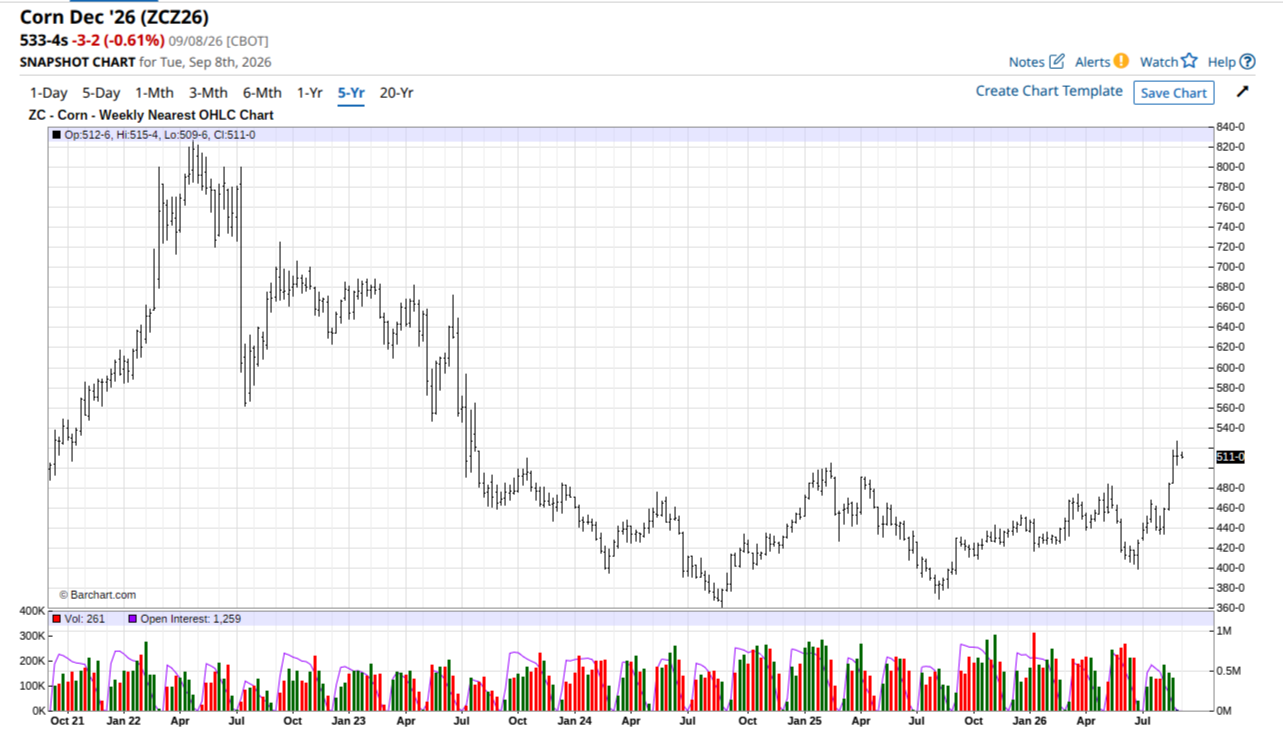
We can see clearly that corn has a strong path forward to the upside. For the last 3 crop years, we have seen a dwindling stocks to use ratio on a global level for corn. In 204/25, we were
at 23.7 % stocks to use ratio, while in 2026/27, we are expected to run around 20.8 %. Stocks are dwindling relative to use which is staying steady. More demand and less supply mean
higher prices until such time that we get, you guessed it, “demand destruction.” Apparently, we have not gotten there yet.
The live cattle market is finally starting to see some toppiness in price structure. I believe that we have seen the highs for this year in cattle, unless corn crashes in the next 1-2 months,
which I find highly unlikely due to many risks still to the crop here in the U.S. and planting that will start soon in South America.
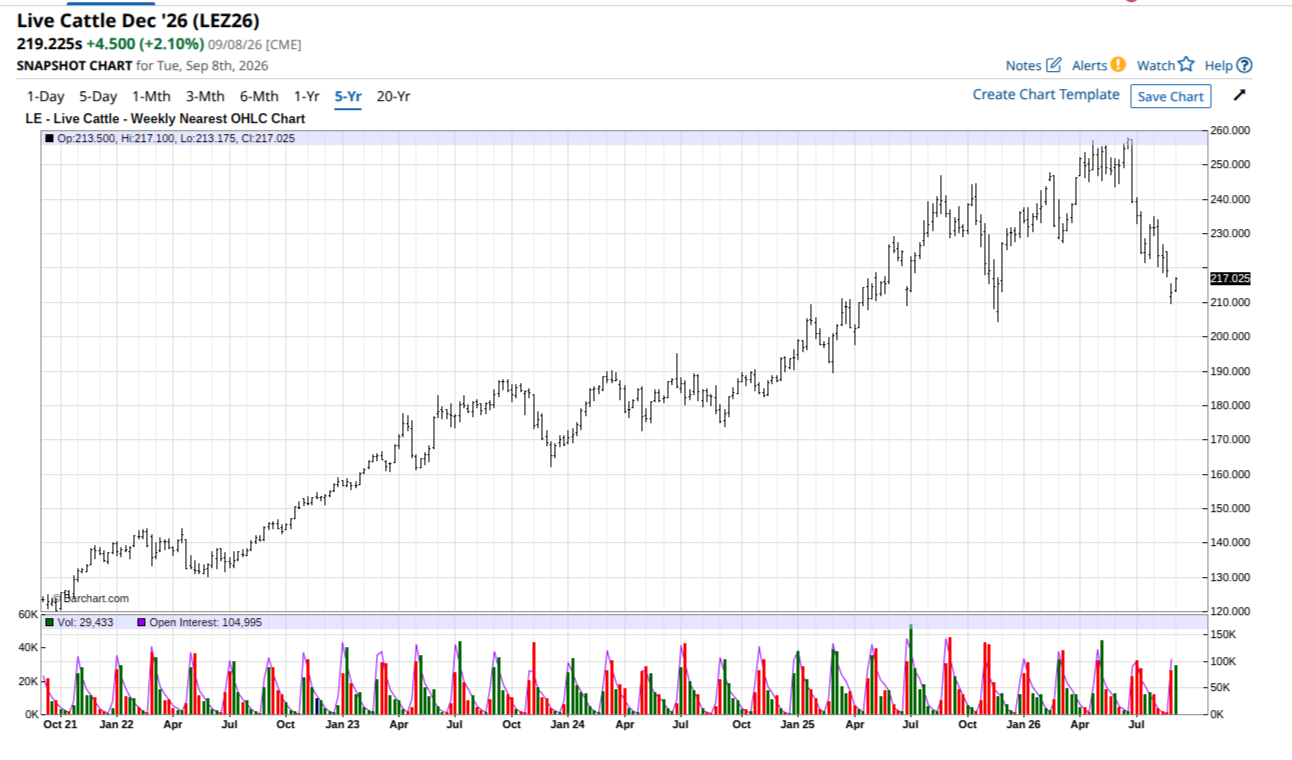
We could see some support here at current levels for live cattle, but unlikely. Demand has been destroyed severely with higher prices and the threat of imports from South America and elsewhere increasing, then I believe we have found a topside to the cattle market. Any rallies should be sold.
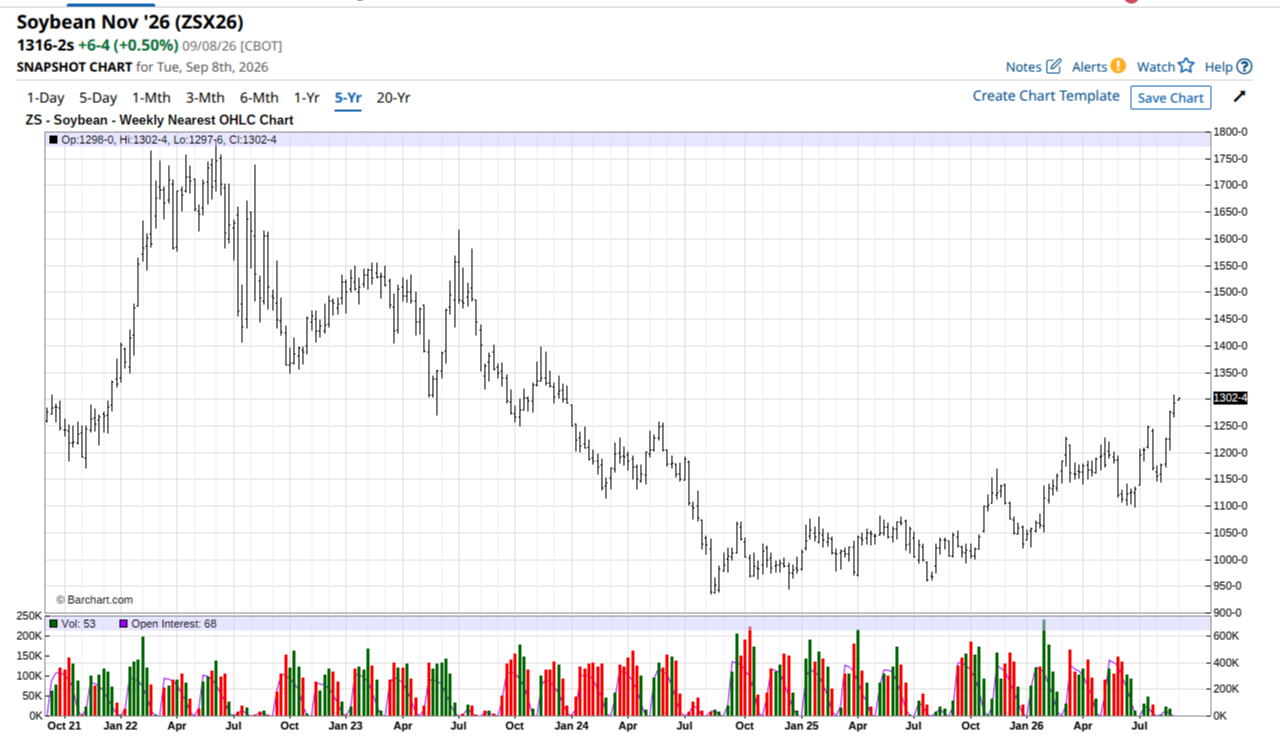
The soybean market, for now, is also a follower of the corn market and the crude oil/ energy sector as they are very visibly attached “at the hip.” I would not be surprised to see $ 6 plus corn
and $16 beans. We are heading soon into the Southern state harvest for corn and beans. Not much has been accomplished yet, but we can see 5-10 points lower in crop ratings throughout
the corn and bean country than the G/E categories from last year at this same time. Yields will be affected and we could still see a downgrade in the crop once we get into the thick of the
harvest season in the next 30-45 days.
In the meantime, we are seeing the USD steady but also having very weak tones. As the balance sheet gets bigger and bigger in the U.S. and trade deficits are blowing up for various reasons,
it is hard to see how the U.S. Dollar could weaken much further, but at this point, if the Fed will intervene with inflation by jumping up rates, then we could see a rally in the USD and therefore, a
weakening in the commodities realm. Right now, it is staying weak, but if inflation continues for a few more months (which is very likely until we see some corn/ bean harvest coming in), then
I could see the Fed easily inch up rates to keep inflation from getting out of hand.
My current bias is to play the commodities, like corn, beans and crude oil on the long side, mainly through futures spreads and perhaps options if the opportunities do allow. At the moment,
implied volatility is quite low, so OTM call structures might make sense, but I would rather play the grains with calendar spreads in futures for a better opportunity in profitability.
I am offering Market Signal Service and Weekly Market Comments again starting this week. Monthly service is $ 475 per month with discounts available for 3-month, 6-month and 12-month
contracting. I will relaunch the Alpine Trading website soon as now reworking new web address and look for the promotion of the Alpine Trading Service. Stay tuned, but I will start the
service this week. If interested, please email me and I can get you set up.
Best Regards
Edgard Cabanillas
Alpine Trading LLC
Denver, CO
Tel: (949) 357-4948
email: agtrader1998@gmail.com
Website Alpine Trading: launching soon / details to follow
DISCLAIMER: Futures and options trading on commodities is highly risky. You could lose all of your initial investment and then more based on margin. Please discuss your risk adversity and proclivity with your broker and consultant to see if this is a fit for all investors involved in commodities futures and options transactions and any agreements you make with a consultant.