


Is Broadridge Financial Stock Underperforming the S&P 500?
With a market cap of $19.4 billion, Broadridge Financial Solutions, Inc. (BR) is a global financial technology leader that provides investor communications and technology-driven solutions to banks, broker-dealers, asset managers, corporate issuers, and other financial institutions. Broadridge plays a critical role in enhancing transparency, efficiency, and engagement across the financial services industry.
Companies valued at $10 billion or more are generally classified as “large-cap” stocks, and Broadridge Financial fits this criterion perfectly. Through its two segments: Investor Communication Solutions and Global Technology & Operations, the company delivers services ranging from regulatory and shareholder communications to front-to-back securities processing and data-driven solutions.
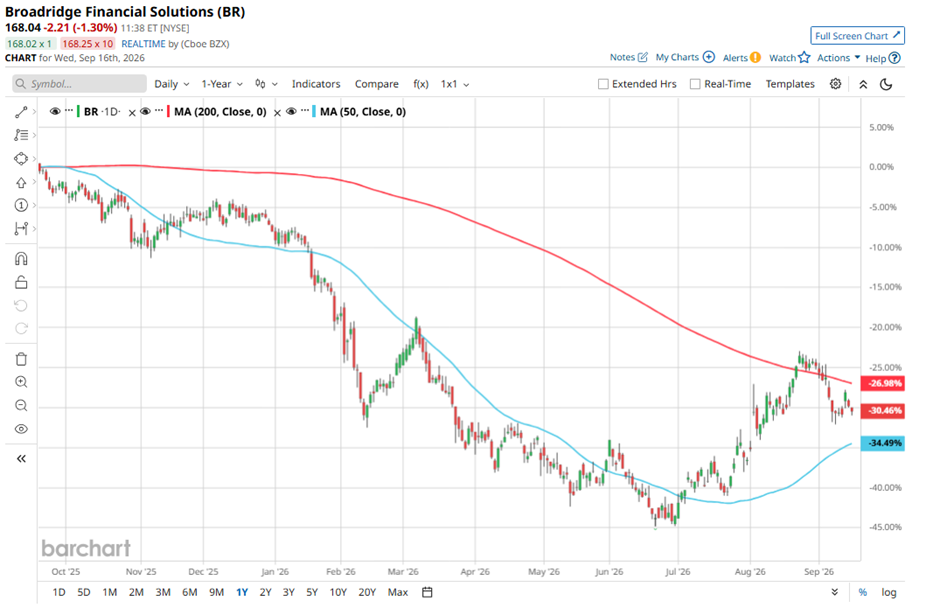
Despite this, shares of the Lake Success, New York-based company have declined 32.7% from its 52-week high of $250.26. BR stock has increased 16.7% over the past three months, outperforming the S&P 500 Index’s ($SPX) 1.4% rise over the same time frame.
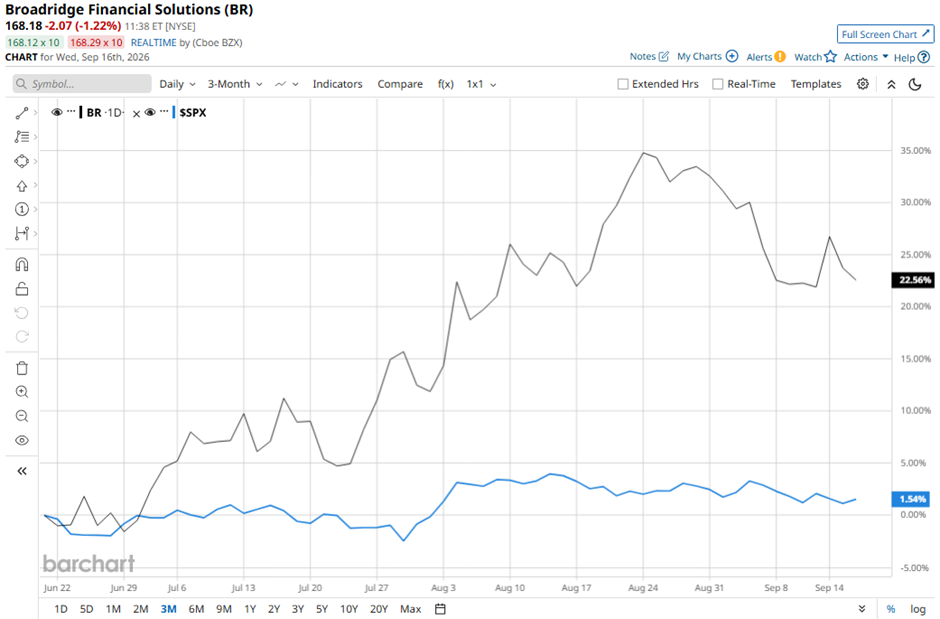
BR stock is down 24.8% on a YTD basis, lagging behind SPX’s 11.2% gain. In the longer term, shares of the fintech firm have decreased 31.6% over the past 52 weeks, compared to the 15.2% surge of the SPX over the same time frame.
Yet, the stock has been trading above its 50-day moving average since July.
Broadridge Financial has underperformed due to concerns that artificial intelligence could disrupt its technology and business-services operations. The rise of tokenization has also created uncertainty around the company’s role as an intermediary in financial markets.
In comparison, rival International Business Machines Corporation (IBM) has shown a less pronounced decline than BR stock. IBM stock has declined 18.9% on a YTD basis and 6.7% over the past 52 weeks.
Despite the stock’s weak performance, analysts remain moderately optimistic on BR. The stock has a consensus rating of “Moderate Buy” from the nine analysts in coverage, and the mean price target of $206 is a premium of 22.6% to current levels.
On the date of publication, Sohini Mondal did not have (either directly or indirectly) positions in any of the securities mentioned in this article. All information and data in this article is solely for informational purposes. For more information please view the Barchart Disclosure Policy here.