


The “deceleration theory” hit the midterm elections, and AI transactions began to be afraid of votes
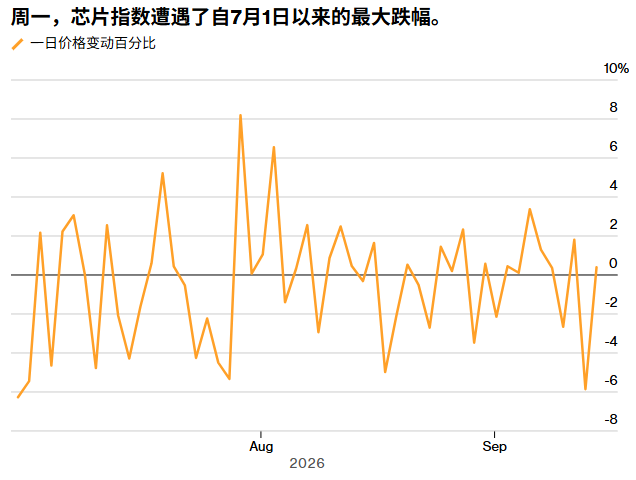
The Zhitong Finance App learned that AI chip stocks have continued to be under pressure recently. This sell-off is not only about AI giants' safety warning essays. The US midterm elections have already become a key risk for AI concept stocks due to a rebound in data centers, and as more lawmakers from both parties issue warnings about AI safety regulations, the weight of this “test” is still increasing.
Midterm Elections: From Edge Issues to Key Market Variables
Optimism about AI has supported the recent four-year rise in US stocks — computing infrastructure spending has soared, and AI transactions have expanded. But after Anthropic PBC and OpenAI made successive promises to slow the development of cutting-edge models, the foundation of the deal has loosened — previously, a series of internal warnings in the industry pointed directly at the industry's ability to control the technology. This pullback is partly driven by resistance to artificial intelligence and data center construction, which has caused sales of semiconductors and other computing devices to soar.
According to reports, the midterm elections originally constituted a key risk for AI concept stocks due to a rebound in data centers, but now this rebound has been recorded in the campaign ledger. According to NPR's statistics based on AdImpact data, since January of this year, campaigns and outside groups have spent more than 45 million dollars on ads referring to data centers, almost evenly split between the two parties; advertising has risen from a few in January to around 164 in August.
Public opinion polls are also getting worse: According to Ipsos's June survey, 77% of Americans are worried that data centers will push up electricity prices; two-thirds of Democrats and half of Republicans oppose building new data centers in their communities; according to an August survey by the University of Pennsylvania's Annaberg Center for Public Policy, about 61% of American adults oppose building data centers locally, up 12 percentage points from the February-March survey. Trump posted on social media on August 31 that “China couldn't be happier with this anti-data center campaign,” trying to characterize the backlash as a situation his opponents would be happy to see.
As for the election itself, the election situation is moving in a direction that is unfavorable to the Republican Party: According to RealClearPolitics's average poll up to around September 10, the Democratic Party is 6.4 percentage points ahead in the general election vote; according to Polymarket, the probability of the Democratic Party winning the House of Representatives is about 90%, the Senate is close to the 5th session, and the probability of “sweeping” both houses at the same time is about 50%. According to the Bank of America's August fund manager survey, 47% of respondents expected “the Republican Party to control the Senate and the Democratic Party to control the House of Representatives,” and only 9% expected the Republican Party to hold both houses — and according to Bank of America's chief investment strategist Michael Hartnett (Michael Hartnett), the Democratic Party's sweep is already one of the biggest tail risks in the market, yet it is hardly priced.
Bipartisan position: writing a bill while shouting a “scam”
Regulatory issues are driving the two parties in opposite directions. According to reports, a group of senators, including Senate Majority Leader John Thune (John Thune), Senators Ted Cruz (Ted Cruz), Bernie Sanders (Bernie Sanders), and Amy Klobuchar (Amy Klobuchar), have proposed a series of policy measures aimed at addressing AI security concerns. Former US President Barack Obama issued a statement on the evening of September 14 calling for AI policies to be “at the center of our public debate.”
President Trump, on the other hand, insisted that the new technology did not require a new fence. In a temporary connection, he told Nvidia CEO Hwang In-hoon, who was speaking at a technology conference, that concerns about the dangers of AI were a “hoax” (hoax).
According to reports, the real action at the legislative level is that Tune, Cruz, and Klobucha are currently discussing a bipartisan bill to require cutting-edge AI developers to prove their own safety measures, introduce a “duty of care” (duty of care), require companies to disclose advanced capabilities and risk mitigation to the Department of Commerce before the model is released, and give the federal government the power to apply to the federal court for a ban and stop publication when determining that the model has an impending major threat; the bill will also discuss some preempt (preempt) state-level AI regulations.
Cruz said he is cooperating with Klobucha and Thun to “deal with catastrophic risks involving biological or nuclear threats.” The differences are also clear: the two sides have yet to agree on how to impose legal liability on Silicon Valley companies and whether federal standards override state laws; Cruz advocates “light regulation,” warning that excessive regulation will slow down US innovation and allow China to take the lead in the AI race.
There has also been an unusual confluence within the Republican Party: according to reports, Senator Josh Hawley (Josh Hawley) has launched an investigation into OpenAI; Sanders is scheduled to ask experts to brief the senators this Wednesday; and Trump ally Steve Bannon (Steve Bannon) overlapped with Sanders' positions at an AI conference, saying “this is the pivot of history.”
House Democrats discussed AI behind closed doors on Tuesday. Vice President JD Vance (JD Vance) said he hoped Congress and the government would reach a “consensus” on regulation; House Speaker Mike Johnson (Mike Johnson) said that Congress “may” need to set up a fence for the industry, but he warned that it will take time to come up with legislation that has sufficient support and can be passed.
Scenario deduction: three sets of scripts, three endings
Aniket Shah (Aniket Shah), global head of sustainability and transformation strategies at Jefferies Washington, said that this split before the midterm elections meant that “the narrative will be: if the Democratic Party gains more control, this is the reason to be more cautious about AI in the future” and “investors will use this point to sell off.” But at the same time, he pointed out that the biggest risk brought about by the midterm elections is an impact on investor sentiment, rather than a specific policy that will actually cause big tech companies to slow down AI spending — Trump still has veto power after the election, and given the importance of AI to the economy, policymakers are fully motivated to avoid strict restrictions.
The Bank of America, on the other hand, calculated the accounts in more detail. According to previous reports, Bank of America strategists warned that if the Democratic Party takes the Senate, it may trigger a sell-off of more than 10% of US stocks and continue until the end of 2026.
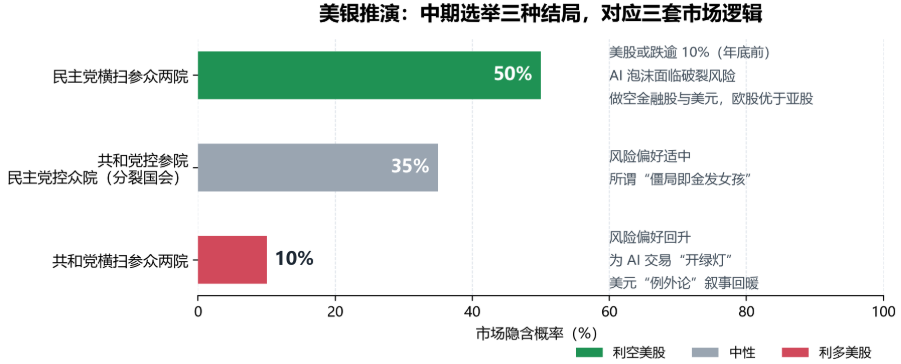
Bank of America Hartnett's “Flow Show” weekly report in early September gave three further scenarios (Figure 2): First, the Democratic Party swept the Senate and House of Representatives (implied market probability is about 50%) — US stocks may fall by more than 10% before the end of the year, the US dollar weakens, bond yields decline, the AI bubble is at risk of bursting, and the policy may shift from “populist capitalism” to “popular socialism”. The bank suggests shorting financial stocks and the US dollar, and Chinese European stocks may be superior to Asian stocks in the international stock market;
Second, a split Congress with Republicans controlling the Senate and Democrats controlling the House of Representatives (about 35%, most likely) — the risk is moderate, creating a so-called “impasse is a blond girl” environment;
Third, the Republican Party unexpectedly held both houses (about 10%) — risk appetite rebounded, “gave the green light” to AI transactions, and the dollar's “exceptionalism” narrative picked up. To sweep the Senate, the Democratic Party needs to take at least 4 of the 6 relatively weak Republican seats in North Carolina, Maine, Alaska, Ohio, Texas, and Iowa, while holding on to Georgia, New Hampshire, and Michigan.
Ohsung Kwon, chief stock strategist at Wells Fargo, wrote in an email: “We are increasingly nervous about AI deals, and we think 2027 may be the year where capital spending will peak. The weekend's news added another layer of uncertainty.” In his report to clients, he pointed out that the Democratic Party appears to be more keen on drafting AI regulations, and the pricing of the gaming market shows that their probability of regaining control of both houses of Congress is rising.
Matt Gertken (Matt Gertken), head of geography and US political strategy at BCA Research, believes that what the market really needs to be repriced is the probability that the Democratic Party will be boosted by the “political dominance” in November: if the Democratic Party takes both houses of Congress, Trump is at least somehow likely to sign the AI regulation bill into law; and winning the midterm elections will also increase the probability that the Democratic Party will win a unified administration in 2028. “It's like dark clouds are gathering on the horizon,” he said. “You have to bring a raincoat and an umbrella, but you don't have to cancel all plans.”
The mainstream judgment of Wall Street political strategists is that regardless of whether the midterm elections can spawn large-scale changes, AI will be a central issue in the 2028 presidential election. Evercore ISI strategist Sarah Bianchi (Sarah Bianchi) put it bluntly: “A bunch of Democrats support what Trump opposes; it's not that important. What's more impactful to the market is the realization that even a Republican president could do some of these things.”