


Learn Why The Bull Case For Lockheed Martin (LMT) Could Change Following Quantum Hub Partnership
- IBM, Lockheed Martin and ETH Zurich have already set up a quantum innovation hub in Switzerland that will host an IBM Quantum System Two at the Swiss National Supercomputing Center, giving local industry and researchers cloud access to IBM’s wider quantum fleet.
- The partnership links Lockheed Martin’s work in quantum sensing, additive manufacturing and aerospace and defense applications to IBM’s quantum and AI platforms. The company also features in a growing global firefighting aircraft market focused on modern, higher performance fleets.
- We will now examine how Lockheed Martin's investment narrative could shift as quantum sensing work with IBM becomes more central.
Scan beyond Lockheed Martin and this IBM-backed quantum pivot to see which other contractors and industrials are quietly building similar exposure through our curated 60 AI infrastructure stocks
Lockheed Martin Investment Narrative Recap
To own Lockheed Martin, you need to buy into a long runway of complex defense programs, steady contract flow and disciplined execution on high risk, fixed price work. The current quantum push with IBM sits alongside core efforts in aircraft, missiles and space, rather than replacing them. It does not change that in the near term, investor focus still leans on delivery, backlog quality and cash generation.
The most important short term swing factor remains execution on large programs that have already produced sizeable charges, as well as any budget shifts around platforms like the F 35. The biggest risk is further cost pressure on legacy and classified contracts, especially given the company’s high debt load and exposure to changing defense priorities.
The ETH Zurich quantum hub with IBM is the clearest recent announcement that ties directly to this broader story. It links Lockheed Martin’s work in quantum sensing and additive manufacturing with IBM’s computing and AI stack, in a setting where Swiss academia and industry can stress test real aerospace and defense use cases over time.
For investors, the relevance is about execution and optionality, not headlines. If quantum sensing improves navigation or materials design in future aircraft or missiles, it can support margins on next generation platforms and possibly help offset pressure on older fixed price programs. That sits alongside more traditional catalysts such as demand for advanced air defense systems and ongoing modernization of firefighting and military fleets.
What The Quantum Push Means For Lockheed Martin’s Numbers
Lockheed Martin's quantum work with IBM adds a fresh angle to a story that analysts are already modelling out in detail. The forecasts on the table sketch out where revenue, earnings and valuation might sit by the end of this decade, while the quantum sensing efforts simply add another potential lever that is not yet fully baked into those spreadsheets.
Consensus assumptions today point to a measured step up rather than a dramatic reset. Analysts see revenue growing by 5.3% a year over the next three years, with profit margins moving from 8.2% today to 9.3% by 2029 as current programs mature and newer, higher value projects scale. That margin profile matters for any quantum upside, because better navigation, signal processing or materials design could eventually support higher quality earnings rather than just higher sales.
On current estimates, Lockheed Martin is expected to lift earnings from US$6.3b today to US$8.4b by 2029, with earnings per share at US$36.59 by that point. That implies an earnings increase of about US$2.1b across the period. The forecasts also build in a 1.15% yearly decline in the share count over the next three years, which means EPS growth is expected to outpace the headline earnings gains if those buybacks and cancellations occur as projected.
The P/E assumptions sit in a tight band. To line up with the analyst price targets, the stock would need to trade on about 21.2x those 2029 earnings, slightly below the current multiple of 21.5x and below the US Aerospace & Defense industry level of 37.7x referenced in the report. In simple terms, the story is not built on multiple expansion. It leans more on earnings progression and a modest improvement in profitability, with quantum-related efforts like the IBM partnership currently sitting in the background rather than driving those numbers outright.
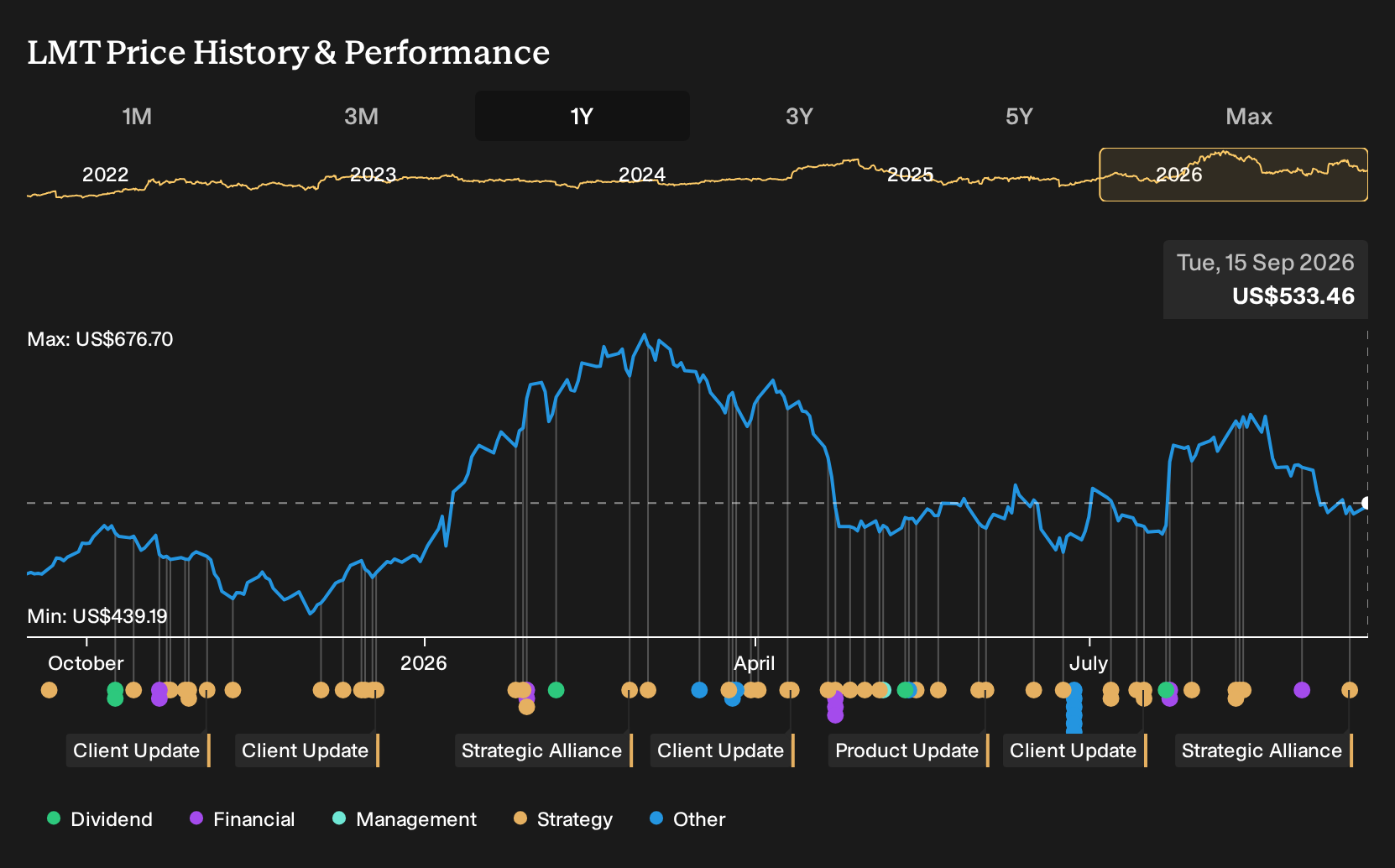
Valuation work pulls these moving parts together into a single line on your screen. The analyst consensus target sits at US$629.53, against a current share price of US$586.29, which is 6.9% higher. Target dispersion is wide, with the most optimistic forecast at US$756.0 and the lowest at US$503.0, hinting at very different views on how quickly margins can settle and how much risk remains on legacy and classified programs.
To align with that middle ground view, you would need to be comfortable that Lockheed Martin can generate about US$89.8b of revenue and US$8.4b of earnings by 2029 while trading on that 21.2x P/E and using a discount rate close to 8.2% or 8.16% as in the Simply Wall St work. The quantum sensing partnership with IBM does not change those inputs today, but it can shape how readers think about the quality and resilience of those 2029 earnings if the technology finds practical deployment in aircraft, missiles or space systems.
Lockheed Martin's narrative projects revenue of about US$89.8b and earnings of US$8.4b by 2029. This set of forecasts assumes yearly revenue growth of 5.3% and an earnings increase of roughly US$2.1b from current earnings of US$6.3b.
Uncover why Lockheed Martin's fair value indicates an 18% potential upside to its current price that could narrow quickly.
Exploring Other Perspectives
You have one big swing factor to weigh. The most optimistic analysts already assumed Lockheed Martin could reach about US$93.5b of revenue and US$8.7b of earnings by 2029, tied largely to defense demand. That view was set before this ETH Zurich quantum hub. You can now ask whether this alliance nudges your expectations closer to that upper band.
Explore 6 other Lockheed Martin fair value estimates, including one that suggests as much as 62% upside from the current price!
Form Your Own Verdict
Disagree with existing narratives? Extraordinary investment returns rarely come from following the herd, so trust your own analysis and judgment.
- A great starting point for your Lockheed Martin research is our analysis highlighting 5 key rewards and 1 important warning sign that could impact your investment decision.
- See our latest analysis for Lockheed Martin. The report includes a comprehensive fundamental analysis summarized in a single visual, the Snowflake, making it easy to evaluate Lockheed Martin's overall financial health at a glance.
Looking For More Investment Ideas Beyond Lockheed Martin?
If the Lockheed Martin story has sharpened your view on defense and advanced computing, it can help to compare it with other opportunities that match different risk and income profiles. The Simply Wall St Screener lets you line up high conviction ideas side by side, so you can see which ones really earn a place in your portfolio.
- For investors hunting for resilient balance sheets and cleaner fundamentals, start with our list of solid balance sheet and fundamentals (22 results) that can handle tougher conditions.
- If your focus is on potential mispricing rather than story alone, scan through the 34 high quality undervalued stocks that may offer more appealing entry points based on fundamentals.
- Income driven investors who like to get paid while they wait can sort through the 6 dividend fortresses that combine higher yields with an emphasis on stability.
This article by Simply Wall St is general in nature. We provide commentary based on historical data and analyst forecasts only using an unbiased methodology and our articles are not intended to be financial advice. It does not constitute a recommendation to buy or sell any stock, and does not take account of your objectives, or your financial situation. We aim to bring you long-term focused analysis driven by fundamental data. Note that our analysis may not factor in the latest price-sensitive company announcements or qualitative material. Simply Wall St has no position in any stocks mentioned.
Have feedback on this article? Concerned about the content? Get in touch with us directly. Alternatively, email editorial-team@simplywallst.com