


Traders are more hawkish than the central bank: betting that the ECB will raise interest rates four more times, and the Bank of England will be seriously out of touch with the official statement
The Zhitong Finance App learned that soaring energy prices have reignited concerns about inflation, and the money market is shifting to more hawkish bets. The swap agreement shows that the ECB may raise interest rates four more times in the next 12 months, 25 basis points each time, while the Bank of England may raise interest rates five times. This is in stark contrast to recent cautious statements by the two major central banks. It also highlights the difficulty of predicting the duration of the Middle East conflict and its ripple effects on inflation.
These bets are far from the signals recently conveyed by policy makers. After raising interest rates for the second time since the outbreak of the war in Iran last week, the ECB reiterated that it would not promise further action in advance. Officials believed at the time that the market's bet on three rate hikes was already too aggressive. However, economists currently expect that the ECB will only raise interest rates one or two more times.
The Bank of England has yet to raise interest rates this year. Vice Governor Dave Rams said last week that he is satisfied with the current policy, but also acknowledged that there are upside risks. The Bank of England will hold an interest rate meeting on Thursday, and the market is not expected to adjust interest rates. Earlier this year, Governor Andrew Bailey countered the market's pricing of two rate hikes, which is less than half of the current market bet.
Dutch International Group economist James Smith said, “Market pricing is completely out of touch with what the Bank of England tells us.” He believes that Bailey may once again refute market pricing, but “these warnings may have gone unheeded.”
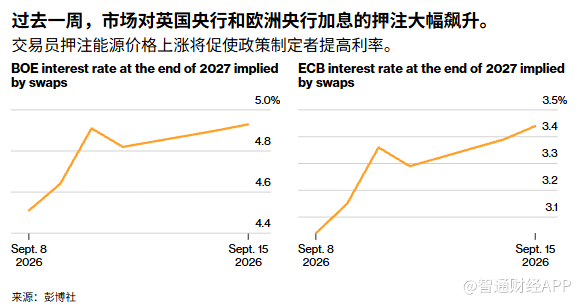
Markets often bet too much on raising or cutting interest rates, but the current level of disagreement is unusual. The reason is that there is a high degree of uncertainty about how long the Middle East conflict is likely to last and how much it will have a ripple effect on inflation.
Energy shock detonates bond market: yields soar, interest rate hike bets heat up
The market's repricing of the interest rate path this week comes after a new surge in energy prices. Natural gas prices jumped to their highest level since 2022, and crude oil futures rose for the second day in a row on Tuesday, breaking through $108 per barrel as a key Saudi pipeline remains out of service.
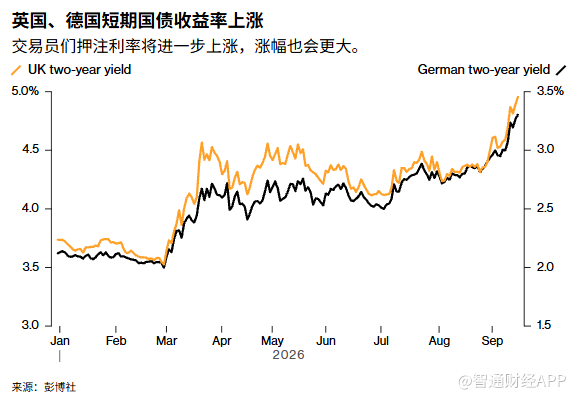
Short-term government bond yields soared as concerns about inflation caused by the long-standing conflict spread to the market. German and British two-year treasury yields recorded their longest weekly rise in years, while long-term borrowing costs hit the highest level in decades.
Speaking about policymakers, Elias Haddad, head of global market strategy at Brown Brothers Harriman, said, “This is an external shock they can't control. The best they can do is ensure that energy shocks don't spread to underlying inflation and inflation expectations.”
The Bank of England is expected to respond to rising energy costs at the upcoming interest rate meeting. The swap contract implied a 30% chance of interest rate hikes, and just a few days ago, this was considered extremely unlikely.
Since there was no press conference after the interest rate resolution was announced, traders will be closely watching the wording of the statement. In March of this year, the Bank of England warned that it was “ready to take action” to deal with inflation caused by soaring energy prices. The market immediately rushed to set higher interest rates, but no rate hikes have been raised so far.
Barclays strategist Moin Islam said, “It's hard for President Bailey to be more hawkish than the market.”
Cross-asset strategist Vin Lam believes that after the ECB raised interest rates last week, it has reached the upper limit of the nominal neutral interest rate range estimated by its economists. If interest rates are raised three more times, the benchmark interest rate will enter a deeply restricted area, and even some more hawkish management committee members will hesitate.
On the Bank of England side, the strategist also said that even within its policy committee, estimates of neutral interest rates are very different, but estimates based on Taylor's rules suggest that the bank's policy target interest rate will be far below the level of 4.75% expected by the market in one year.”
Demand for hedging heats up: volatility rises, traders are not only betting on direction
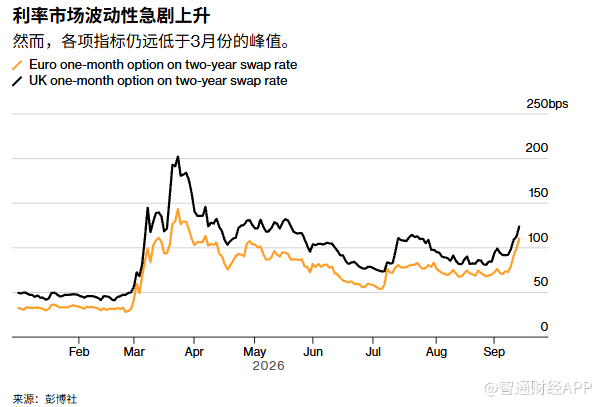
Swaps are an indicator of interest rate expectations, but the operation of this market is more complicated. Traders are not only making pure directional bets; some are also hedging fluctuations in borrowing costs.
Market indicators show that the expected volatility of the UK and European two-year swap rates in the coming month has risen sharply, but it is still far below the peak reached in March. The situation may change if the oil supply is further disrupted.
Last week, ECB President Christine Lagarde said that inflation in the Eurozone will remain high for some time because the price shock caused by rising energy costs may last longer than expected. After repeated questioning by reporters, she also admitted that there are differences with interest rate market pricing.
“The market will act according to its own logic, and we will do what we are supposed to do.” she said.