


Meta (META.US) stock price experienced a one-year “fake breakthrough”! However, with the risk of litigation lifted and the support of Muse AI, the bulls bet on the market to break the game
The Zhitong Finance App learned that as investors' confidence in Meta Platforms (META.US) as a player in the field of artificial intelligence (AI) rises and falls, the stock price has been on a roller coaster since 2026. However, after the company settled social media addiction lawsuits with multiple states in the US and released the Muse AI agent aimed at automating everyday tasks for ordinary people, bulls are betting that the stock may be ready for a continuous breakthrough.
According to the data, Meta's stock price has risen 22% from its August low, and this month is expected to achieve the biggest monthly increase since May 2025. This rebound is no different from the other rounds Meta has experienced this year — the stock has previously seen four rounds of gains from trough to peak of at least 20%. However, each round of gains did not last long, and the high point of each subsequent round of rebound moved downward. As a result, the stock has remained largely flat since the beginning of the year, far behind the 15% increase in the Nasdaq 100 index during the year.
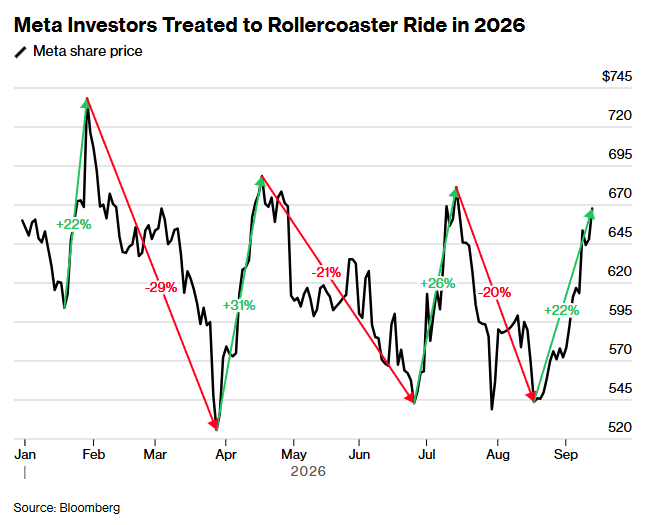
Meta's stock price has fluctuated since 2026
Dan Russo, co-chief investment officer of Potomac Fund Management, which holds Meta shares, said: “Removing an unresolved element at the legal level and adding a positive product in a popular narrative is certainly enough to drive the early stages of a trend shift. However, we have seen many such contrarian reversals come to an end without incident and gradually subside. The key after that is to consolidate momentum and verify changes in trends.” According to Russo, to determine that Meta's recent rise is sustainable, the stock price needs to “continue to stand at $700.” The stock closed up 2.7% to $665.60 on Monday.
At the end of August, Meta reached a settlement agreement with several US states, agreeing to pay up to about $18 billion, and promised to place comprehensive new restrictions on young people's use of the company's two major social media platforms, Facebook and Instagram, to end a class action lawsuit about the harm of social media for teenagers.
The lawsuit is viewed as one of the highest-risk “life and death lawsuits” Meta has faced so far. Meta previously estimated that if the lawsuit is lost, the related cases in California, Colorado, Kentucky, and New Jersey alone could face fines of up to 1.4 trillion US dollars, which is once close to the company's current market value. States are not only seeking huge financial penalties on behalf of the public, but are also requesting court orders that could have forced Meta to change the way the platform operates.
For Meta, the biggest significance of this settlement is probably not the payment of about $18 billion per se, but rather the elimination of a tail risk that could theoretically reach the level of a trillion dollars. In addition to Meta's own estimate of a maximum fine of $1.4 trillion, the states concerned believe the actual figure is closer to $200 billion. Whatever the final figure, the size of the potential fine would be enough to have a fundamental impact on Meta's financial position and business model. For investors, Meta paid a huge, definitive cost, but the risk of litigation, which may have previously been much higher than this figure and whose outcome is highly uncertain, has been drastically reduced.
For the bulls, Meta's settlement with multiple US states over social media addiction lawsuits removed a key unresolved element in the stock. Since the settlement agreement was announced on August 26, EST, the stock has only been falling for 4 out of 12 trading days.
Morgan Stanley analyst Brian Novak compared the Meta stock situation to what Google (GOOGL.US) investors saw at the end of 2025. At the time, Google obtained a favorable ruling in an antitrust case that had been pending for a long time, and then launched a series of new AI products one after another. Since that antitrust ruling, Google's stock price has soared by more than 50%, making it the best-performing stock in the “Magnificent Seven” (Magnificent Seven) of the same period.
Novak wrote in an August 30 report that Meta is expected to continue releasing new products, “which together can increase earnings per share (EPS) by more than $10.” The analyst added: “We don't think these are currently reflected in Meta's share price because the share's valuation is far below its peak level in 2025 — when Meta was seen as an 'AI winner', and GPU investments are driving faster growth.”
Novak isn't the only analyst who has turned to more bullish Meta in recent weeks. J.P. Morgan last week upgraded Meta's stock rating to “excess holdings,” citing Muse's “strong early performance.” The bank's analyst Doug Ammus said the initial success proved why “Meta is well-positioned to deliver consumer-driven AI products to its user base of around 4 billion.” “Meta still has significant upside potential as the company is in the early stages of releasing cutting-edge models and AI-driven products beyond advertising,” he added.
Meta's valuation — the cheapest of the “Big Seven” other than Nvidia (NVDA.US) — could also help attract investors. The stock is currently about 18 times the expected earnings for the next 12 months, 20 times lower than its 10-year average, and discounted by more than 30% from its peak in 2025.
In addition to relatively low valuations, investors also have optimistic expectations for Meta's growth this year. According to compiled data, Wall Street analysts expect the company's revenue to increase by more than 25% this year, while earnings per share are expected to jump more than 30%.
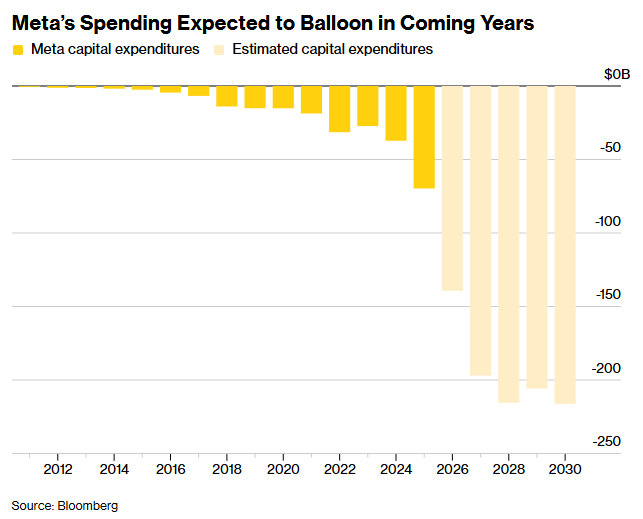
Meta's capital expenditure is expected to expand significantly in the next few years
However, for Meta investors, one area where concerns remain is the company's tens of billions of dollars in capital expenditure on AI. Meta's spending is expected to double to nearly $140 billion this year, then expand further to nearly $200 billion in 2027. The company, once known for its huge cash flow, is expected to report negative free cash flow of $6.3 billion this year, and this figure is expected to expand to nearly $30 billion by 2027.
Cyrus Amini, chief investment officer of Hyphen Wealth Management, said that these two factors alone are enough to make investors doubt whether Meta's current upward trend will continue. He said, “The valuation is very attractive, and it may have more short-term catalysts compared to big tech stocks. But if you consider the longer time span, it's hard to say. It's easy for the share price to fall back again.” “Things are changing so fast that it's hard to say with any certainty that any company's stock will be a long-term winner.”