


RBOB Gasoline at a Crossroads: Will Escalating Gulf Tensions Push Prices Through Key Resistance?
War Premium Returns: What Is Fueling RBOB's Latest Move
RBOB and crude oil markets remain squarely focused on the Middle East, where fighting between the United States and Iran intensified over the past week. Brent crude surged roughly 9% over the past week, briefly testing the $105 level before easing back on Friday as diplomatic efforts emerged. Gulf Cooperation Council diplomats are scheduled to meet their Iranian counterpart in Oman to discuss a temporary arrangement for managing shipping through the Strait of Hormuz. Earlier in the week, tensions ran hotter. The U.S. military reportedly destroyed five Iranian crude oil tankers in retaliation for an attempted attack on an American warship, and no American personnel were harmed in the exchange. Iranian officials responded with sharper rhetoric, with Parliament Speaker Mohammad Bagher Ghalibaf warning that Iran's future responses would be faster, more intense, and more painful than before. Physical flows through the Strait have tightened materially. Only one or two tankers per day are reportedly transiting the waterway, carrying an estimated 2.0 million barrels per day compared with roughly 4.0 million barrels per day in July. Adding to the supply anxiety, Saudi Arabia shut its East-West crude pipeline as a precaution after multiple attacks, while Iran backed Houthi forces reportedly advanced toward Yemen's Perim Island near the Bab el-Mandeb chokepoint. At the pump, the impact has already shown up in consumer prices. U.S. gasoline prices hit a Labor Day record of 4.15 dollars per gallon. On the demand side, the picture is more mixed. The International Energy Agency sharply cut its 2026 global oil demand outlook, forecasting a 2.5 million barrel per day contraction, the largest annual decline since the Covid 19 pandemic, while the EIA simultaneously raised its 2027 U.S. crude production forecast to 14.3 million barrels per day. Refinery capacity constraints have also been cited as a factor keeping RBOB relatively firm versus crude. With headlines shifting quickly between escalation and diplomacy, gasoline remains a market trading on geopolitical headlines as much as on supply and demand fundamentals.
What the Market Has Done
- The market rallied aggressively from the start of 2026 and consolidated from March to April between 3.33 (Daily Level 2) and 2.8 (Daily Level 3), a level that originated in 2024.
- Market subsequently broke above 3.33 and revisited 3.8 (Daily Level 1), a daily level that dates back to 2022.
- From late April to late May, the market attempted to accept and build value higher above 3.8 but was unable to sustain it.
- Subsequently, buyers gave up control at 3.33 (Daily Level 2), resulting in the market rotating back into Auction Block 1.
- Since that rotation, the market has been engaged in a two way auction between 3.33 and 2.8, forming Consolidation Range 1.
- More recently, buyers have stepped up bids within the range, evidenced by a pattern of higher lows.
- This price action is confluent with the market holding above the yearly VWAP, reinforcing that underlying demand has not fully given way.
What to Expect in the Coming Weeks
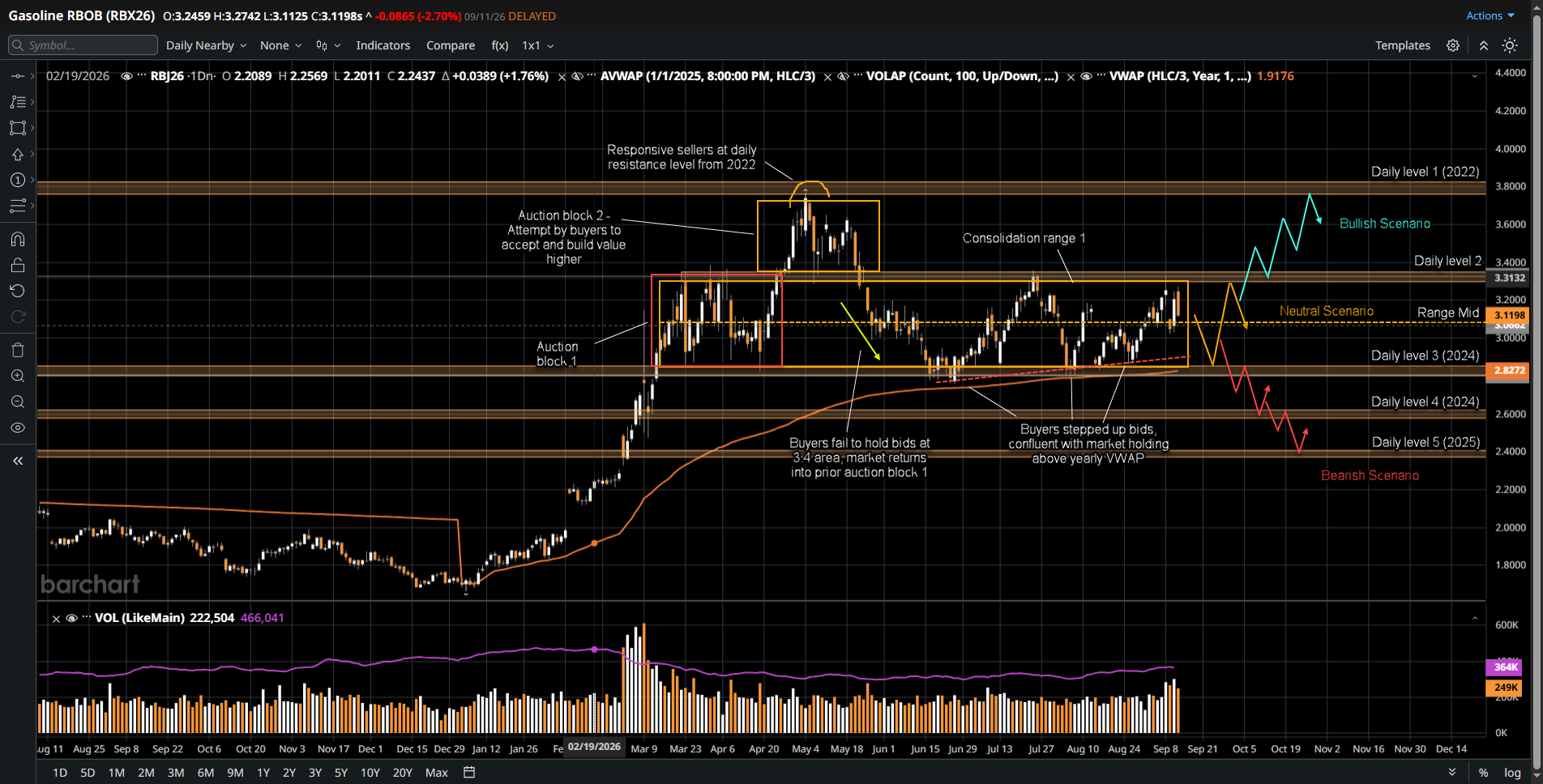
Watch this level closely: 3.33 (Daily Level 2) and 2.8 (Daily Level 3), a daily level dating back to 2024, remain the two boundaries defining the current auction.
Neutral Scenario
- Without an increase in pace and volume at the edges of the range, expect the market to continue its two way rotation within the current Consolidation Range 1 between 3.33 and 2.8.
- A possible supporting condition for this scenario is a temporary Hormuz shipping arrangement that reduces headline volatility without fully resolving the underlying conflict, keeping both buyers and sellers cautious.
Bullish Scenario
- An early clue of this scenario developing is if buyers start holding bids above 3.07 (Range Mid) and begin compressing against the 3.33 level.
- If buyers are able to break and accept above 3.33, expect the market to move up through Auction Block 2 toward 3.6 initially, and subsequently revisit 3.8 (Daily Level 1).
- A possible trigger for this scenario is a fresh escalation in Strait of Hormuz hostilities, such as a strike on a major tanker or export terminal that further disrupts physical flows.
Bearish Scenario
- If the market rotates back down to the 2.8 area and buyers fail to defend it, a break and acceptance below 2.8 would expose a move down to 2.6 (Daily Level 4), a daily level from 2024.
- If buyers fail to respond at that level, expect a further move down to 2.4 (Daily Level 5), a daily level from 2025.
- A possible trigger for this scenario is a confirmed and durable diplomatic agreement between Iran and Gulf states that fully reopens Hormuz shipping lanes, easing the geopolitical risk premium currently embedded in price.
Conclusion
Technically, RBOB remains locked in a well defined auction between 3.33 (Daily Level 2) and 2.8 (Daily Level 3), with recent higher lows and support above the yearly VWAP hinting that buyers have not yet lost the broader argument. Fundamentally, the market is being pulled in opposite directions: a tightening physical market and record pump prices on one side, against a softer demand outlook and rising non OPEC supply on the other, with the outcome of Hormuz diplomacy likely to be the tie breaker. With so much resting on headlines that can shift within a single session, this is a market that rewards patience at the edges of the range far more than conviction in the middle of it.
We believe that professional growth is impossible without the truth found in your own data. Our presence on Barchart bridges the gap between complex exchange data and professional execution. Open an Account and access the tools you need to see your performance clearly.
Disclaimer:
This article is provided for informational and educational purposes only and does not constitute financial, investment, or trading advice. The analysis presented reflects the author’s market observations and opinions at the time of writing and is not a recommendation to buy or sell any futures contract, security, or financial instrument. Futures trading involves significant risk and is not suitable for all market participants. Losses may exceed initial margin deposits, and market conditions can change rapidly.
Any scenarios, levels, or market expectations discussed are hypothetical in nature and are intended solely to illustrate potential market behavior. They do not represent actual trading results and should not be interpreted as guarantees of future performance. Past performance, market behavior, or historical price action are not indicative of future outcomes.
Readers are solely responsible for their own trading decisions and risk management. Always conduct independent research, consider your financial situation and risk tolerance, and consult with a qualified financial professional, if necessary, before engaging in futures or derivatives trading.