


At a time when global tungsten prices are soaring, US mining company Almonty Industries (ALM.US) quickly took over Rwandan tungsten ore to ease supply constraints
Zhitong Finance App learned that against the backdrop of a historic surge in global tungsten prices and the continued tightening of China's export controls, US mining company Almonty Industries (ALM.US) reached a landmark cooperation agreement with the Rwandan government. According to the binding agreement disclosed on September 14, Rwanda will provide exploration concessions and processing licenses in exchange for 25% of Almonty's local subsidiary shares, and Almonty will retain ownership of the remaining 75%. This deal is not only a key step in Almonty's global expansion strategy, but also marks the first time that the West is systematically reaching deep into the African continent in the process of building a “de-Chinesized” tungsten supply chain.
Transaction structure: asset-light model of exchanging shares with “concessions+licenses”
The beauty of this collaboration is its structural design. Instead of investing in cash, the Rwandan government contributed exploration concessions and processing licenses in exchange for 25% of the local subsidiary's shares. Almonty is responsible for providing technology, operations, and capital. This model allows Almonty to quickly obtain access to resources without having to invest huge initial exploration costs.
What is more noteworthy is its pragmatic approach of “buy first, build a factory later”. Almonty plans to first buy ore, pre-concentrate, and tailings from existing licensed producers in Rwanda rather than wait years to build new mines. These materials can be sold, upgraded, or exported in advance to provide immediate cash flow to the project. At the same time, the joint venture will build a permanent collection and processing facility in Rwanda and deploy mobile processing units in the existing Shyorongi concession area (about 32 square kilometers) to carry out exploration work.
Almonty CEO Lewis Black made it clear in an interview that the US government helped facilitate this collaboration and provided political support, but did not directly fund it. The products will be sold to customers in the US, Europe, Japan, and Korea.
Rwanda's strategic role: Africa's only top ten global tungsten producer
Rwanda is the only African country among the top ten producers of tungsten in the world, which makes it highly strategic in the West's efforts to diversify its supply chain. Currently, Vancouver-based Trinity Metals operates the continent's largest tungsten mine, the Nyakabingo mine, in Rwanda. Since reaching an offtake agreement last year, the company has delivered more than 320 tons of high-grade concentrate to a processing plant in Pennsylvania, USA, supplying 20% of the US primary tungsten concentrate consumption.
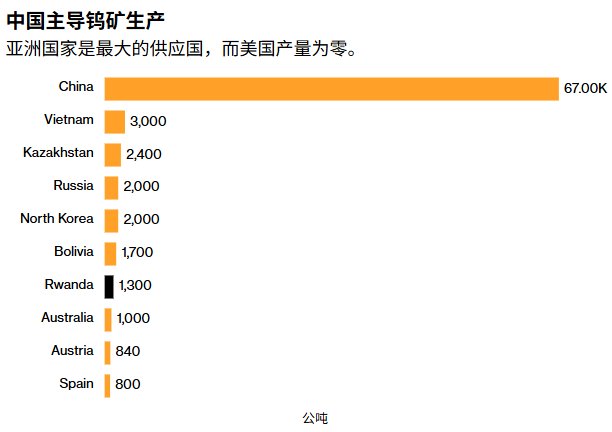
The core challenge of Almonty's collaboration is supply chain traceability. Rwanda has long faced accusations of smuggling tungsten ore from neighboring Congo (DRC) and Burundi and “whitewashing” the output for Rwanda. Black's response to this was clear and tough: “Traders can play with pirates; we're only interested in certified domestic output.” This statement highlights the difficult trade-off that Western buyers must make between “geopolitical correctness” and “supply chain compliance.”
Fundamentals of the tungsten market: a tenfold “structural shortage” in ten years
Almonty is increasing its tungsten assets at this time, which coincides with the tungsten market experiencing an unprecedented supply shock. The global benchmark ammonium paratungstate (APT) price has soared from about $300 per ton five years ago to more than $3,000 per ton, an increase of about ten times. The European APT CIF price is currently stable in the range of 2,900 to 3,100 US dollars/ton, while the domestic price in China is about 595,000 yuan/ton, and the price difference between China and foreign countries has widened to about 2,000 US dollars/ton.
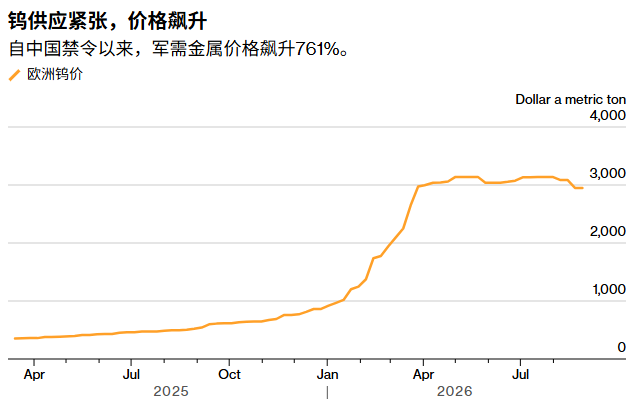
The supply side faces multiple structural constraints. China accounts for about 80% of the world's tungsten ore production, but it itself is also facing the double pressure of declining resource grade (the WOgrade of major mining areas in Jiangxi has dropped from 0.40% to less than 0.28%) and policy tightening (6.5% reduction in mining quotas in 2025). In February 2025, China added various key metals, including tungsten, to the export control list, which directly led to a significant drop in the available supply of APT and tungsten oxide in the Western market.
The demand side was simultaneously ignited by the two major engines of AI and defense. Tungsten hexafluoride (WF) is the first material needed for the TSV process in HBM and 3D NAND manufacturing. Global demand is expected to increase from 9,000 tons in 2025 to 15,000 tons in 2030, corresponding to a net increase of 3,700 tons in tungsten demand. In terms of PCB drills, the number of PCB layers on AI servers has jumped from the traditional 12-16 layers to 24-40 layers, and drill loss has increased dramatically. The net tungsten requirement for 2025-2030 is estimated to be 789 tons.
The most critical catalyst is the new US defense procurement regulations that will come into effect on January 1, 2027. At that time, the US defense supply chain will ban the use of tungsten “covering materials” mined, produced, or processed in “concerned countries” (including China, Russia, North Korea, and Iran), and the requirement can be traced back to the mine level. This means that large existing global commercial stocks will not be able to meet US defense application requirements, forcing the Western military system to structurally decouple China's tungsten supply.
US tungsten sector: benefits realized, short-term cooling
Although the Rwanda agreement is a typical subject catalyst, the US share concept of tungsten has recently declined. On September 14, Almonty Industries closed down 6.52% to $15.49; US Tungsten closed down 5.33% to $1.42.
The correction came after a considerable increase: Almonty Industries' stock price rose by about 67% during the year, with a cumulative increase of about 159% over the past 12 months, and the 52-week range was 4.45-24.41 US dollars. Fundamental support is also remarkable — as South Korea's Sangdong mine moved into processing and production in July, the company's second-quarter revenue reached 43 million Canadian dollars, a sharp increase of 498% over the previous year, reversed losses and recorded net profit of 181.8 million Canadian dollars, a cash position of about 1.2 billion Canadian dollars at the end of the period, and was approved to implement stock repurchases of up to 300 million US dollars. The company was delisted from the Toronto Stock Exchange on July 31 and completed delisting from the Australian Stock Exchange on September 1. Currently, it is only traded between NASDAQ (ALM) and Frankfurt.
Other targets within the sector are also undertaking this supply chain theme: Guardian Metal Resources (GMTL.US) released preliminary research for the Nevada Pilot Mountain project in June, with a net present value of US$660.3 million after tax, and an investment of 6.2 million US dollars under Chapter 3 of the US Defense Production Act; Fireweed Metals (OTCQX: FWEDF) is promoting the development of an updated version of the Mactung project in Yukon, Canada — the mine is known as the world's largest high-grade tungsten deposit It also received support of up to 22.5 million Canadian dollars in Chapter 3 of the Defense Production Act; American Tungsten, as the designated supplier of the American Defense Industry Foundation Coalition (DIBC), is restarting the historic IMA mine in Idaho with the goal of achieving the first batch of tungsten concentrate sales before the end of the year. Another focus of the market is compliance catalysis: According to the US Defense Authorization Act (NDAA), defense manufacturers will have to prove that their tungsten supply chain sources are compliant from January 2027, which provides a rigid demand logic that does not rely on short-term prices for local production capacity in the US and its allies.