


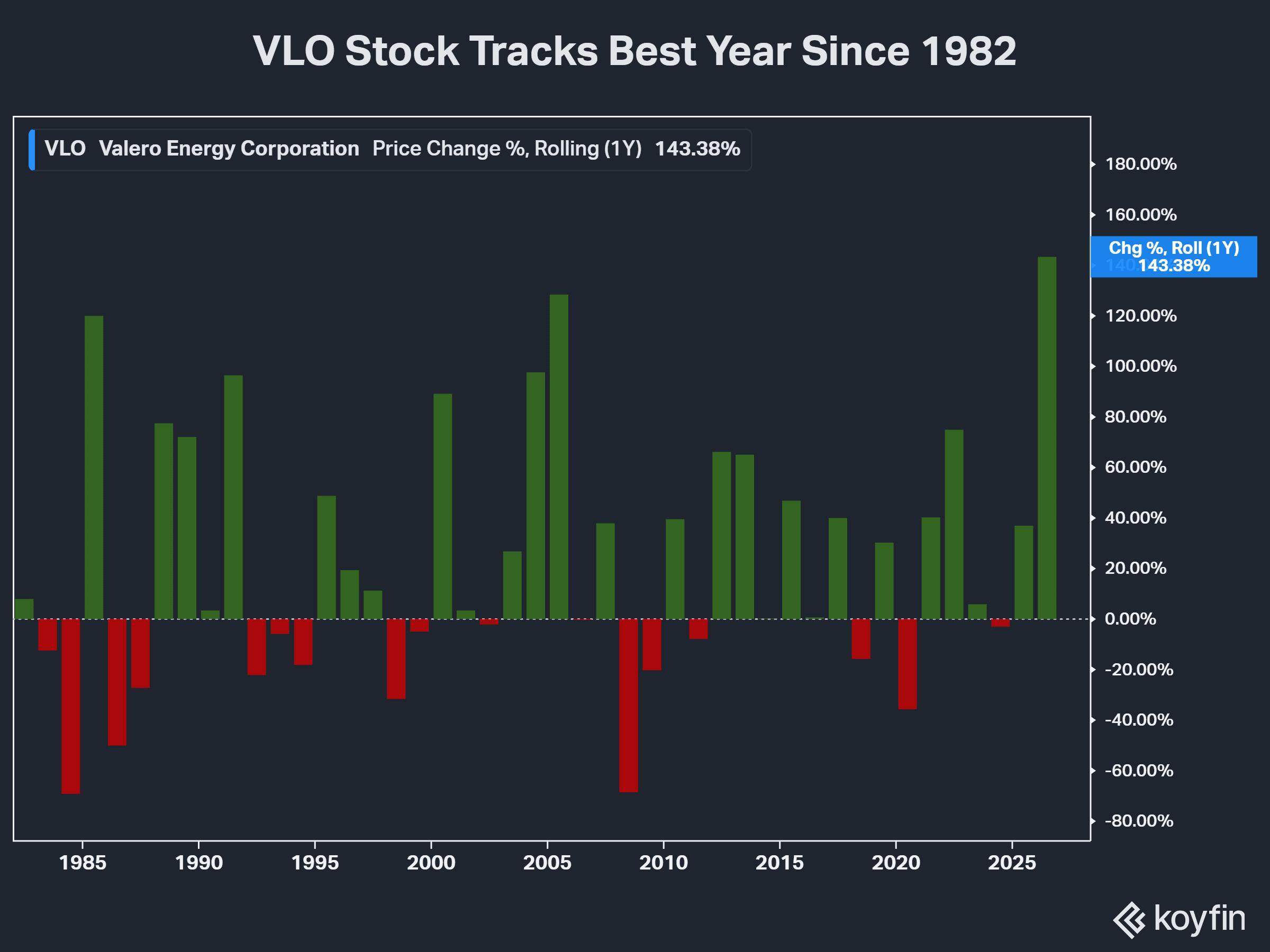
The “big short” Bury is betting on the “refining shortage”! Valero Energy (VLO.US) surged 143% during the year, pointing to the best annual performance since 1982
The Zhitong Finance App learned that Michael Berry, an investor famous for accurately predicting the 2008 subprime mortgage crisis, said that after experiencing a historic rise, Valero Energy (VLO.US) has become his “huge position.” As a result, the prototype character of the movie “The Big Short” took out the initial capital investment and donated the proceeds to charity while continuing to hold a sizable position.
Bury made these remarks as a new round of attacks on Saudi energy infrastructure and damage to Russian refineries exacerbated global fuel shortages. Valero Energy rose 1.3% on Friday to close at a record level of $390.42, with a return of about 143% during the year — far exceeding the S&P 500's increase of about 12% during the year, making the stock expected to record its strongest annual performance since records began in 1982.
According to reports, the last time Bury bought Valero Energy was during 2020. At that time, global travel, flights, and factories were shut down due to the COVID-19 pandemic, and WTI crude oil futures fell to a negative value for a while. In a recent subscriber chat for his Substack column “Cassandra Unchained,” Barry said, “Valero Energy is a great business. After this round of growth, it is now a huge position for me.” He said he had withdrawn his initial investment “even more” from this position and donated the entire amount to a donor-recommended fund for charity. He added: “The remaining Valero Energy position is still significant, but it's already 'won money', and I put it in my dividend reinvestment plan.”
In January of this year, Barry detailed his investment logic for Valero Energy. His investment logic focuses on Valero Energy's Gulf Coast refineries, many of which are built to process heavy Venezuelan high-sulphur crude oil. Previously, after sanctions, underinvestment, and the collapse of crude oil production in Venezuela reduced such supplies, these refineries were only able to operate using lighter and less suitable raw materials. Meanwhile, in January of this year, changes in Venezuela's political situation rekindled the market's expectations that Venezuela's crude oil production might recover.
“Many of the Gulf Coast refineries are built specifically for heavy Venezuelan crude oil,” Burry said. He added that the restoration of supply “may generate better profit margins in aviation kerosene, asphalt and diesel over time.”
Barry also said at the time, “I've owned Valero Energy since 2020, and I'm even more determined to hold it longer.” However, he also warned that resuming Venezuelan crude oil exports could take several years.
Soaring refining profits boost Valero Energy's stock price
One important reason driving Valero Energy's stock price to soar this year is that the high price of refined oil products has boosted refining profits. Against the backdrop of the closure of refineries in the US over the years and the tightening of global fuel supply due to the Middle East war, US refiners are fully operating to meet market demand, making the second quarter one of the most profitable quarters in history.
According to financial reports previously released by Valero Energy (VLO.US), in terms of earnings per share, the company achieved the strongest quarterly performance in history; the company's net profit for the second quarter increased more than fourfold year-on-year, from US$714 million in the same period last year to US$3.7 billion, a record high.
As fuel supply continues to be tight, refiners' profit performance is likely to improve further. Gary Simmons, chief operating officer of Valero Energy, previously stated in a conference call with analysts: “The profit margin environment has been stronger so far than in the second quarter.” He pointed out that lower crude oil costs are driving improved profits. Simmons also said that there is currently little indication that fuel prices will fall in the short term. He pointed out that aviation fuel prices, which fell somewhat from their historical high this summer, seem to be rising again.
Refinery shutdowns over the years have led to a lack of supply buffers in the fuel market. Today, the war between the US and Iran has disrupted fuel exports to the Middle East, while Ukraine's attack on Russian refineries has also limited gasoline and diesel exports. Together, these supply disruptions have led to a decline in global fuel stocks and a rise in global fuel prices.
While demand remains relatively stable, gasoline and diesel inventories show little sign of recovery, which means that market supply will remain tight and prices will remain high. Although fuel production usually starts to slow in the fall, US refiners say they will continue to chase near historic profit margins.
US refining capacity is nearing its limit White House plans to use the Defense Production Act to expand production
Although the US is one of the world's largest refiners, has a huge network of refineries, and can process millions of barrels of crude oil every day, the price of refined oil products is still high. The average price of gasoline across the US surpassed 4 US dollars/gallon on Labor Day (September 7) this year, setting a record high for this holiday. Meanwhile, the latest data from the American Automobile Association (AAA) on Friday showed that the average price of diesel in the US reached 6.0556 US dollars/gallon, breaking 6 US dollars/gallon for the first time in history; in California, the average price of diesel was as high as 7.9827 US dollars/gallon.
American refiners are operating almost at full speed. As of July, the operating rate of US refineries was close to or above 95% for nearly two months, which raised the risk of equipment failure and maintenance delays, and could exacerbate an already tight supply situation.
Meanwhile, according to two people familiar with the matter, as the conflict with Iran revealed America's vulnerability in the face of disruptions in global crude oil supply and soaring prices, the White House is considering how to invoke the Defense Production Act to expand America's refining capacity.
People familiar with the matter revealed that the proposal to use the bill was made during Trump's recent meeting with nearly 12 US refiners. At the meeting, White House officials tried to figure out how federal support could most effectively be used to increase production capacity. Refinery executives told officials that federal funding is best used to improve the operational efficiency of existing refineries or expand existing plants rather than fund the construction of a new refinery, because the latter is much more expensive and takes years to complete.
Citing the Defense Production Act is seen as a last resort, which has never before been used to increase refining capacity. According to reports, the bill gives Trump broad powers, allocates industrial resources, and provides financial incentives to companies that produce and expand the production of materials recognized as important for national defense.
Considering such an extraordinary move highlights the growing pressure on the Trump administration — Trump needs to show that he can contain the impact of soaring fuel prices on consumers and businesses before the November midterm elections arrive.