


Tesla (TSLA.US) Roadster has been warming up for 9 years, and the market won't buy it! “Big short” Bury is concerned about BYD buying opportunities
The Zhitong Finance App learned that Tesla (TSLA.US) warmed up the next generation of the Roadster on Sunday, but investors didn't seem to buy it. Before the US stock market on Monday, Tesla's stock price fell by nearly 2%. Retail investors questioned whether this expensive sports car, which has repeatedly jumped tickets, can actually boost revenue. Meanwhile, the “big short” Michael Berry turned his attention to Chinese competitor BYD (01211) because the latter's stock price was close to his ideal buying range.
Tesla warms up a new generation of Roadster
Tesla posted on Sunday morning on X that it was “ready to be released,” and attached an image of a sports car with four propeller-shaped tail flames and the “October 1” date, reigniting market speculation about the upcoming launch of its next Roadster. The words “WHERE WE'RE GOING” also appear vaguely in the picture, which seems to pay tribute to the movie “Back to the Future” and CEO Elon Musk's long-standing statement that the Roadster can levitate.
Tesla did not disclose specific models, locations, or event dates. However, according to the invitation letter circulating on X, the event will be held in Waco, Texas on October 1, and the deadline for responses is September 16. Tesla investor and celebrity Sawyer Merritt (Sawyer Merritt) said on X that Tesla has issued invitations to the next Roadster sports car press conference to those who have booked it. Merritt revealed that the press conference will be held on October 1 in Waco, Texas, and the invitees must respond to confirm attendance by September 16.
Tesla first released the second-generation Roadster in November 2017, promising an acceleration time of 1.9 seconds from zero to 60 mph, a top speed of over 250 miles per hour, a battery range of 620 miles, and delivery to begin in 2020. Since then, the car has been delayed several times, and is still in the “design and development” stage in Tesla's latest financial report.
Musk has said that the optional SpaceX kit will add 10 air conditioning thrusters to improve acceleration, braking, cornering and top speed. “Maybe they can even make Tesla fly,” he said in 2018.
Retail investors turned short, but Damo is betting on Semi: institutions and retail investors are now at odds
However, on Stocktwits, retail sentiments about Tesla have changed from “bullish” to “bearish” a week ago, with traders questioning the commercial value of this expensive, under-selling sports car. The number of tweets on Tesla stock plummeted 87% over the past month, but the number of followers increased slightly by 0.1%.
One user compared the Roadster to Apple releasing a $40,000 ultra-thin TV and asked, “Who really cares about that tiny revenue increase?” Another trader who is optimistic about the Roadster said that the car is probably fast enough to “feel like it's flying.”
Other users said that investors will pay attention to Tesla's stock price performance on Monday to determine whether this news is a real catalyst or “another headline that delays the cycle.”
In contrast to the pessimism of retail investors, Morgan Stanley raised the target price for Tesla's bull market scenario from $820 to $840, implying nearly 130% upward space from current levels. The reason is that Tesla Semi electric trucks and autonomous trucks have long-term potential for development. The bank estimates that the utilization rate of autonomous trucks can be increased 2.3 times, the cost per mile can be reduced by 20%, and the profit of bicycles is 6 times that of human-driven trucks.
Morgan Stanley reports that if fully automated driving (FSD) services are charged at $0.85 to $1 per mile, each truck can generate revenue of $12,000 to $18,000 per month, which can have a significant impact on Tesla's financial prospects, even if the sales volume of Semi trucks is relatively small. However, under the benchmark scenario, Morgan Stanley maintained Tesla's target price of $400 and a “neutral” rating.
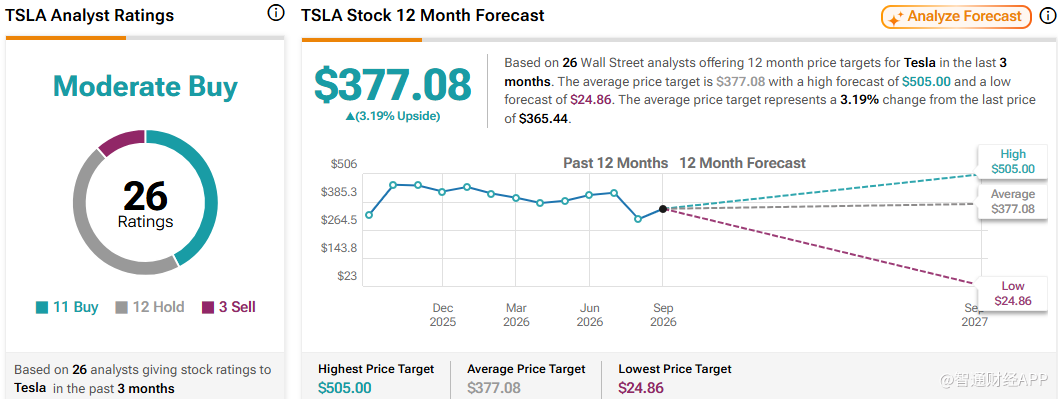
According to Tipranks data, overall, Wall Street analysts gave Tesla a “moderate buy” rating, with an average target price of $377.08, which is 3% higher than the latest closing price.
Bury is concerned about BYD's buying opportunities
While Tesla investors are buzzing about the Roadster sports car, Bury confirmed that he is closely watching BYD, as the latter's stock price is close to the level he previously said he would actively buy. When asked if BYD's stock price was close to its target price and if he was considering buying it, Burry replied on Substack: “Yes, I'm watching.”
In March, he said, “If the investment logic still holds true at that time, I will actively buy at HK$75 or higher.” Bury revealed at the time that he did not own shares in BYD. The share price of BYD has now risen to around HK$80.
Barry stressed that BYD's traditional shareholding structure is a major advantage over many Chinese technology companies that use variable interest entities (VIE). BYD investors hold the operating company's common shares, which are in the same type of shares held by founder Wang Chuanfu and the founding team.
He also appreciated BYD's vertical integration, international expansion, and ability to independently produce batteries, chips, motors, and other major components. According to Bury, BYD may become the lowest-cost automobile manufacturer in large-scale global production.
Its self-developed blade battery uses lithium iron phosphate chemistry, which is generally cheaper than the nickel-manganese-cobalt batteries used by Tesla and many competitors, and is also considered safer.