


3 Defence Stocks to Watch as Europe Eyes a €90b Ukraine Rebuild Loan
War in Europe, a huge proposed €90b Ukraine support loan and fresh pressure on trade rules between Canada and the EU are quietly reshaping where defence and reconstruction money might flow next. That mix of military aid, tariff talks and long term rebuilding needs could be significant for investors who pay attention to how these shifts develop. This article breaks down three stocks directly exposed to this news and why they may deserve a closer look.
The stocks covered in the rest of this article are only a sample, and the full screen surfaced 33 more European and Canadian defence and reconstruction companies with equally compelling stories that are not discussed below. To go straight to the broader opportunity set, use the European and Canadian Defence & Reconstruction Equities screener to identify, filter and analyze potential higher conviction ideas built around this theme.
Rolls-Royce Holdings (LSE:RR.)
Rolls-Royce Holdings taps directly into the defence and reconstruction theme through its engines for military aircraft, naval vessels and power systems, while still leaning on a large civil aerospace franchise.
Rolls-Royce Holdings develops aero engines for commercial jets and business aircraft, supplies military and naval propulsion and produces mtu branded onsite power solutions, with £11.8b from Civil Aerospace, £5.0b from Defence and £5.5b from Power Systems, and an equity value around £120.7b.
For investors focused on defence linked spending and long term rebuilding of critical infrastructure, the interest in Rolls-Royce is less about a single contract and more about how its engines and power systems sit across NATO aligned fleets, data centres and energy projects.
"A significant portion of current narrative and valuation appears premised on Power Systems segment growth, particularly the data center power generation boom, continuing at near-peak rates (20%+ per year) as cloud and AI infrastructure expand."
What happens to future cash flows if one quiet shift in this demand cycle changes the pricing power behind those long-term service deals.
If that pricing power question is on your mind, read the full narrative for Rolls-Royce Holdings to see how Rolls-Royce could be reshaped by defence demand, AI power and rebuild spending.

Lisi (ENXTPA:FII)
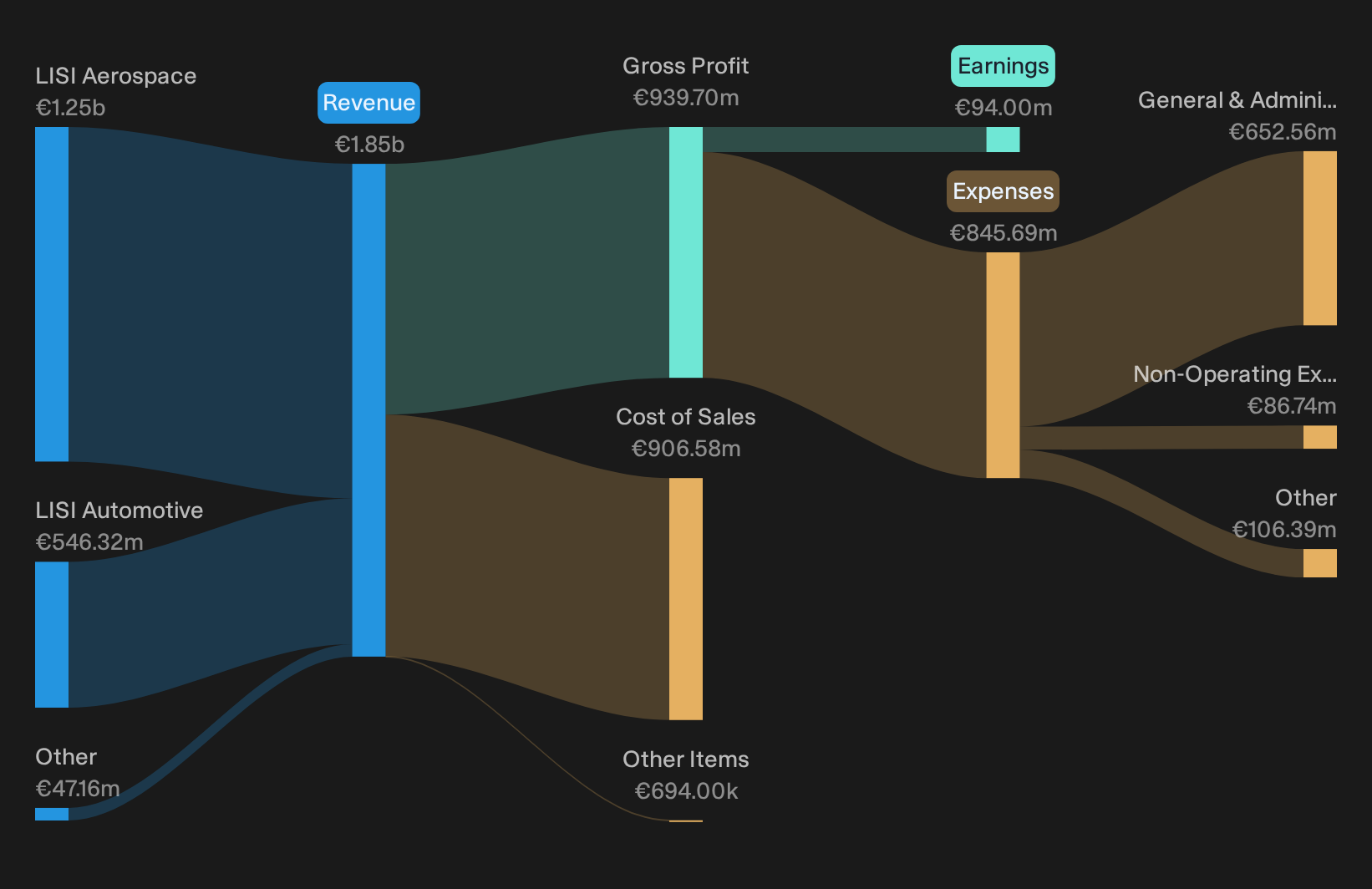
Lisi supplies aerospace fasteners and structural parts embedded in civil and defence aircraft, tying it directly into the European defence and reconstruction theme. The LISI Aerospace division generates about €1.3b in revenue, with LISI Automotive adding around €546 million. The stock has a market value near €2.8b.
Lisi plugs into the defence and reconstruction story through the small but critical components that keep European aircraft flying and maintained. Recent half year revenue of €988.88 million and net income of €62.44 million provide supporting figures, while one unseen pressure could decide how much of that profitability investors actually keep over time.
That hidden pressure is the kind of thing you only catch by reading the analysis report for Lisi, where margin durability and contract quality are examined in detail.
Airbus (ENXTPA:AIR)
Airbus anchors the defence side of this screener by supplying military aircraft, helicopters and space systems that plug directly into European and NATO rearmament. Its large civil aviation business provides scale and diversification across cycles.
Airbus SE designs and delivers commercial jets, helicopters and defence and space systems worldwide, with about €55.6b from its Airbus commercial unit, €8.9b from Airbus Helicopters and €13.9b from Airbus Defence and Space, and a market value near €157.8b.
For investors looking at defence and reconstruction exposure built on industrial depth rather than a single contract, Airbus offers a mix of military platforms, satellite capabilities and a substantial civil backlog that can provide more predictable demand visibility across different budget cycles.
"Defense & Space provided partial stability. More importantly, the order backlog largely held."
What happens to Airbus margins and cash generation if one unresolved supply chain assumption changes the pace at which that backlog turns into delivered aircraft?
That supply chain swing is exactly what the full narrative for Airbus unpacks, showing where Airbus resilience could be accelerating and which risks might quietly be receding.

Seeking Fresh Alternatives Before They Fly
New themes can gain momentum fast. Once the crowd catches on, the cleanest entries tend to vanish. Scan these fresh under-the-radar ideas while it matters and consider them early.
- Spot potential turnarounds before they become headlines by running through the curated 8 high quality undiscovered gems and see which stories still trade like the market has not caught up yet.
- Explore structural cash flow trends by scanning the hand picked 1 dividend fortresses where payouts aim to stay sturdy even when sentiment drops in other corners of the market.
- Evaluate infrastructure-oriented opportunities by filtering the pre selected 39 power grid technology and infrastructure stocks and assess which operators could benefit if electrification spending changes.
This article by Simply Wall St is general in nature. We provide commentary based on historical data and analyst forecasts only using an unbiased methodology and our articles are not intended to be financial advice. It does not constitute a recommendation to buy or sell any stock, and does not take account of your objectives, or your financial situation. We aim to bring you long-term focused analysis driven by fundamental data. Note that our analysis may not factor in the latest price-sensitive company announcements or qualitative material. Simply Wall St has no position in any stocks mentioned.
Have feedback on this article? Concerned about the content? Get in touch with us directly. Alternatively, email editorial-team@simplywallst.com