


Intel (INTC) Tackles Encryption Bottlenecks, Is It Still 80% Undervalued?
Intel (INTC) is back in the spotlight after Atsign said it worked with the chip producer to remove a key encryption bottleneck for autonomous edge AI agents, reporting an approximately 88x uplift in secure Agent to Agent throughput.
Intel’s recent encryption breakthrough with Atsign lands during a volatile stretch for the stock, with a 7-day share price return of 7.45% and a 1-day move of 2.61% helping to claw back some of the 19.49% share price decline over the past 90 days. At the same time, a very large 1-year total shareholder return of 327.49% and 5-year total shareholder return of 105.97% show powerful longer term momentum that investors are now weighing against richer expectations and ongoing execution risk.
Spot fresh AI infrastructure momentum beyond Intel by scanning a hand-picked set of 89 AI infrastructure stocks.Intel’s sharp rebound, the Atsign partnership, and fresh AI headlines all hit at once. Are you seeing a genuine reset in how the business is valued, or a sentiment swing that stretched the multiple?
Most Popular Narrative: 79.5% Undervalued
Intel’s latest close at $102.94 sits far below the narrative fair value of $500.93, which frames the Atsign encryption news against a much bigger long term bet.
On Foundry business :
They are the single largest USA based foundry.
Comparing Intel vs TSMC: is essentially comparing the USA vs Taiwan
USA has stronger supply chain, required materials exist within the USA and not as dependent on foreign suppliers.
USA has better engineers / stronger universities
USA has better equipment
Taiwan has cheaper labor
Taiwan has geo political risks.
Want to see how a retail narrative, according to Suen, takes Intel’s foundry push, rich margins, and aggressive growth path and turns it into that triple digit fair value? The key ingredients span revenue pacing, profitability trajectory, and the multiple investors might one day be willing to pay. The exact mix is where this story gets interesting.
Result: Fair Value of $500.93 (UNDERVALUED)
Have a read of the narrative in full and understand what's behind the forecasts.
Still, Intel’s loss of $11,289m and a value score of 2 flag execution risk if assumptions about revenue growth, foundry scaling, or AI demand fail to materialize.
Find out about the key risks to this Intel narrative.
Another View On Intel’s Valuation
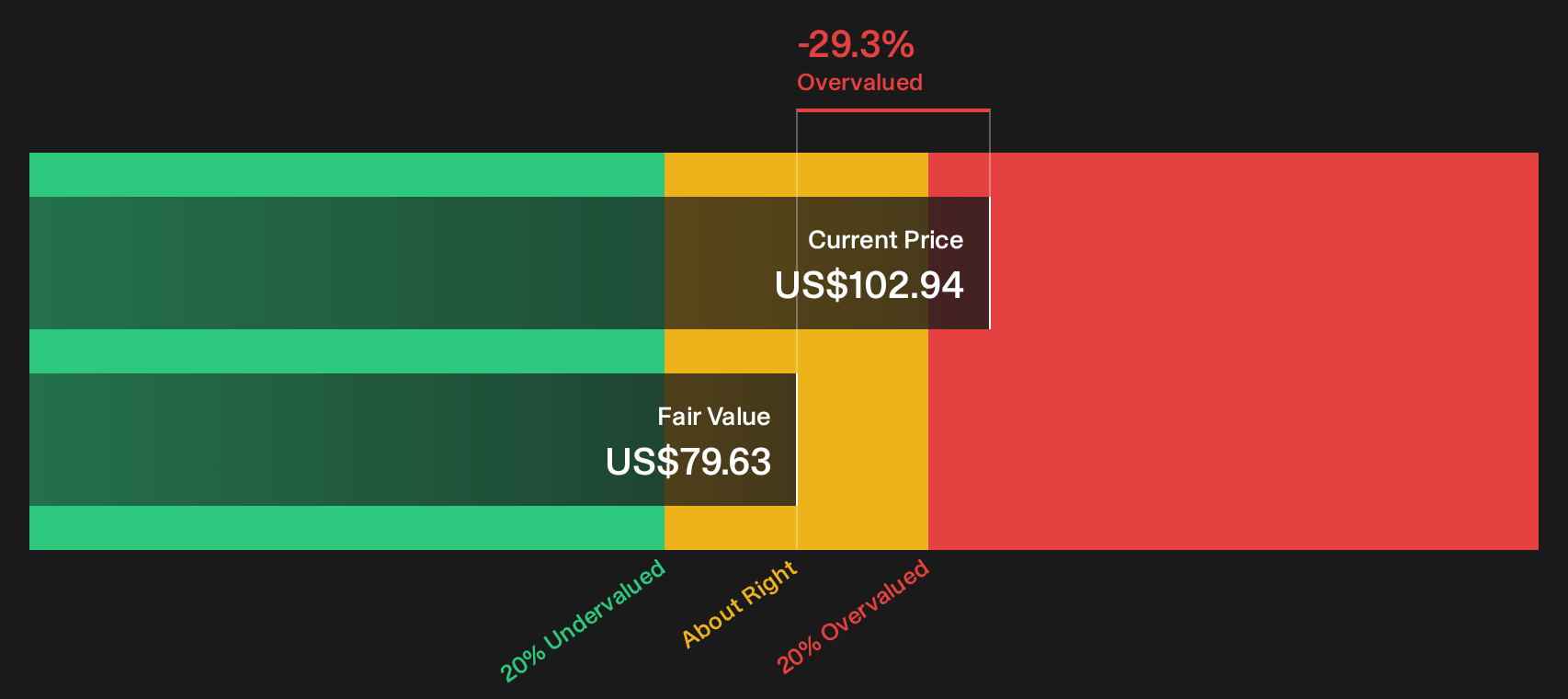
The Suen narrative leans heavily on upside, yet Intel’s own SWS DCF model points in the other direction. At $102.94, the stock trades above an estimated future cash flow value of $79.63, which frames the shares as overvalued on this measure rather than cheap.
That kind of gap does not automatically make the narrative wrong. However, it does raise a practical question for investors: Are you more comfortable leaning on long term story assumptions, or on a cash flow model that asks you to pay up today for earnings that still have to arrive and on time?
Look into how the SWS DCF model arrives at its fair value.
Next Steps
Sentiment around Intel is clearly split, with strong rewards on one side and clear risks on the other. If you want to move quickly and form your own view based on both angles, start with the 1 key reward and 1 important warning sign.
Looking for more Intel sized investment ideas?
If you stop with Intel, you risk missing other opportunities that fit your style, risk tolerance, and income goals across sectors and market caps.
- Target rapid upside potential by scanning a tight 21 elite penny stocks with strong financials universe that filters for stronger financial quality than the usual micro cap crowd.
- Focus on value and strength together by reviewing a list of solid balance sheet and fundamentals (23 results) that avoids weak balance sheets while still leaving room for meaningful price upside.
- Build a steadier income stream by locking in ideas from a curated list of 6 dividend fortresses that aim to combine yield with resilience.
This article by Simply Wall St is general in nature. We provide commentary based on historical data and analyst forecasts only using an unbiased methodology and our articles are not intended to be financial advice. It does not constitute a recommendation to buy or sell any stock, and does not take account of your objectives, or your financial situation. We aim to bring you long-term focused analysis driven by fundamental data. Note that our analysis may not factor in the latest price-sensitive company announcements or qualitative material. Simply Wall St has no position in any stocks mentioned.
Have feedback on this article? Concerned about the content? Get in touch with us directly. Alternatively, email editorial-team@simplywallst.com