


Should Cost Cuts And New Projects Require Action From APA (APA) Investors?
- APA featured in a recent Zacks review of the U.S. oil and gas exploration and production sector, which flagged stronger commodity fundamentals and improving operating efficiency across the industry. The review highlighted APA's cash-generating asset base, cost and debt reduction efforts, and its GranMorgu project in Suriname that management now targets for first output in mid 2028, a timeline that from today's perspective sits in the future.
- An important angle is how APA's push to cut costs, lower debt and advance long lead projects like GranMorgu could reshape its balance between near term cash generation and longer dated resource development, particularly as the broader sector focuses heavily on efficiency rather than pure volume growth.
- We will explore how APA's investment narrative, centered on efficiency and capital discipline, may be reframed by this constructive sector backdrop.
Scan APA alongside peers that are also focusing on capital discipline and efficiency by reviewing the hand picked 32 high quality undervalued stocks in this part of the energy sector.
APA Investment Narrative Recap
To own APA, you need to be comfortable with a story built on efficiency gains, disciplined capital spending and heavy exposure to oil and gas. The constructive sector read through from Zacks reinforces that backdrop but does not fundamentally change APA's near term focus on squeezing more cash from its U.S., Egypt and North Sea asset base.
The key short term swing factor remains how effectively management converts recent cost savings and operational tweaks into steady free cash flow while servicing a meaningful debt load. The biggest risk is that ongoing reliance on hydrocarbons, plus geographic concentration in Egypt, collides with weaker demand or local disruption, which could pressure both revenue and margins.
Against that context, the GranMorgu project in Suriname, now framed by Zacks for first output in mid 2028, is the announcement that most clearly connects to APA's next phase. It is a long dated development, but early spending and engineering choices made today influence future returns, execution risk and capital availability.
That Suriname timeline also interacts directly with current catalysts. Investors are watching whether APA can keep improving drilling efficiency in the Permian and Egypt, advance corporate wide cost cuts toward the targeted US$350 million run rate in 2026, and still fund GranMorgu without stretching the balance sheet. Any wobble in project delivery or cost control could amplify existing concerns about forecast declines in earnings and revenue over the next few years.
APA Analyst Expectations in Context
APA's forecast framework ties together a softer top line with slightly firmer profitability. Analysts see revenue declining by 3.1% per year over the next three years, while margins are modeled to edge up from 19.6% today to 20.3% by 2029. On the earnings side, consensus points to US$1.6b in profit in 2029, compared with US$1.7b today, which is a decrease of US$0.1b. These projections sit against a wide spread of views from US$736.6m at the low end to US$1.9b at the high end.
APA's narrative projects US$7.8b revenue and US$1.6b earnings by 2029. This rests on a 3.1% yearly revenue decline and a US$0.1b earnings decrease from US$1.7b today.
Valuation work in the current research ties those operating assumptions to a P/E re-rating. The stock price targets are built on APA trading at about 11.8x the US$1.6b earnings estimate in 2029, compared with roughly 9.4x earnings today. That prospective multiple sits below the 12.9x P/E cited for the wider U.S. oil and gas peer group, which matters if you are comparing how much optimism is already reflected in APA versus other producers.
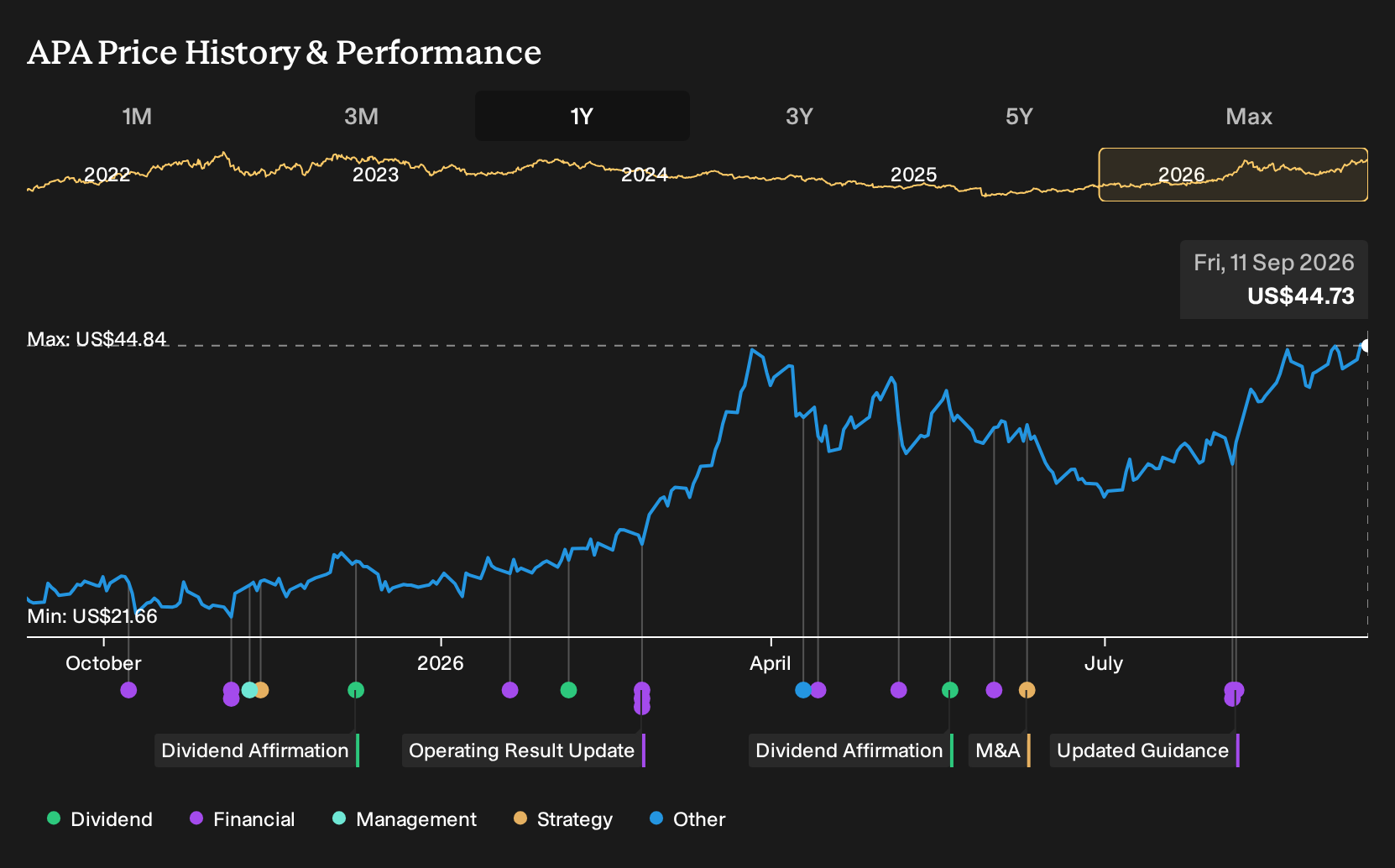
Price targets cluster tightly around where APA changes hands today. The consensus sits at US$45.16 per share against a recent price of US$44.84, a gap of just 0.7%. Analysts are effectively signaling that, based on these revenue and earnings paths, the stock looks close to fully priced on average. The more upbeat forecasts reach US$62, while the most cautious come in at US$36. This shows how much your own view on long run commodity exposure, Suriname execution and Egypt risk can swing any personal estimate of value.
Uncover why APA's fair value aligns with its current price.
Exploring Other Perspectives
One alternative lens focuses on energy transition risk. The most cautious analysts assume APA’s revenue could slide toward about US$6.0b by 2029 and earnings toward roughly US$738.1m, which is far more pessimistic than consensus. Those views were set before the Zacks update, so you may see estimates shift as opinions adjust.
Explore 4 other APA fair value estimates, including one that suggests as much as 27% downside from the current price!
Reach Your Own Conclusion
Disagree with existing narratives? Extraordinary investment returns rarely come from following the herd, so trust your own analysis and judgment.
- A great starting point for your APA research is our analysis highlighting 4 key rewards and 2 important warning signs that could impact your investment decision.
- See our latest analysis for APA. The report includes a comprehensive fundamental analysis summarized in a single visual, the Snowflake, making it easy to evaluate APA's overall financial health at a glance.
Looking For More Investment Ideas Beyond APA?
Once you have formed a view on APA, it can help to put that thesis in context by comparing it with other stocks that match different risk and income profiles using the Simply Wall St Screener.
- If capital preservation sits high on your list, consider starting with a basket of relatively steady companies through the 11 resilient stocks with low risk scores.
- For investors who want income as a priority, you can scan higher yielding opportunities using the 6 dividend fortresses.
- If the goal is to uncover fresh ideas with stronger underlying fundamentals, broaden your research with the 15 high quality undiscovered gems.
This article by Simply Wall St is general in nature. We provide commentary based on historical data and analyst forecasts only using an unbiased methodology and our articles are not intended to be financial advice. It does not constitute a recommendation to buy or sell any stock, and does not take account of your objectives, or your financial situation. We aim to bring you long-term focused analysis driven by fundamental data. Note that our analysis may not factor in the latest price-sensitive company announcements or qualitative material. Simply Wall St has no position in any stocks mentioned.
Have feedback on this article? Concerned about the content? Get in touch with us directly. Alternatively, email editorial-team@simplywallst.com