


AutoZone (AZO) Stock Looks Pricey On Earnings Yet Firm On Cash Flow
AutoZone has delivered a strong 80.6% share price gain over the past five years. Today, however, the stock appears roughly in line with an intrinsic value estimate based on a Discounted Cash Flow, so the current price does not look like an obvious bargain or a clear stretch.
- The 80.6% return over five years highlights solid long term wealth creation for AutoZone shareholders, and the stock now appears closer to fairly priced than deeply discounted.
- Future cash flow can be influenced by demand for replacement auto parts and services, while any pressure on repair activity or store level profitability may affect what investors are willing to pay for those cash flows.
- The broader checks point to a mixed picture rather than a clear bargain or clear overvaluation, with AutoZone scoring 4 out of 6 on value metrics.
The key question now is whether AutoZone's current share price already captures most of that intrinsic value, or if the present level still leaves room for a better payoff over time.
Compare AutoZone's fairly valued setup with other potential opportunities by scanning 32 high quality undervalued stocks, which highlights companies that pair solid balance sheets with cash flows the market may not fully appreciate yet.
Is AutoZone Fairly Priced on Cash Flow?
The Discounted Cash Flow model here values AutoZone by projecting future free cash generation and then discounting it back to today. Over the latest twelve months, the business produced about $1.75b in free cash flow, and the assumptions behind the model point to growing cash flows rather than a shrinking stream.
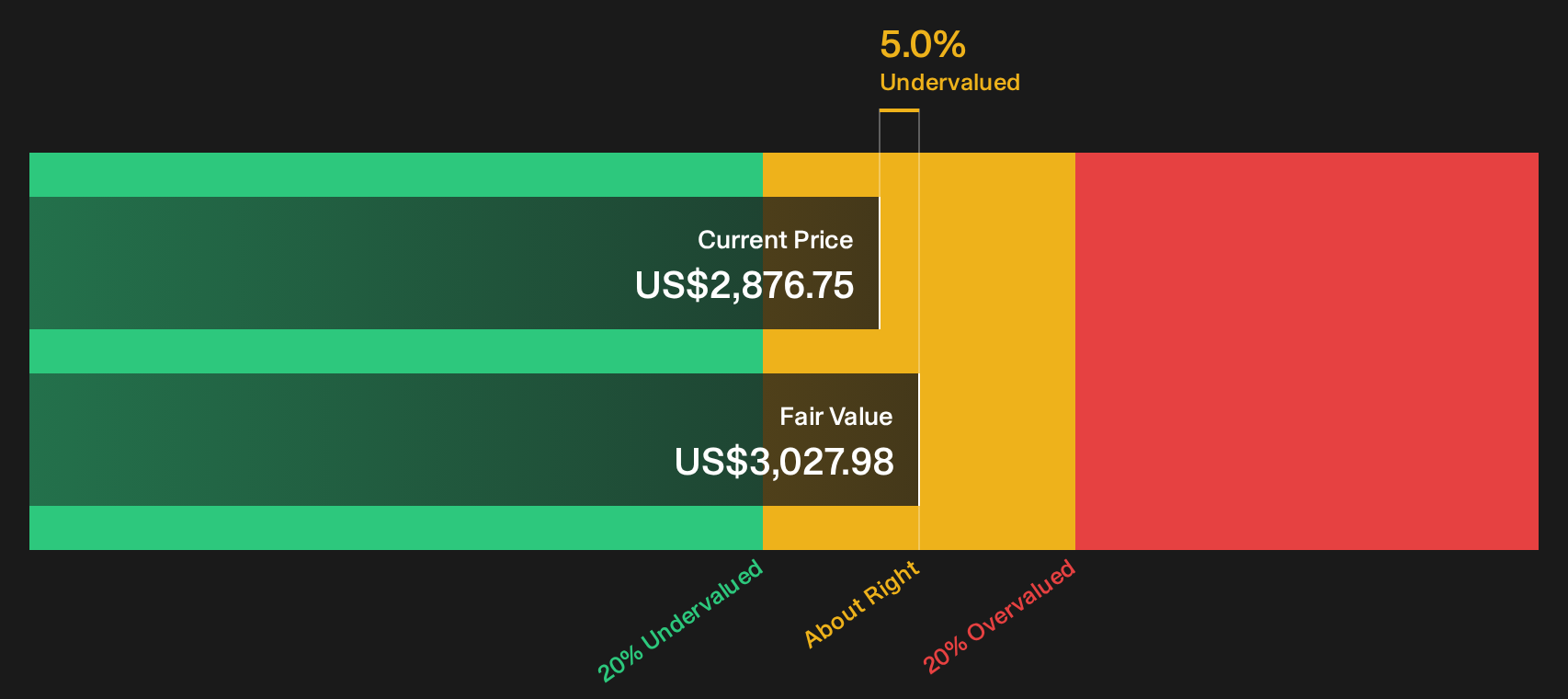
Feeding those projections into the 2 Stage Free Cash Flow to Equity framework gives an estimated intrinsic value of about $3,028 per share. That sits only modestly above the current market price, which implies roughly a 5.0% discount. For you as an investor, that indicates a setup where AutoZone does not screen as a glaring bargain or an obvious excess. Instead, the share price is generally in the same ballpark as the cash flow estimate.
On this DCF view, AutoZone appears roughly fairly valued with only a small gap between the modelled worth and where the stock trades today.
AutoZone is fairly valued according to our Discounted Cash Flow (DCF), but this can change at a moment's notice. Track the value in your watchlist or portfolio and be alerted on when to act.
Where Does AutoZone Sit on Earnings?
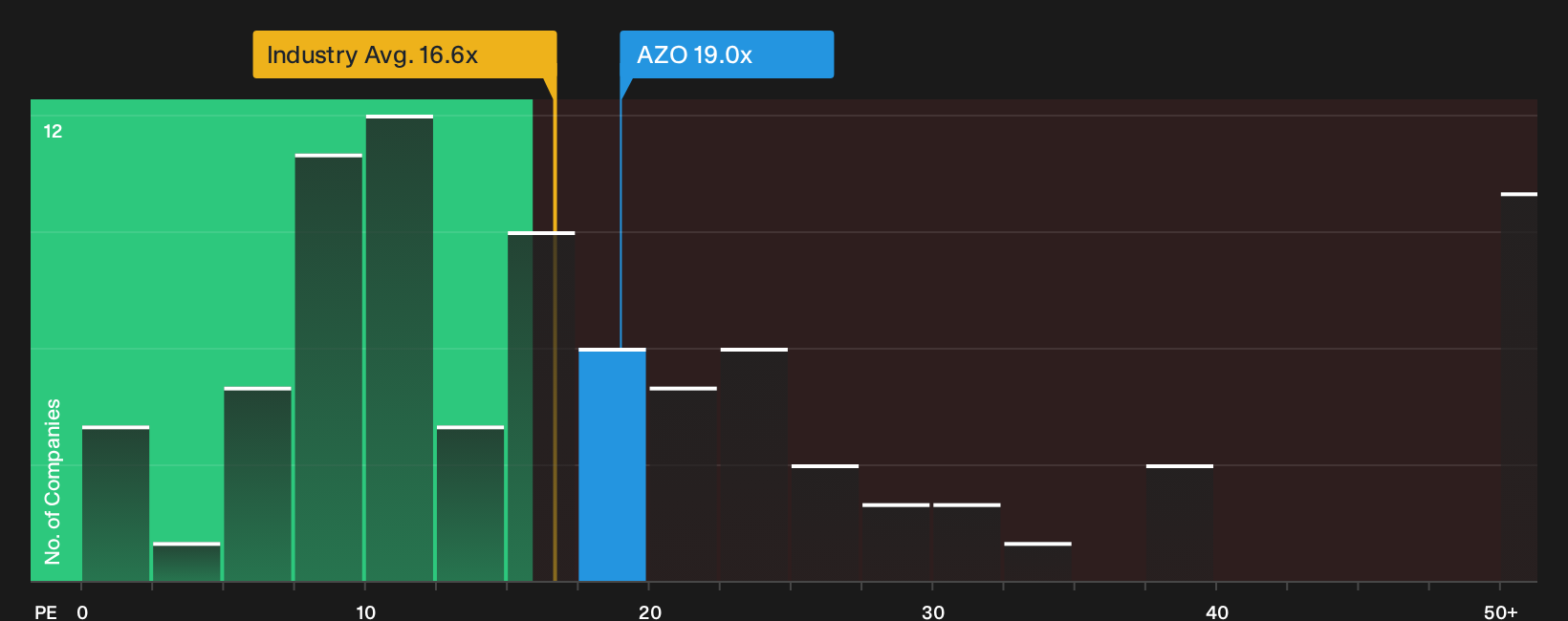
The P/E ratio is often a clean way to judge what you pay for each dollar of AutoZone earnings. On this lens, the stock trades at about 19.0x, above the broader specialty retail average of roughly 16.6x but below a peer group mark near 22.3x.
A more tailored yardstick that blends AutoZone's sector, size and risk profile points to a fair P/E of about 19.7x. That is only slightly above where the equity changes hands today, so the valuation does not signal a clear discount or premium relative to what the model suggests investors might typically be willing to pay.
On the earnings multiple, AutoZone looks roughly fairly valued, with its current P/E sitting close to the level implied by the fair ratio.
See what the numbers say about this price — find out in our valuation breakdown.
The AutoZone Narrative: What Would Justify Today's Price?
AutoZone Narratives on Simply Wall St pick up where the valuation work stops by spelling out which expectations for growth, profitability and earnings would need to hold for the shares to be worth meaningfully more or less than today’s level, and they sit on the company’s Community page.
Each narrative turns that view of fair worth into a clear, trackable thesis about AutoZone’s business so you can see how the logic holds up as new information arrives.
Share a narrative on AutoZone that lays out your number-driven view on the outlook for its growth, margins, and execution, and track how that thesis performs as fresh results and updates roll in over time.
Do you think there's more to the story for AutoZone? Head over to our Community to see what others are saying!
The Bottom Line
AutoZone screens as roughly fairly valued, with the Discounted Cash Flow (DCF) estimate and the P/E based view both clustering near the current share price. That mix points to a setup where the easy valuation win has largely passed and future returns lean more on execution rather than on multiple re rating. What matters most from here is whether AutoZone can keep generating resilient cash flows and earnings that justify investors continuing to pay about this level for the stock.
This article by Simply Wall St is general in nature. We provide commentary based on historical data and analyst forecasts only using an unbiased methodology and our articles are not intended to be financial advice. It does not constitute a recommendation to buy or sell any stock, and does not take account of your objectives, or your financial situation. We aim to bring you long-term focused analysis driven by fundamental data. Note that our analysis may not factor in the latest price-sensitive company announcements or qualitative material. Simply Wall St has no position in any stocks mentioned.
Have feedback on this article? Concerned about the content? Get in touch with us directly. Alternatively, email editorial-team@simplywallst.com