


Leadership Changes Change The Bull Case For UPS Stock?
- United Parcel Service announced a major leadership reshuffle after the retirement of long-time executive Kate Gutmann, appointing Wilfredo Ramos, Nando Cesarone and Matt Guffey to new executive roles while beginning a search for a new Chief Global Commercial Strategy Officer.
- The restructured reporting lines to the CEO and the creation of a global commercial strategy role indicate a sharper focus on international logistics, healthcare and pricing as UPS pursues margin-focused network changes.
- We will now assess how United Parcel Service's refreshed executive team, particularly the new international and healthcare leadership, could influence its investment narrative.
United Parcel Service Investment Narrative Recap
To own United Parcel Service, you have to believe the firm can trade lower margin bulk volume like Amazon for higher quality business while keeping its network running smoothly. The leadership reshuffle appears aimed at tightening execution in international, healthcare and U.S. operations. The catalyst that still matters most in the near term is clean delivery on the large network reconfiguration and cost savings plan.
The largest risk remains operational friction as UPS closes facilities, rebalances routes and absorbs Amazon volume reductions at the same time. The management changes around global operations and domestic leadership appear important but not thesis breaking by themselves. Execution on safety, labor relations and service quality remains central to how this transition develops.
The creation of the Executive Vice President and Chief Global Commercial Strategy Officer role ties directly into the main catalyst. UPS is seeking to lean harder into pricing, product mix and marketing so that the new, leaner network and Amazon reset can translate into better per parcel economics rather than just lower volume.
How well the future commercial chief lines up pricing with capacity, and coordinates with the new international, healthcare and U.S. domestic leaders, will influence whether those planned US$3.5b in annual cost reductions feel like real profit improvement or just a complicated reshuffle. For you, the question is whether this structure improves the odds of disciplined execution on that plan.
United Parcel Service's current earnings are about US$4.6b and analysts project revenue growth of roughly 3.6% a year. This points to forecast revenue of US$100.1b and earnings of US$7.2b by 2029, which implies an earnings increase of about US$2.6b.
Uncover how United Parcel Service's fair value indicates a 16% potential upside to its current price before investors fully account for the leadership and network reset.
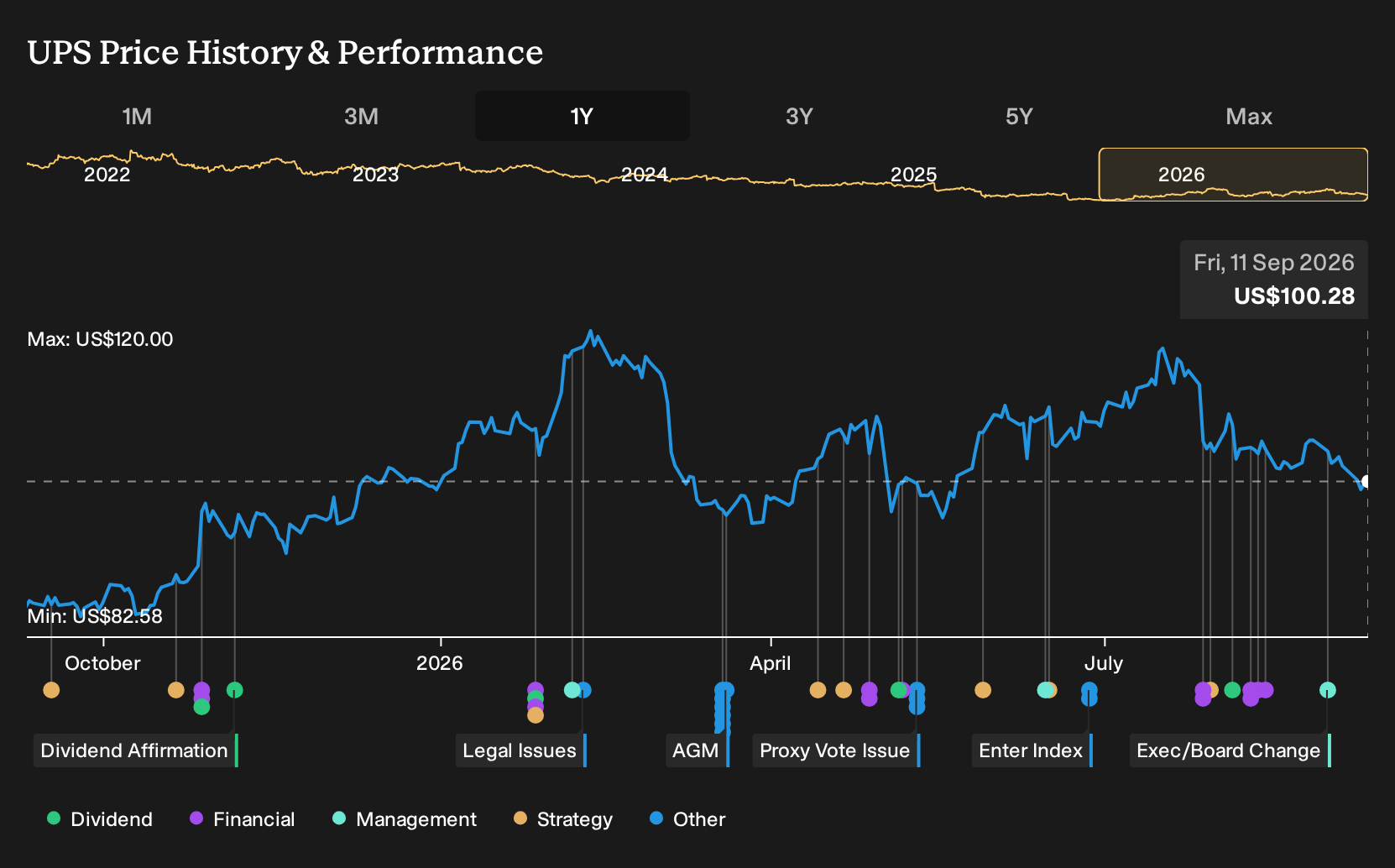
Exploring Other Perspectives
One alternate view on United Parcel Service leans heavily on global trade risk. The most pessimistic analysts were penciling in only 1.3% annual revenue growth to about US$93.4b and earnings of US$6.0b by 2029. That is a far colder outlook than consensus and could shift again as this leadership change beds in.
Explore 10 other United Parcel Service fair value estimates, including one that suggests there may be as much as 15% downside from the current price.
The Verdict Is Yours
Don't just follow the ticker. Dig into the data and build a conviction that's truly your own.
- A great starting point for your United Parcel Service research is our analysis highlighting 2 key rewards and 3 important warning signs that could impact your investment decision.
- See our latest analysis for United Parcel Service. The report includes a comprehensive fundamental analysis summarized in a single visual, the Snowflake, making it easy to evaluate United Parcel Service's overall financial health at a glance.
Looking For More Investment Ideas Beyond United Parcel Service?
Once you have formed a view on United Parcel Service, it can help to compare that thesis with other opportunities that share similar qualities or offer a different risk profile. The Simply Wall St Screener can surface focused shortlists so you are not starting from a blank page each time you research a new stock.
- If capital preservation and steadier profiles matter most to you, start with a group of companies filtered as 11 resilient stocks with low risk scores to see which ones match your comfort level.
- For investors who want stronger financial footing and cleaner balance sheets, consider reviewing a list of solid balance sheet and fundamentals (23 results) that could handle tougher conditions without stressing their finances.
- If you are hunting for lesser-known opportunities with robust fundamentals, scan a 15 high quality undiscovered gems that the wider market might not be paying close attention to yet.
This article by Simply Wall St is general in nature. We provide commentary based on historical data and analyst forecasts only using an unbiased methodology and our articles are not intended to be financial advice. It does not constitute a recommendation to buy or sell any stock, and does not take account of your objectives, or your financial situation. We aim to bring you long-term focused analysis driven by fundamental data. Note that our analysis may not factor in the latest price-sensitive company announcements or qualitative material. Simply Wall St has no position in any stocks mentioned.
Have feedback on this article? Concerned about the content? Get in touch with us directly. Alternatively, email editorial-team@simplywallst.com