


How Investors May Respond To Aon (AON) Reinsurance Platform Launch
- Aon has issued fixed rate notes due 2036 and 2046 with guarantees, call features, and senior unsecured structures as part of a fresh funding move, alongside an M&A update involving USI Insurance Services.
- The push to make a portion of reinsurance broking flow investable through a mini index with Blackstone signals Aon’s attempt to tap third party capital alongside traditional debt funding.
- This article examines how Aon’s investment narrative is affected by this mini index reinsurance platform and related funding activity.
Scan beyond Aon’s bond funding and reinsurance mini index plans by lining up other capital-efficient insurers and brokers on the 11 resilient stocks with low risk scores.
Aon Investment Narrative Recap
To own Aon, you need to be comfortable with a story built on fee-based risk and human capital services, meaningful past earnings growth, and a high forecast return on equity, alongside a heavy reliance on borrowing. The fixed rate notes and mini index plans do not obviously change the near term operating catalyst, which still hinges on integrating prior acquisitions and extracting efficiencies from Aon Business Services.
The main near term risk remains pressure on margins if softer commercial pricing, higher interest costs and currency moves bite at the same time. Fresh fixed income funding adds to the focus on debt and interest expense, so investors will likely watch cash generation and leverage trends even more closely from here.
The fixed rate notes due 2036 and 2046 look most relevant right now. These bonds extend Aon’s maturity profile and add to what is already described as a high level of debt. For equity holders, the key question is whether the underlying cash flow from Risk Capital and Human Capital is strong and stable enough to comfortably support this funding stack.
That is where the reinsurance mini index idea with Blackstone connects back to the catalyst list. If Aon can turn part of its broking flow into a scalable third party capital platform, it could support client demand and fee opportunities while relying less on its own balance sheet to grow. Execution risk is real, but operationally this sits alongside NFP and USI as another lever that could matter for earnings quality over time.
Aon's current analyst narrative points to revenues of $25.3b and earnings of $3.4b by 2029, based on 12.9% yearly top line growth and an earnings decline of $0.5b from $3.9b today to that 2029 consensus level.
Uncover why Aon's fair value indicates a 29% potential upside to its current price before competing buyers reduce that difference.
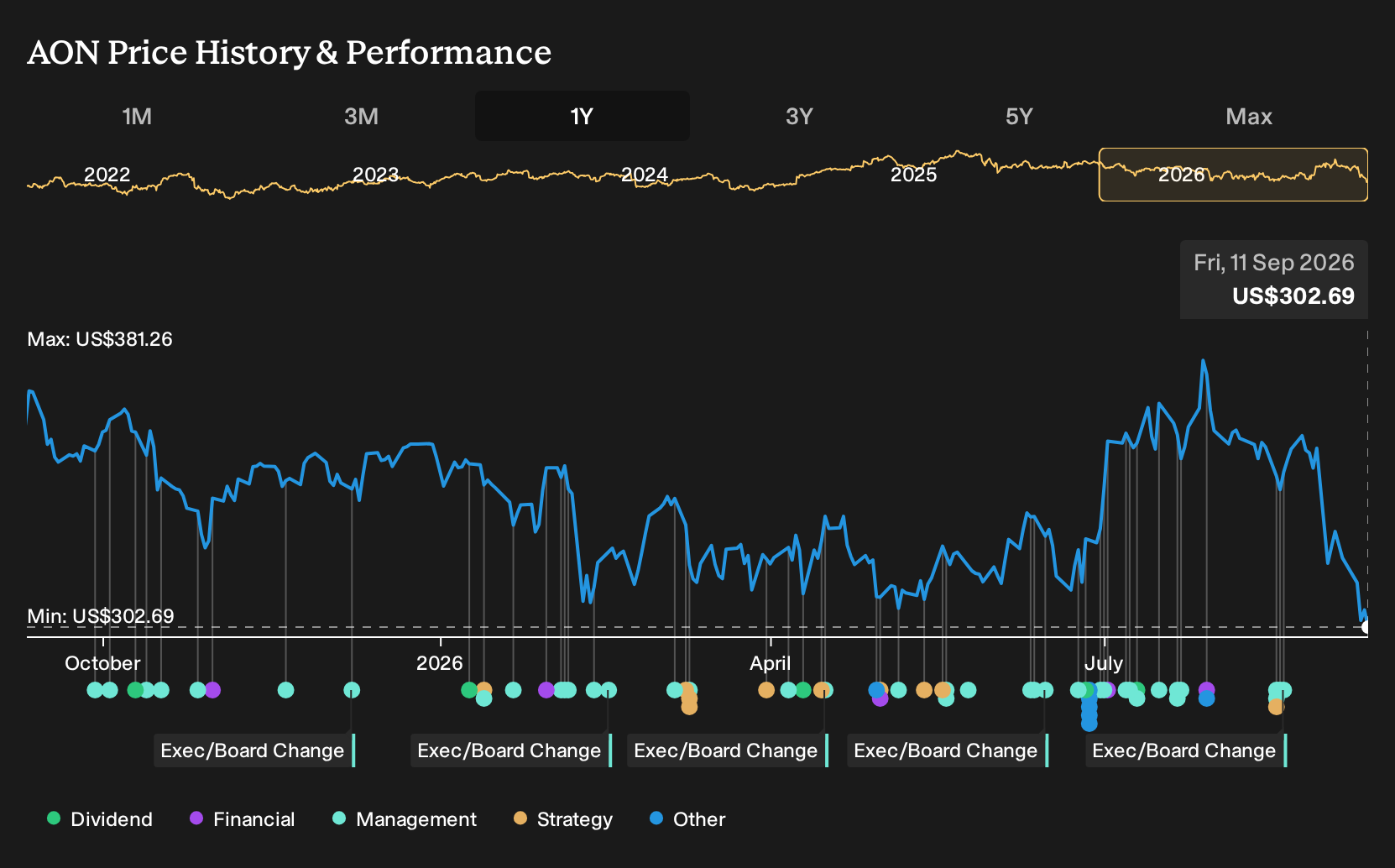
Exploring Other Perspectives
Three fair value estimates from the Simply Wall St Community span roughly US$390 to US$533 per share, so you are looking at a wide band of retail opinion on Aon. These private investors have not yet baked in the new bond issues or the USI and mini index plans, which could change how future cash flows and balance sheet risk are viewed. Use that spread as a prompt to test your own assumptions, then compare them against several contrasting viewpoints before taking a position.
Explore 2 other Aon fair value estimates, including one that suggests it could be worth just $389.53!
Form Your Own Verdict
Disagree with existing narratives? Extraordinary investment returns rarely come from following the herd, so go with your instincts.
- A great starting point for your Aon research is our analysis highlighting 3 key rewards and 2 important warning signs that could impact your investment decision.
- See our latest analysis for Aon. The report includes a comprehensive fundamental analysis summarized in a single visual, the Snowflake, making it easy to evaluate Aon's overall financial health at a glance.
Looking For More Aon Investment Ideas Beyond This Narrative?
If the Aon story has sharpened your thinking about quality, risk and income, it can help to line it up against a wider watchlist built around clear themes. The Simply Wall St Screener lets you filter for balance sheet strength, potential mispricing, or income resilience so you can build a set of comparisons that matches how you like to invest.
- For investors who care most about financial resilience and clean fundamentals, scan a curated list of solid balance sheet and fundamentals (23 results) that can sit alongside Aon in a sturdier core portfolio.
- If your priority is finding companies that may trade below their estimated worth, line up Aon against a targeted 32 high quality undervalued stocks to see where the market might be mispricing quality.
- For readers who lean on income as a key part of returns, compare Aon with a focused 6 dividend fortresses that screens for higher yield paired with stability.
This article by Simply Wall St is general in nature. We provide commentary based on historical data and analyst forecasts only using an unbiased methodology and our articles are not intended to be financial advice. It does not constitute a recommendation to buy or sell any stock, and does not take account of your objectives, or your financial situation. We aim to bring you long-term focused analysis driven by fundamental data. Note that our analysis may not factor in the latest price-sensitive company announcements or qualitative material. Simply Wall St has no position in any stocks mentioned.
Have feedback on this article? Concerned about the content? Get in touch with us directly. Alternatively, email editorial-team@simplywallst.com