


Aeon (TSE:8267) Slides Despite Growth, Is The 4.5% Undervaluation Enough?
Aeon (TSE:8267) has drawn investor attention after a recent price near ¥1,332.5, with the share price down over the past month, past 3 months and year despite positive annual revenue and net income growth.
Aeon’s recent share price slide, with the stock down over the past week and month and a year to date share price return weaker at around 46% lower, points to fading momentum. However, the 3 year and 5 year total shareholder returns of 33.7% and 38.9% indicate that longer term holders have still seen gains.
Compare Aeon’s pullback with other retailers by scanning our hand picked list of list of solid balance sheet and fundamentals (19 results) to see how the broader sector is holding up.
Given Aeon’s slide despite growing revenue and net income, the real tension now is simple. Does the recent drop finally tilt the risk reward in favour of new buyers, or has the valuation still not reset enough?
Most Popular Narrative: 4.5% Undervalued
Aeon’s most followed narrative places fair value near ¥1,396, slightly above the recent close around ¥1,332.5 and framing the recent slide as a modest discount.
Structural demographic and cost challenges in Japan, coupled with aggressive expansion in riskier markets, threaten Aeon's ability to grow profitably and sustainably. Slow adaptation to digitalization and heightened price competition may further erode margins, with store optimization and private brand efforts offering only limited relief.
Want the full story behind that valuation gap? The narrative leans on specific revenue forecasts, slim margin changes and a rich future earnings multiple. The key assumptions are all laid out there.
Result: Fair Value of ¥1,395.56 (UNDERVALUED)
Have a read of the narrative in full and understand what's behind the forecasts.
Still, the narrative can break if Aeon’s digital investments lift productivity faster than expected, or if private brands and overseas units deliver stronger profit resilience.
Find out about the key risks to this Aeon narrative.
Another View on Aeon’s Valuation
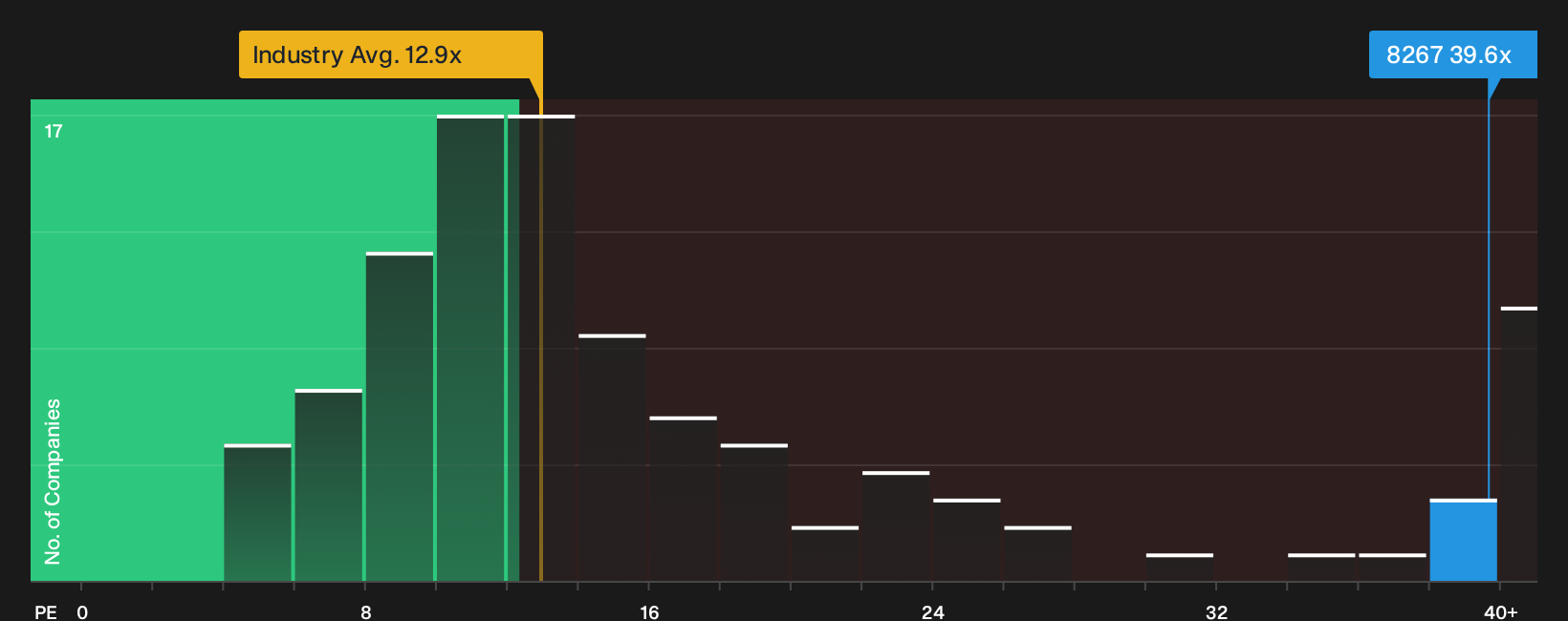
There is a catch. While the most popular Aeon narrative points to a modest 4.5% discount to its fair value near ¥1,396, the P/E tells a very different story. The stock trades around 39.6x earnings, versus 12.8x for the JP Consumer Retailing industry and a fair ratio of 20.2x.
That means investors are paying a much richer multiple than both the sector and the fair ratio that the market could move towards, which raises the risk that any disappointment in earnings or sentiment might hit the share price harder than a more lowly rated peer.
For anyone weighing these competing signals, the key question is simple: Does Aeon really deserve to trade almost twice the fair ratio, or is that gap more fragility than opportunity?
See what the numbers say about this price — find out in our valuation breakdown.
Next Steps
Mixed on Aeon after all this, or starting to lean one way? Move quickly, test the numbers yourself, then weigh the 2 key rewards and 1 important warning sign.
Looking for more investment ideas beyond Aeon?
If Aeon has you rethinking where your next yen goes, use this moment to widen your watchlist with other focused opportunities before they move without you.
- Target resilient cash generators by scanning our 17 high quality undervalued stocks that combine quality fundamentals with prices that still sit below their assessed worth.
- Prioritise sleep at night holdings by reviewing a curated set of 10 resilient stocks with low risk scores that emphasise balance sheet strength and steadier business profiles.
- Spot tomorrow’s potential leaders early by browsing the 73 high quality undiscovered gems that meet strict financial quality filters yet remain off most investors’ radar.
This article by Simply Wall St is general in nature. We provide commentary based on historical data and analyst forecasts only using an unbiased methodology and our articles are not intended to be financial advice. It does not constitute a recommendation to buy or sell any stock, and does not take account of your objectives, or your financial situation. We aim to bring you long-term focused analysis driven by fundamental data. Note that our analysis may not factor in the latest price-sensitive company announcements or qualitative material. Simply Wall St has no position in any stocks mentioned.
Have feedback on this article? Concerned about the content? Get in touch with us directly. Alternatively, email editorial-team@simplywallst.com