


Visa (V) Could Be 88% Overvalued On AI Payments And Onchain Credit Push
Visa (V) is pushing deeper into AI-driven payments, teaming up with Mastercard and Ant International on shared standards for verifying autonomous purchasing agents, while rolling out new blockchain-based onchain credit tools for stablecoin-linked programs.
Recent moves in AI agents, onchain credit and A2A fraud controls are landing against a supportive tape for Visa, with a 90-day share price return of 14.4% and a 3-year total shareholder return of 57.21%. This points to momentum that long-term holders have already seen play out.
Scan beyond Visa and track how other payment and AI infrastructure players are positioning themselves with our curated list of 89 AI infrastructure stocks.
Visa now trades after a strong 90 day run and a 3 year total return above 57%. Does the current valuation still offer an appealing trade off between AI upside and downside risk for new money today?
Most Popular Narrative: 87.7% Overvalued
Visa closed at $370.45 while the most followed fair value narrative, according to Esteban, sits at $197.40 per share. This creates a wide valuation gap that rests on detailed long term cash flow work.
Visa executes steadily on its three-pillar strategy: Consumer Payments volume growing 8-9% in constant dollars driven by secular cash-to-card conversion and cross-border recovery, CMS at ~20% initially decelerating to ~12% by FY30, VAS sustaining 20-25% growth before decelerating to ~15% by FY32 as the business matures. The DOJ antitrust case resolves with a monetary settlement and limited routing adjustments, painful but not structurally disruptive to the debit network economics.
Read the complete narrative. Read the complete narrative.
Want to understand why such strong margin and free cash flow assumptions still lead Esteban to a much lower fair value for Visa than today’s price? The narrative leans on rich profitability, high cash conversion and a specific glide path for revenue growth and value added services that all have to line up. The key inputs are all there, but the punchline on how they compress the valuation sits inside that full write up.
Result: Fair Value of $197.40 (OVERVALUED)
Have a read of the narrative in full and understand what's behind the forecasts.
Still, Visa faces real swing factors, including a harsher outcome in the DOJ case or faster A2A adoption that erodes traditional card economics.
Find out about the key risks to this Visa narrative.
Another View On Visa’s Value
Esteban’s work points to Visa being heavily overvalued at $370.45 versus a fair value of $197.40. Our DCF model takes the opposite side. It estimates future cash flows at $403.78 per share, which implies Visa trades about 8.3% below that mark today. Which framework do you trust more for sizing risk?
Look into how the SWS DCF model arrives at its fair value.
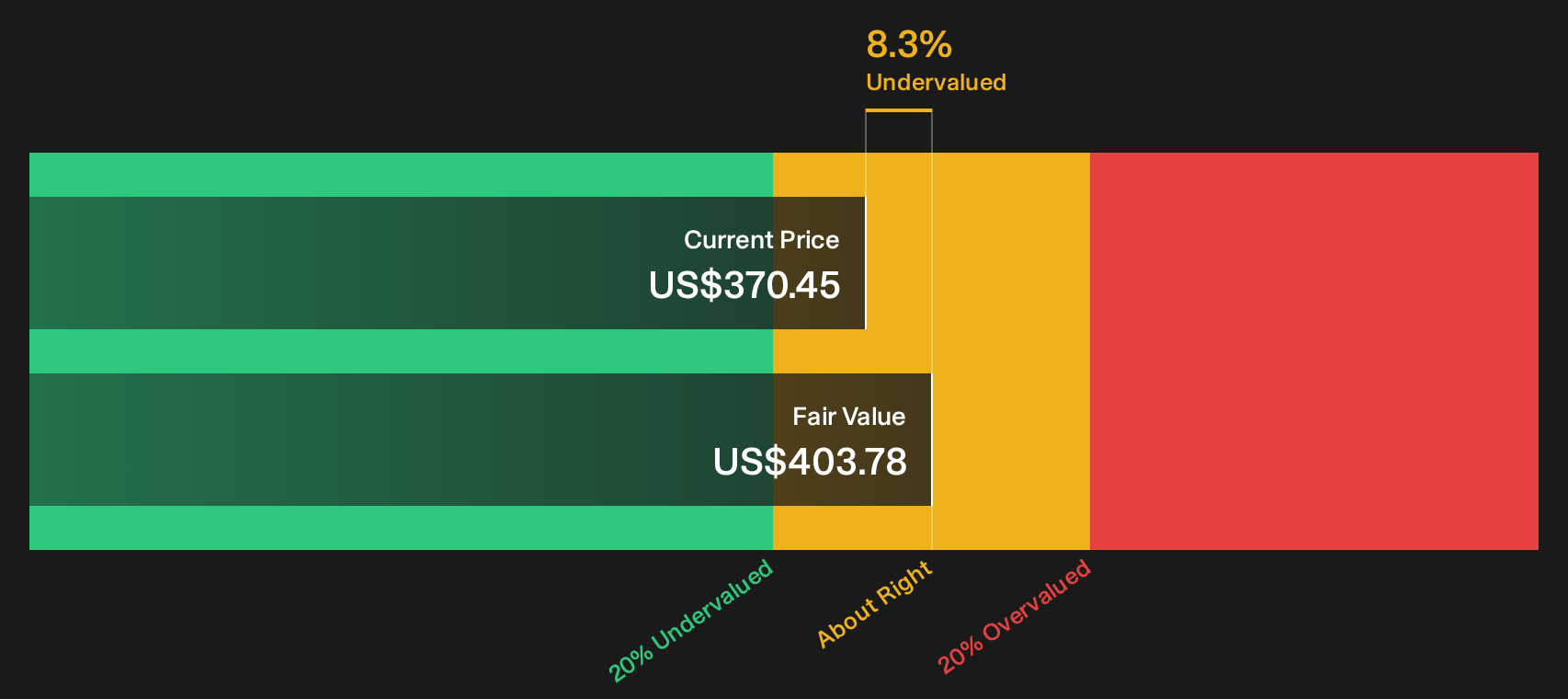
Simply Wall St performs a discounted cash flow (DCF) on every stock in the world every day (check out Visa for example). We show the entire calculation in full. You can track the result in your watchlist or portfolio and be alerted when this changes, or use our stock screener to discover 32 high quality undervalued stocks. If you save a screener we even alert you when new companies match - so you never miss a potential opportunity.
Next Steps
Plenty in this Visa story points both ways, with optimism on AI and concern on legal and structural risks, so move quickly to review the underlying data and weigh the 3 key rewards and 1 important warning sign.
Looking for more ideas beyond Visa?
Do not stop with Visa. Use the screener tools to spot fresh opportunities that match your risk profile, income needs and valuation discipline in minutes.
- Target potential mispricing and hunt for quality at a discount with our 32 high quality undervalued stocks.
- Strengthen portfolio resilience by focusing on balance sheet robustness through the list of solid balance sheet and fundamentals (23 results).
- Hunt for overlooked potential and widen your opportunity set with the 15 high quality undiscovered gems.
This article by Simply Wall St is general in nature. We provide commentary based on historical data and analyst forecasts only using an unbiased methodology and our articles are not intended to be financial advice. It does not constitute a recommendation to buy or sell any stock, and does not take account of your objectives, or your financial situation. We aim to bring you long-term focused analysis driven by fundamental data. Note that our analysis may not factor in the latest price-sensitive company announcements or qualitative material. Simply Wall St has no position in any stocks mentioned.
Have feedback on this article? Concerned about the content? Get in touch with us directly. Alternatively, email editorial-team@simplywallst.com