


Trustmark (TRMK) Could Be 5% Below Fair Value On Its $91.7 Million Sale Leaseback
Trustmark (TRMK) moved after disclosing a $91.7 million sale-leaseback of 34 branches and a securities portfolio reshuffle. The steps generated an estimated $61.5 million pre-tax gain and sharpened focus on asset yields.
The sale leaseback news landed against a share price that has slipped 0.99% on a 1 day basis and 2.37% over 30 days, yet Trustmark still carries a 20.18% year to date share price return and a very large 3 year total shareholder return. This signals that longer term momentum remains intact even as near term sentiment cools slightly.
Scan how other regional financials are repositioning their balance sheets by comparing Trustmark's move with a curated set of list of solid balance sheet and fundamentals (23 results).
Trustmark has just booked a sizeable gain and tilted its balance sheet toward higher yielding assets, yet the share price has cooled in the near term. Investors may now be weighing whether that setup supports taking a position at current levels or waiting for a potentially more attractive entry as valuation comes into clearer focus.
Most Popular Narrative: 4.6% Undervalued
Trustmark's most followed valuation view pegs fair value at $49.25, slightly above the last close of $46.98, which points to a modest undervaluation and puts the recent balance sheet reshuffle in a broader context.
The analysts have a consensus price target of $49.85 for Trustmark based on their expectations of its future earnings growth, profit margins and other risk factors.
In order for you to agree with the analysts, you'd need to believe that by 2029, revenues will be $987.2 million, earnings will come to $242.7 million, and it would be trading on a PE ratio of 13.4x, assuming you use a discount rate of 7.2%.
Want to see what sits behind that fair value call for Trustmark? The narrative leans on measured revenue growth, slightly slimmer margins, and a richer future earnings multiple. Curious which assumptions really carry the weight in that calculation?
Result: Fair Value of $49.25 (UNDERVALUED)
Have a read of the narrative in full and understand what's behind the forecasts.
Still, the Trustmark narrative could be knocked off course if higher credit costs persist or if slower digital progress leaves the bank losing ground to larger peers.
Find out about the key risks to this Trustmark narrative.
Another View On Trustmark's Valuation
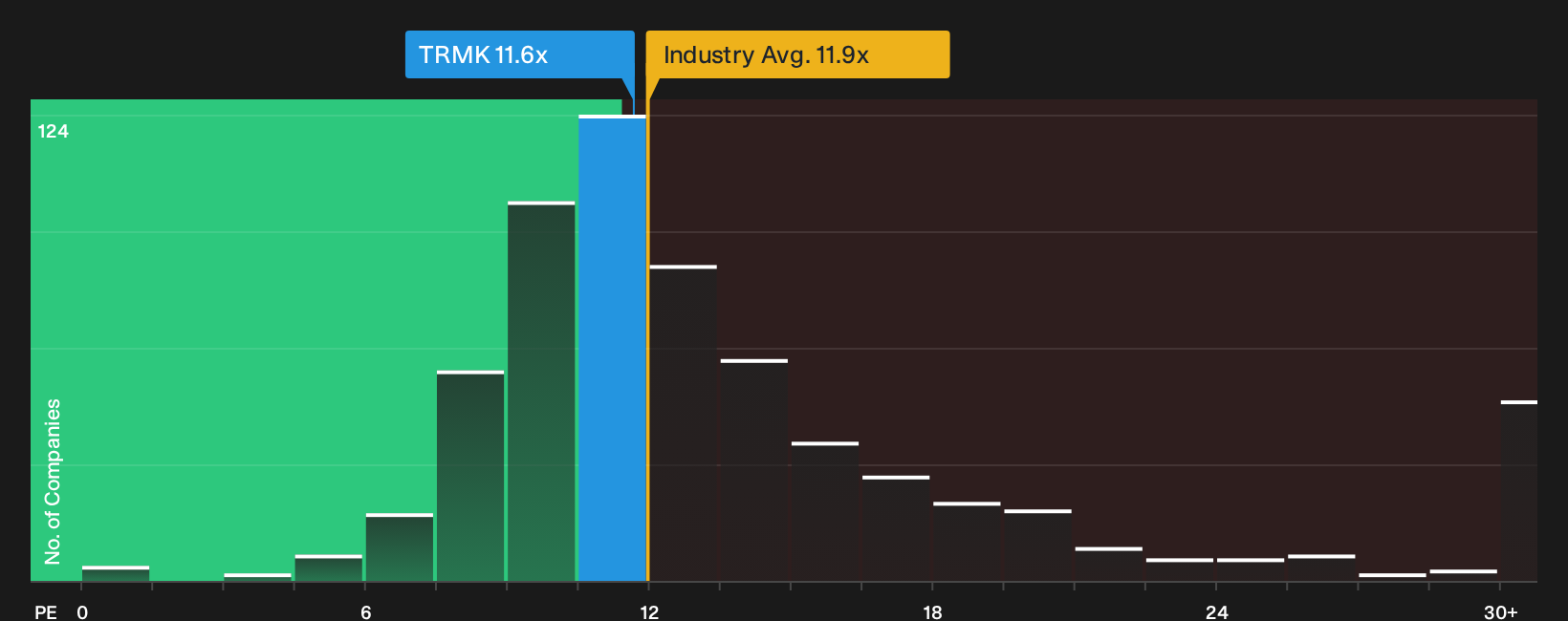
That narrative-driven fair value of $49.25 paints Trustmark as modestly undervalued. The picture changes when the focus shifts to earnings multiples. The shares trade on a P/E of 11.6x, which is slightly cheaper than the US Banks sector at 11.9x but a bit richer than the 10.9x fair ratio. That mix of small discounts and a mild premium raises a simple question for you: Is this closer to a margin of safety or to full pricing with limited room for error?
See what the numbers say about this price — find out in our valuation breakdown.
Next Steps
Sentiment in this Trustmark story is mixed, so do not wait for someone else to decide what it all means. Review the numbers, weigh the optimism around potential rewards, and then check the full breakdown of 3 key rewards.
Looking for more investment ideas beyond Trustmark?
If you only stop at Trustmark, you could miss other setups that match your risk, income, or value goals, so keep widening your opportunity set.
- Target potential mispricing by scanning companies that pair earnings strength with attractive valuations through the 31 high quality undervalued stocks.
- Build steadier income streams by focusing on businesses that offer higher yields and resilient payouts via the 6 dividend fortresses.
- Reduce unwanted surprises by concentrating on businesses with robust financial footing using the 11 resilient stocks with low risk scores.
This article by Simply Wall St is general in nature. We provide commentary based on historical data and analyst forecasts only using an unbiased methodology and our articles are not intended to be financial advice. It does not constitute a recommendation to buy or sell any stock, and does not take account of your objectives, or your financial situation. We aim to bring you long-term focused analysis driven by fundamental data. Note that our analysis may not factor in the latest price-sensitive company announcements or qualitative material. Simply Wall St has no position in any stocks mentioned.
Have feedback on this article? Concerned about the content? Get in touch with us directly. Alternatively, email editorial-team@simplywallst.com