


Voya Financial (VOYA) Stock Looks Fully Priced Near Fair Value
Voya Financial stock has delivered an 84.1% total return over the past five years, yet the core valuation checks now suggest it is closer to fairly priced than obviously cheap. The Excess Returns intrinsic value estimate and the market multiples both point to a price that sits roughly in line with what the underlying business currently supports.
- That 84.1% gain over five years leaves Voya Financial looking more like a mature compounder, rather than a recovery story that still trades at distressed levels.
- Future gains can be influenced by how efficiently the business converts its asset and fee base into steady cash flow. Any setback in underwriting or investment performance may compress the value investors are willing to ascribe.
- The broader checks give Voya Financial a 2 out of 6 value score, which leans to the stock being on the expensive side rather than a clear bargain.
The issue now is whether the current price already reflects most of what the Excess Returns model and the market-based metrics see in Voya Financial, or if there is still room for a valuation edge.
Scan beyond Voya Financial and compare it with 31 high quality undervalued stocks that financial models suggest may offer a more attractive gap between price and underlying business quality.
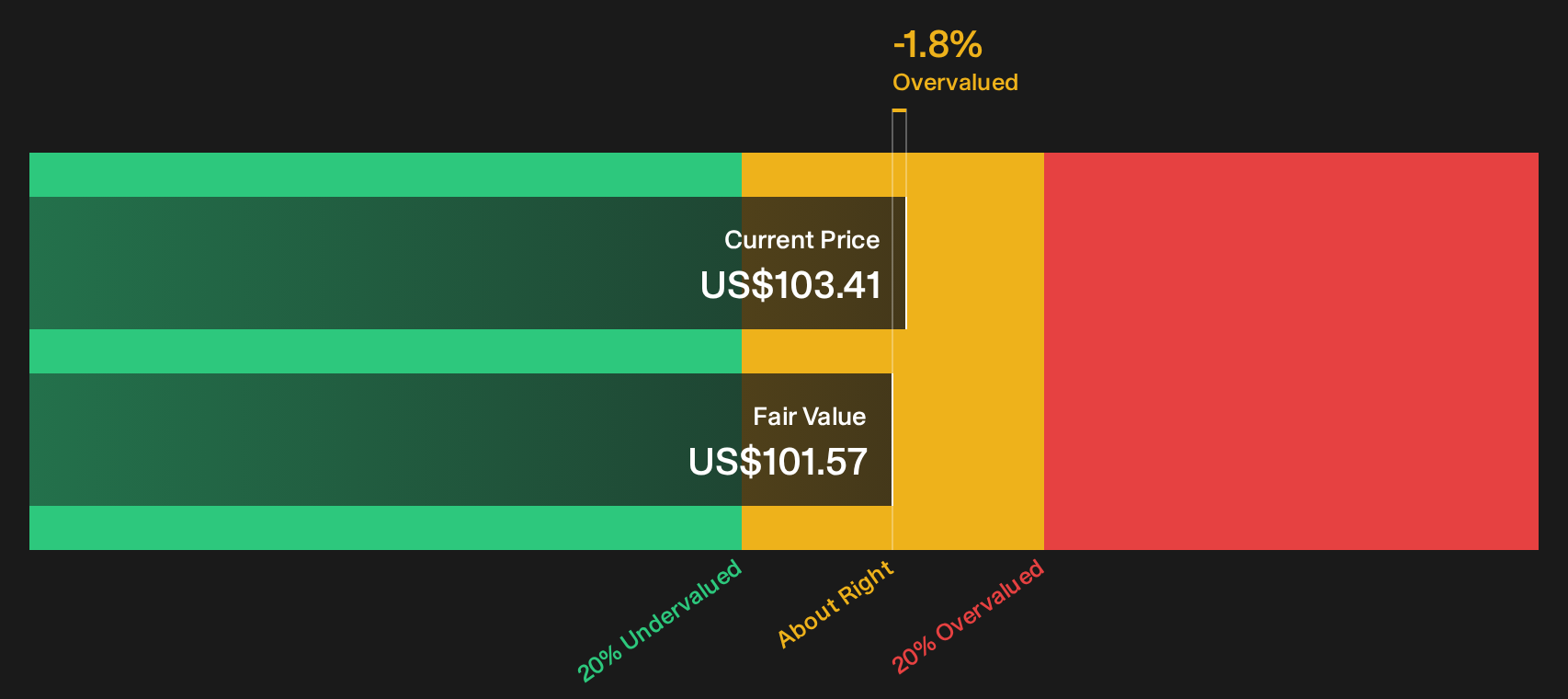
Is Voya Financial Fairly Priced on Excess Returns?
The Excess Returns model asks whether Voya Financial earns more on its equity base than investors require, then capitalizes that surplus into an intrinsic value estimate. For Voya Financial, the framework leans on a Book Value of $51.72 per share and an Average Return on Equity of 11.52%, which translates into Stable EPS of $6.60 per share based on the past five years of profitability.
With a Cost of Equity of $4.65 per share and an Excess Return of $1.95 per share, the analysis assumes the business can keep generating returns above its funding cost on a Stable Book Value of $57.32 per share that reflects analyst expectations. These inputs feed into an Excess Returns value of $101.57 per share, which sits only slightly below the current share price and implies the stock is about 1.8% overvalued on this lens.
On the Excess Returns math, Voya Financial looks roughly fairly valued with only a small tilt toward being overvalued at today’s price.
Voya Financial is fairly valued according to our Excess Returns, but this can change at a moment's notice. Track the value in your watchlist or portfolio and be alerted on when to act.
Does Voya Financial Look Fairly Valued on Earnings?
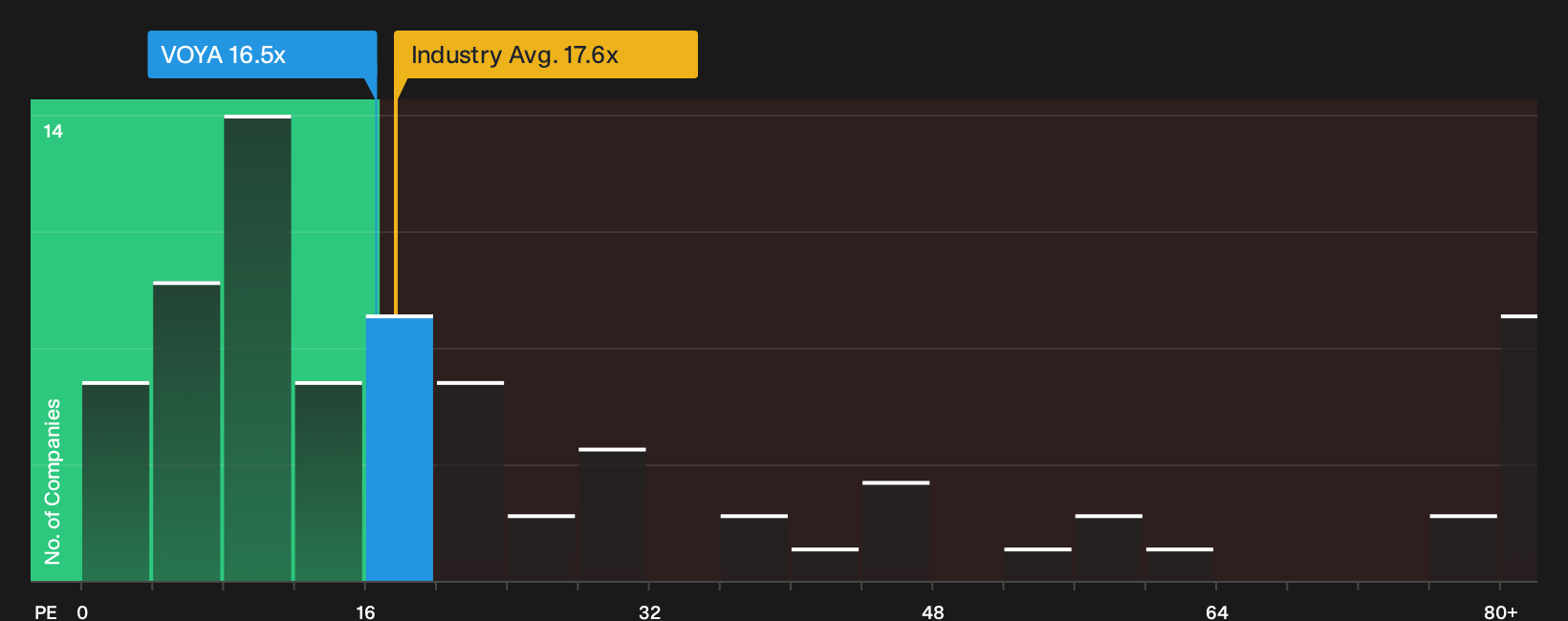
P/E suits Voya Financial because earnings are a core metric for fee driven financial groups where reported profit ties closely to shareholder value. The stock trades on a P/E of 16.5x, which is slightly below the diversified financial industry average of 17.6x and far below the broad peer group average of 61.6x. That positions the current price in a middle ground where investors are not paying a clear premium, but the shares also do not screen as obviously cheap against comparable businesses.
The Fair Ratio for Voya Financial sits at 16.0x, which is almost directly in line with the current multiple. That small gap suggests the market is roughly matching the P/E that the model would expect based on the company’s size, profitability profile and risk. Taken together, the P/E evidence points to Voya Financial trading at a level that looks broadly in line with a fair earnings based valuation.
See what the numbers say about this price — find out in our valuation breakdown.
The Voya Financial Narrative: What Would Justify Today's Price?
Simply Wall St Narratives for Voya Financial pick up where the valuation work stops and turn that puzzle into a set of clear future assumptions you can actually monitor. Narratives for Voya Financial show what levels of growth, profitability and earnings power would need to play out for the share price to move meaningfully higher or lower from here. Where a ratio or model gives one figure, these narratives describe the business path that number depends on so you can see whether reality lines up over time.
Opinion on Voya Financial splits sharply, with one camp focused on digital growth and capital return while the other fixates on Stop Loss volatility and execution risk.
Bull case: roughly fairly valued
"Voya's continued investments in digital transformation, including automation, AI adoption, and expansion of its integrated benefits platform, are improving customer experience and lowering operational costs, providing the potential for durable margin expansion and higher long-term earnings…"
Read the full Bull Case to see why Voya Financial could be undervalued
Bear case: 15% overvalued
"Reliance on elevated Stop Loss pricing, including approximately 24% rate increases on the 2026 book, could be difficult to sustain if medical trend moderates…"
Read the full Bear Case to see why Voya Financial could be overvalued
Do you think there's more to the story for Voya Financial? Head over to our Community to see what others are saying!
The Bottom Line
On the numbers, Voya Financial looks roughly fairly valued, with the Excess Returns intrinsic value estimate and the current P/E both pointing to pricing that is close to what the business fundamentals support. The stronger signal is that there is no clear valuation cushion, which means execution on digital initiatives, capital returns and underwriting discipline matters more than multiple expansion from here. The real swing factor is whether Voya Financial can keep earning returns on equity that comfortably exceed its funding cost without leaning too hard on Stop Loss pricing that might prove difficult to maintain.
This article by Simply Wall St is general in nature. We provide commentary based on historical data and analyst forecasts only using an unbiased methodology and our articles are not intended to be financial advice. It does not constitute a recommendation to buy or sell any stock, and does not take account of your objectives, or your financial situation. We aim to bring you long-term focused analysis driven by fundamental data. Note that our analysis may not factor in the latest price-sensitive company announcements or qualitative material. Simply Wall St has no position in any stocks mentioned.
Have feedback on this article? Concerned about the content? Get in touch with us directly. Alternatively, email editorial-team@simplywallst.com