


Does Debt Offering Change The Bull Case For Thomson Reuters Stock (TSX:TRI)?
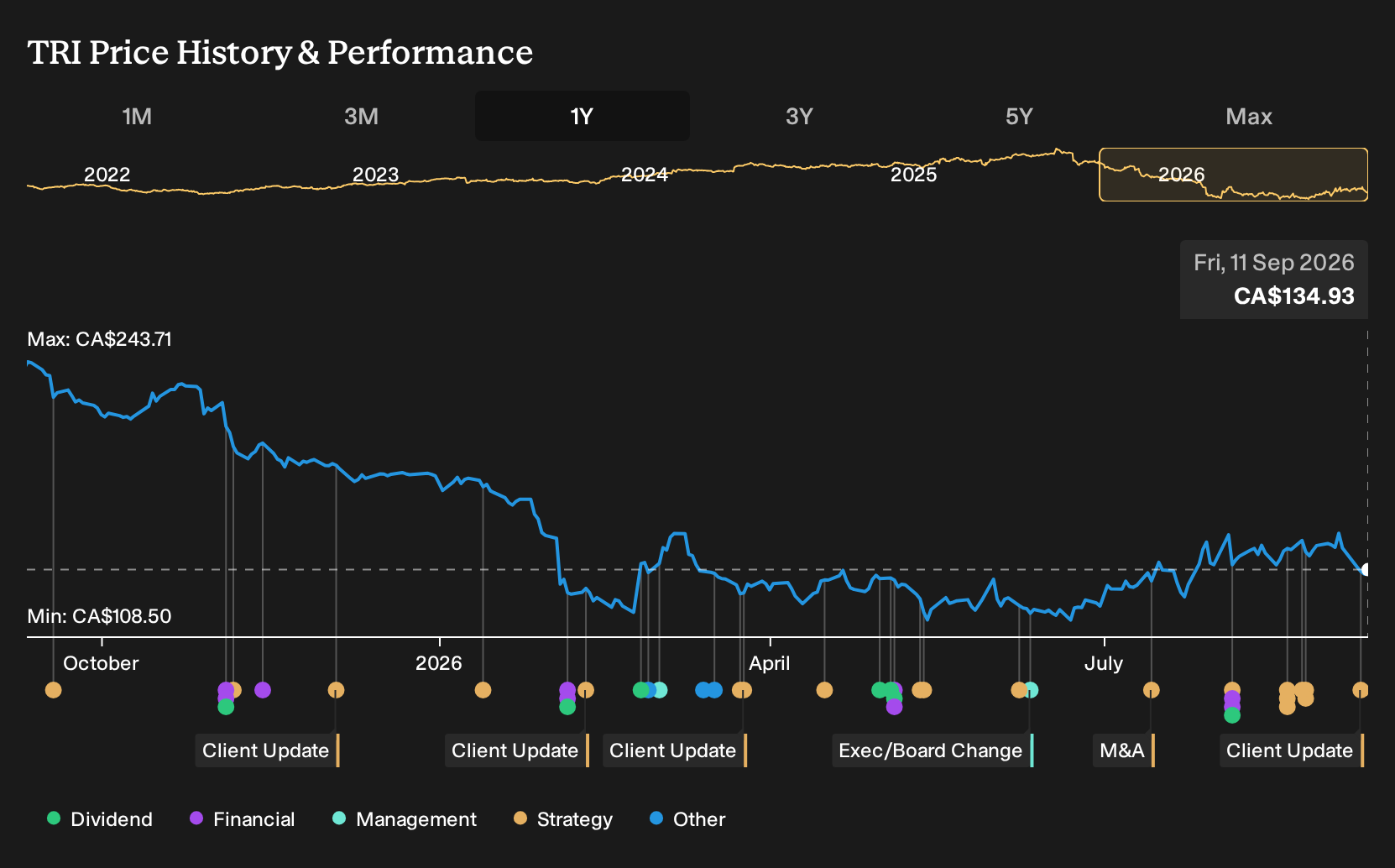
- Medius AB previously announced an integration of Thomson Reuters ONESOURCE indirect tax determination into its AP Automation platform, while Thomson Reuters also priced US$800 million of 5.100% notes due 2028 and C$1 billion of Canadian notes, with proceeds earmarked for general corporate purposes including commercial paper repayment.
- The new tax integration and large-scale debt funding together highlight how Thomson Reuters is pushing deeper into embedded tax workflows, while at the same time reshaping its funding mix and liquidity toolkit.
- We will now assess how Thomson Reuters' sizable new debt issuance could interact with its broader investment narrative around workflow automation.
Scan how Thomson Reuters is wiring itself into automated tax workflows, then widen your radar with list of solid balance sheet and fundamentals (7 results), which is built to handle complex compliance and invoice volumes at scale.
Thomson Reuters Investment Narrative Recap
To own Thomson Reuters, you need to believe it can keep turning deep legal and tax content into workflow tools that customers treat as infrastructure. The Medius AP integration reinforces that story on the tax side, plugging ONESOURCE more tightly into clients’ daily processes. The new debt issue looks more like balance sheet housekeeping than a swing factor for near term trading.
The near term swing factor still sits in execution on AI and workflow automation across Legal Professionals and Tax, Audit & Accounting. The main risk remains rising competition from AI focused rivals and in house tools, which could pressure pricing and slow uptake if Thomson Reuters fails to keep its products clearly ahead.
The Medius AP Automation integration with ONESOURCE tax determination is the announcement that matters most here. It shows Thomson Reuters finding more embedded points inside finance workflows, where accurate, jurisdiction level tax checks are hard to replicate and become very sticky once implemented.
For catalysts, this kind of embedded deployment supports the broader push into agentic AI and automated compliance flows, especially as e invoicing mandates spread. Execution risk is real. The firm still has to keep integrations simple for customers and avoid overload from parallel partnerships and acquisitions that could strain product focus.
Thomson Reuters' current analyst story lines up around revenues of $9.9b and earnings of $2.4b by 2029, which implies forecast revenue growth of 8.3% a year and an earnings increase of about $700m from earnings today of $1.7b.
Uncover how Thomson Reuters' fair value indicates a 29% potential upside to its current price before that discount closes and the window narrows.
Exploring Other Perspectives
One alternate view focuses on risk in the government and corporate arms of Thomson Reuters. The most cautious analysts, working with revenue of about $9.4b and earnings of $2.3b by 2029, see contract downgrades and sales missteps as real threats. They have not yet factored this Medius partnership or the new debt raise into their story. As a result, you should expect opinions to shift as fresh information feeds in and explore how different forecasts might fit your own expectations.
Explore 6 other Thomson Reuters fair value estimates, including one that suggests it could be worth just CA$153.96.
Reach Your Own Conclusion
Disagree with existing narratives? Extraordinary investment returns rarely come from following the herd, so go with your instincts.
- A great starting point for your Thomson Reuters research is our analysis highlighting 3 key rewards and 1 important warning sign that could impact your investment decision.
- See our latest analysis for Thomson Reuters. The report includes a comprehensive fundamental analysis summarized in a single visual, the Snowflake, making it easy to evaluate Thomson Reuters' overall financial health at a glance.
Looking for more investment ideas beyond Thomson Reuters?
Once you understand how Thomson Reuters fits into your portfolio, it can help to compare it with other companies that offer different profiles in terms of valuation, balance sheet resilience, and income potential.
- If you want a wider field of potential bargains with strong fundamentals, scan our 9 high quality undiscovered gems and see which businesses match your checklist.
- For steadier profiles that aim to keep risk in check, review the 1 resilient stocks with low risk scores and compare their metrics to what you see at Thomson Reuters.
- If income is a priority, expand your watchlist with the 2 dividend fortresses and look for yields and payout histories that suit your goals.
This article by Simply Wall St is general in nature. We provide commentary based on historical data and analyst forecasts only using an unbiased methodology and our articles are not intended to be financial advice. It does not constitute a recommendation to buy or sell any stock, and does not take account of your objectives, or your financial situation. We aim to bring you long-term focused analysis driven by fundamental data. Note that our analysis may not factor in the latest price-sensitive company announcements or qualitative material. Simply Wall St has no position in any stocks mentioned.
Have feedback on this article? Concerned about the content? Get in touch with us directly. Alternatively, email editorial-team@simplywallst.com