


Rolls Royce (LSE:RR.) Stock Could Be 21% Overvalued Despite Indiana Expansion
Rolls-Royce Holdings has delivered a very large 5 year gain that now meets a less generous valuation read, with the Discounted Cash Flow (DCF) estimate pointing to the shares trading at a premium while market based multiples look roughly in line and the broader value score leans expensive.
- The stock is up very sharply over 5 years, which means a lot of optimism is already reflected in the current share price.
- The completed US$1b investment in the Indiana manufacturing campus, together with the B-52 engine contract, can support long term cash flow. Any hit to defense budgets or program timing remains a key risk for how much of that cash ultimately reaches shareholders.
- The broader valuation checks suggest the shares are not a clear bargain. The value score of 1 out of 6 indicates more things screen expensive than cheap right now.
For investors, the debate is whether Rolls-Royce Holdings now simply reflects its improved prospects or whether recent enthusiasm has pushed the valuation beyond a level that current fundamentals can comfortably support.
Pressure test the Rolls-Royce Holdings story against other defense and industrial plays by scanning our hand picked list of solid balance sheet and fundamentals stocks screener (10 results)
Has Rolls-Royce Holdings Run Too Far on Cash Flow?
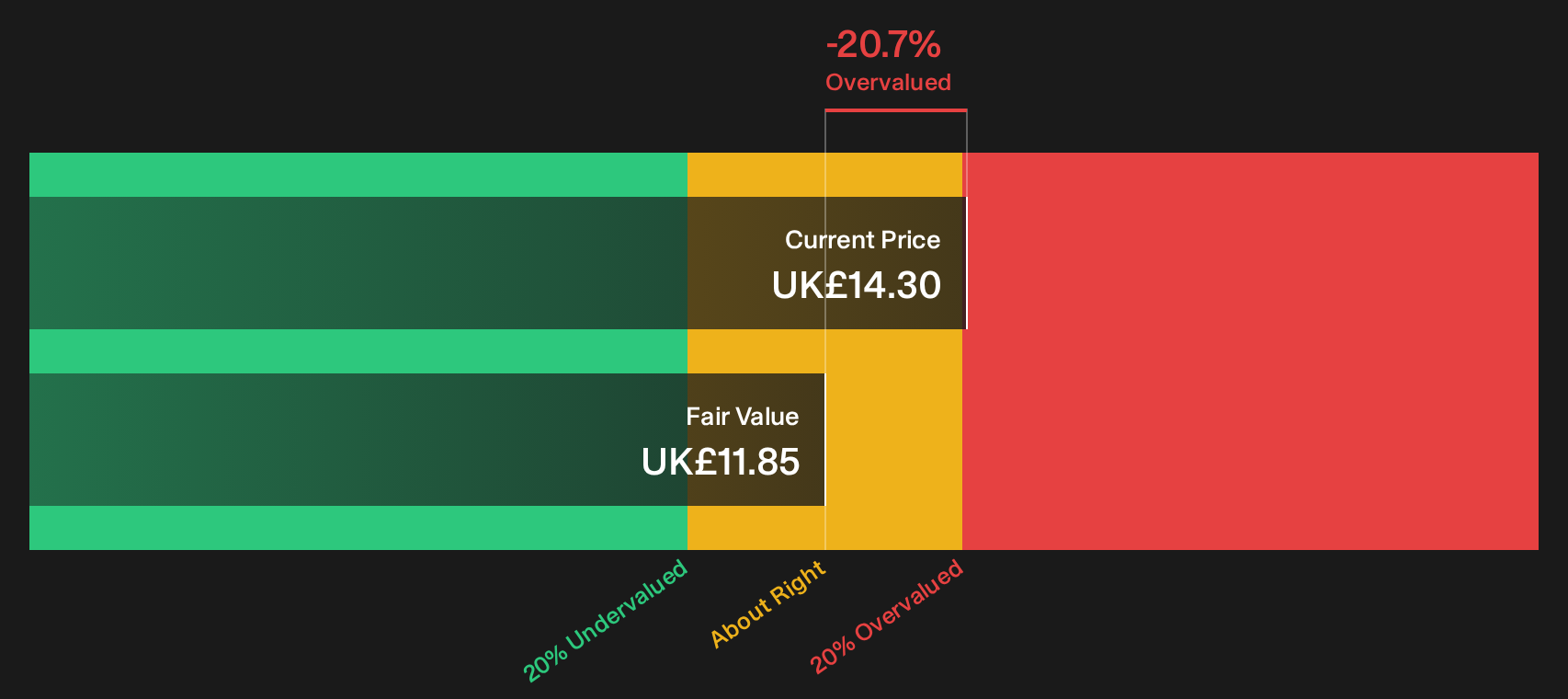
The Discounted Cash Flow (DCF) model estimates what Rolls-Royce Holdings is worth based on the cash it is expected to generate for shareholders. Latest twelve month free cash flow is about £4.1b, and the projections in this 2 Stage Free Cash Flow to Equity framework assume growing cash generation rather than a shrinkage story. On those inputs, the model points to an intrinsic value of roughly £11.85 per share.
That valuation sits below the current market price, implying the stock screens about 20.7% overvalued on this cash flow view. The completed £1b Indiana manufacturing investment and the related B 52 engine work help explain why investors are confident, because they support future cash flow in the model even if not all of it ultimately flows through to equity holders.
On this DCF run, Rolls-Royce Holdings looks overvalued relative to what its projected cash flows alone appear to justify.
Our Discounted Cash Flow (DCF) analysis suggests Rolls-Royce Holdings may be overvalued by 20.7%. Discover 10 high quality undervalued stocks or create your own screener to find better value opportunities.
Is Rolls-Royce Holdings Fairly Priced on Earnings?
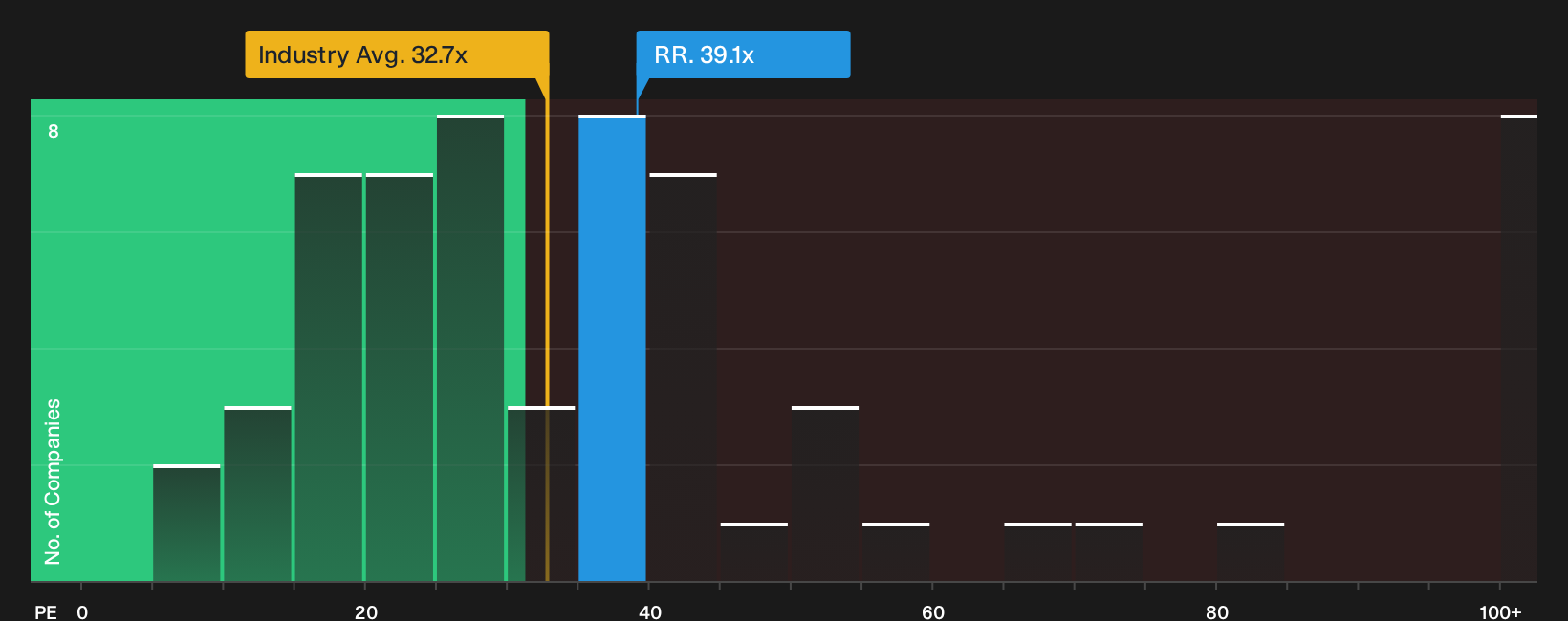
P/E suits Rolls-Royce Holdings because earnings remain a core anchor for how investors frame the business today. The current P/E sits around 39.1x, which is slightly above the peer average near 26.9x and a touch below the wider Aerospace & Defense industry at roughly 41.6x. On a simple comparison, the stock trades richer than many direct peers but not out of line with the broader group.
The fair P/E from the model is about 38.4x, which is very close to where Rolls-Royce Holdings trades now. That indicates the current earnings multiple already reflects the mix of its margins, growth profile, size and risk, without a clear discount or a glaring premium versus that tailored benchmark.
On the P/E yardstick, Rolls-Royce Holdings looks priced roughly in line with what its current fundamentals and risk profile would suggest.
See what the numbers say about this price — find out in our valuation breakdown.
The Rolls-Royce Holdings Narrative: What Would Justify Today's Price?
Simply Wall St Narratives for Rolls-Royce Holdings pick up where the valuation puzzle leaves off. They spell out which expectations on Rolls-Royce Holdings' growth, profitability and earnings would need to hold for the shares to be worth meaningfully more or less than today's price, on the Community page. Rather than relying on a single model output, each narrative lays out its own fair value assumptions so you can track how those hypotheses compare with future reported results.
Community views on Rolls-Royce Holdings split sharply between a repaired engine of growth and a cycle that already looks fully priced in.
Bull case: 17% undervalued
"Substantial growth opportunities in Power Systems (especially from surging data center demand) and civil/defense aerospace with large backlogs, double-digit order intake growth, and high recurring revenues underscore greater earnings visibility and revenue resilience into the late 2020s and beyond…"
Read the full Bull Case to see why Rolls-Royce Holdings could be undervalued
Bear case: roughly fairly valued
"One honest catch: even the optimists expect profits to dip a bit over the next few years, because last year's profit margins were unusually high and will likely settle down…"
Read the full Bear Case to see why Rolls-Royce Holdings could be overvalued
Do you think there's more to the story for Rolls-Royce Holdings? Head over to our Community to see what others are saying!
The Bottom Line
For Rolls-Royce Holdings, the Discounted Cash Flow (DCF) work flags the equity as overvalued, while the P/E cross check suggests pricing that is roughly in line with peers and business quality. The broader value score leans weak, so the cleaner read is that expectations have moved ahead of what current cash flow assumptions comfortably support, even if earnings multiples do not look extreme.
The main question from here is whether cash generation and margins can match the optimism embedded in both the DCF inputs and today’s earnings multiple, or whether any disappointment on those cash flows leaves little valuation buffer.
This article by Simply Wall St is general in nature. We provide commentary based on historical data and analyst forecasts only using an unbiased methodology and our articles are not intended to be financial advice. It does not constitute a recommendation to buy or sell any stock, and does not take account of your objectives, or your financial situation. We aim to bring you long-term focused analysis driven by fundamental data. Note that our analysis may not factor in the latest price-sensitive company announcements or qualitative material. Simply Wall St has no position in any stocks mentioned.
Have feedback on this article? Concerned about the content? Get in touch with us directly. Alternatively, email editorial-team@simplywallst.com