


How Investors May Respond To Texas Pacific Land Stock After Saudi Supply Fears
- Texas Pacific Land and several other oil related stocks reacted to a past spike in crude prices after missile and drone attacks disrupted Saudi Arabian energy facilities and raised concerns about global supply reliability.
- The crude move directly affects Texas Pacific Land’s royalty and water businesses, because activity and economics across its Permian Basin acreage are closely tied to operator cash generation and drilling appetite.
- We will now examine how Texas Pacific Land's investment narrative relates to periods of higher crude prices associated with fears of Middle East supply disruptions.
Scan other oil linked plays reacting to the same Saudi supply scare by zeroing in on our curated shortlist of 39 power grid technology and infrastructure stocks that could feel the ripple effects of higher crude.
Texas Pacific Land Investment Narrative Recap
To own Texas Pacific Land, you need to be comfortable with a business model tied tightly to activity in the Permian Basin and to long term hydrocarbon development there. The spike in crude after the Saudi attacks feeds directly into royalty and water economics, but the key near term swing factor is still how aggressively operators drill and complete wells on TPL acreage.
The biggest operational risk remains concentration in one basin and in oil linked activity, while longer term decarbonization and potential regulatory pressure hang in the background. Higher crude today may support near term cash generation for operators, yet it does not remove concerns about water regulation, ESG driven capital shifts, or future reserve maturity.
Recent commentary around Texas Pacific Land has focused on its royalty and water segments rather than new corporate moves, so the Saudi disruption mainly intersects with TPL through commodity pricing. That price spike can improve operator cash flow and may support completion schedules, which flows through to TPL via royalty volumes and water handling demand.
Those same events also highlight why some investors worry about long dated oil exposure. The thesis around diversified income streams like easements, fixed fee SLEM contracts and produced water royalties matters more when geopolitical shocks put long term demand, regulation and ESG pressure back in focus, because it frames how TPL might handle periods when commodity pricing is less favorable.
Texas Pacific Land's current analyst narrative points to revenue of about US$1.3b and earnings of US$837.1 million by 2029, based on an assumed 17.2% yearly revenue growth rate and a move in profits from US$503.6 million today to that US$837.1 million figure, which is roughly a 66% earnings increase on the current level.
Uncover why Texas Pacific Land's fair value indicates a 22% potential upside to its current price, which could narrow quickly.
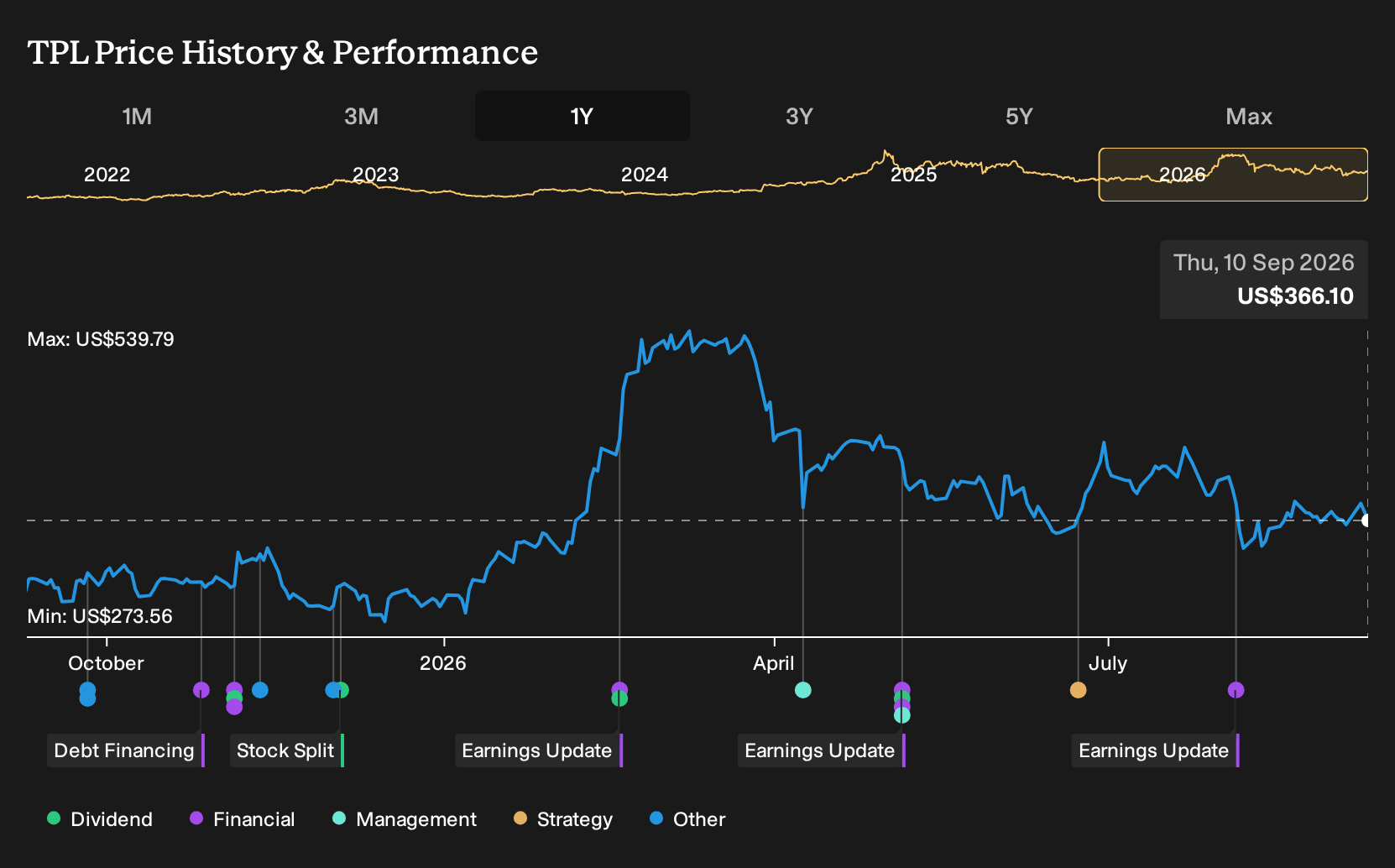
Exploring Other Perspectives
One alternate view on Texas Pacific Land puts more weight on a prolonged cool down in Permian drilling, even before this Saudi supply shock. The most cautious analysts were penciling in revenue growth of about 14% a year and earnings of roughly US$822.9 million by 2029. That is a much more subdued story. These estimates all predate the latest crude price spike, so it is reasonable to expect that some of these narratives may shift, and it is worth comparing several viewpoints before deciding how you feel about the stock.
Explore 5 other Texas Pacific Land fair value estimates, including one that suggests as much as 33% downside from the current price.
Decide For Yourself
Don't just follow the ticker; dig into the data and build a conviction that's truly your own.
- A great starting point for your Texas Pacific Land research is our analysis highlighting 3 key rewards and 1 important warning sign that could impact your investment decision.
- See our latest analysis for Texas Pacific Land. The report includes a comprehensive fundamental analysis summarized in a single visual, the Snowflake, making it easy to evaluate Texas Pacific Land's overall financial health at a glance.
Looking For More Ideas Beyond Texas Pacific Land?
Texas Pacific Land may be front of mind today, but your portfolio decisions usually feel stronger when you compare it with a few other opportunities that share similar qualities. The Simply Wall St Screener can help you quickly surface different types of stocks that match how you like to invest.
- If you care most about value and quality together, use the screener to focus on companies that trade below their estimated worth with sturdy fundamentals by running a search across 33 high quality undervalued stocks.
- If steadier balance sheets help you sleep better at night, filter for businesses with low leverage and solid fundamentals using a curated list of solid balance sheet and fundamentals (23 results).
- If you are hunting for underfollowed opportunities with robust metrics, broaden your research with a targeted set of 18 high quality undiscovered gems.
This article by Simply Wall St is general in nature. We provide commentary based on historical data and analyst forecasts only using an unbiased methodology and our articles are not intended to be financial advice. It does not constitute a recommendation to buy or sell any stock, and does not take account of your objectives, or your financial situation. We aim to bring you long-term focused analysis driven by fundamental data. Note that our analysis may not factor in the latest price-sensitive company announcements or qualitative material. Simply Wall St has no position in any stocks mentioned.
Have feedback on this article? Concerned about the content? Get in touch with us directly. Alternatively, email editorial-team@simplywallst.com