


Texas Instruments (TXN) Raises Chip Prices, Is The Pullback A Buying Opportunity?
Texas Instruments pricing move and stock reaction
Texas Instruments (TXN) has begun raising chip prices as semiconductor demand firms up, with management indicating the changes should start affecting reported results from the third quarter of 2026 onward.
The move puts the company in line with peers such as Analog Devices and ON Semiconductor, which have already adjusted pricing. This gives investors another lens beyond shipment volumes when assessing Texas Instruments and its recent share performance.
Recent action has been choppy. Texas Instruments shares are down 7.97% on a 30‑day share price basis and 14.05% over 90 days, yet the year to date share price return of 45.80% and 1‑year total shareholder return of 44.03% point to momentum that has cooled in the short term while remaining strong over a longer horizon.
That mix fits the current news flow. Investors have been weighing the recent price increases, the planned Silicon Labs acquisition and expectations for stronger semiconductor demand in the second half of 2026. Together, these factors have shifted attention toward how much of that earlier share price strength already reflects these potential revenue and margin levers.
Surf 89 AI infrastructure stocks to see which chipmakers, including peers to Texas Instruments, are being rewarded most for pricing power tied to rising semiconductor demand.For Texas Instruments, recent price increases, a pending deal and a strong longer term share run are all reflected in the current quote. Do you buy now, or wait for a cheaper entry before the valuation work stacks up?
Most Popular Narrative: 40.6% Undervalued
Texas Instruments last closed at $258.82, while the most followed valuation story on Simply Wall St argues for a fair value of $435.69, which frames the recent pullback in a very different light.
Texas Instruments is in the midst of a multiyear capacity-expansion cycle that is temporarily suppressing free cash flow but materially enhancing the company’s long-term competitive position. The buildout of U.S.-based 300mm analog manufacturing is expected to structurally improve cost efficiency, support higher gross margins, and increase supply-chain resilience. As these assets ramp and utilization normalizes, TXN should regain its historical free-cash-flow profile, supported by diversified end-market exposure across industrial, automotive, aerospace/defense, and energy infrastructure.
Want to understand why this narrative sees such a wide gap to today’s share price? It leans heavily on richer margins, sturdier cash generation and a premium earnings multiple. Curious which specific long term growth, profitability and discount rate assumptions need to line up to support a fair value that high? The full write up breaks down those moving parts in plain numbers and shows how they combine to reach that $435.69 mark.
Result: Fair Value of $435.69 (UNDERVALUED)
Have a read of the narrative in full and understand what's behind the forecasts.
Still, Texas Instruments faces clear pressure points if this story misfires, including slower utilization of new fabs and weaker demand from key industrial or automotive customers.
Find out about the key risks to this Texas Instruments narrative.
Another View: Texas Instruments through market ratios
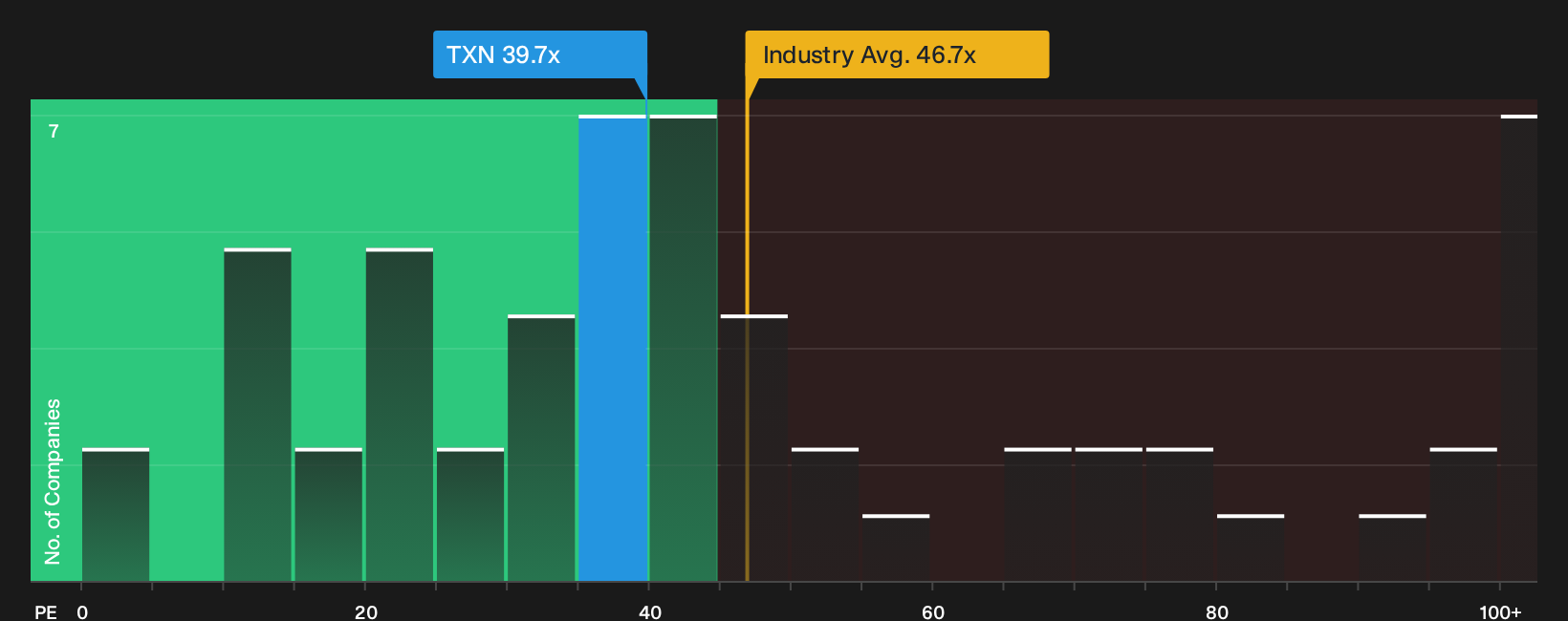
The narrative model paints Texas Instruments as 40.6% undervalued at a fair value of $435.69, yet the market is applying a P/E of 39.3x versus a fair ratio estimate of 33.7x. That richer multiple signals investors could be paying up today. Which story do you trust more: the narrative or the current market ratio?
See what the numbers say about this price — find out in our valuation breakdown.
Next Steps
Plenty in this Texas Instruments story looks optimistic on the surface, yet there are also clear concerns sitting underneath the headline numbers, so move quickly to review the underlying data and decide where you stand on the balance of opportunity and risk using the 3 key rewards and 2 important warning signs.
Want more ideas beyond Texas Instruments?
Texas Instruments might already be on your radar, but the real edge often comes from lining up a few more high quality candidates beside it.
- Target resilient upside potential by scanning a focused set of 18 high quality undiscovered gems that many investors have not yet priced fully into their expectations.
- Protect your downside first and hunt for steadier compounding through a 11 resilient stocks with low risk scores that filters for businesses with calmer risk profiles.
- Zero in on financial strength by running a list of solid balance sheet and fundamentals (23 results) that highlights companies with sturdy balance sheets and fundamentals before the crowd catches on.
This article by Simply Wall St is general in nature. We provide commentary based on historical data and analyst forecasts only using an unbiased methodology and our articles are not intended to be financial advice. It does not constitute a recommendation to buy or sell any stock, and does not take account of your objectives, or your financial situation. We aim to bring you long-term focused analysis driven by fundamental data. Note that our analysis may not factor in the latest price-sensitive company announcements or qualitative material. Simply Wall St has no position in any stocks mentioned.
Have feedback on this article? Concerned about the content? Get in touch with us directly. Alternatively, email editorial-team@simplywallst.com