


How Investors Are Reacting To Comcast (CMCSA) Broadband Subscriber Losses
- Comcast recently highlighted continued pressure in its broadband unit, with management flagging ongoing subscriber losses and aggressive fiber pricing from rivals after remarks at an industry conference.
- The commentary underscored how competitive gigabit offers and softer broadband trends could weigh on Comcast’s core connectivity business, even as the company invests in network partnerships and new services.
- With Comcast’s management calling out persistent broadband subscriber pressure, we will now look at how this development reshapes the broader investment narrative.
Comcast Investment Narrative Recap
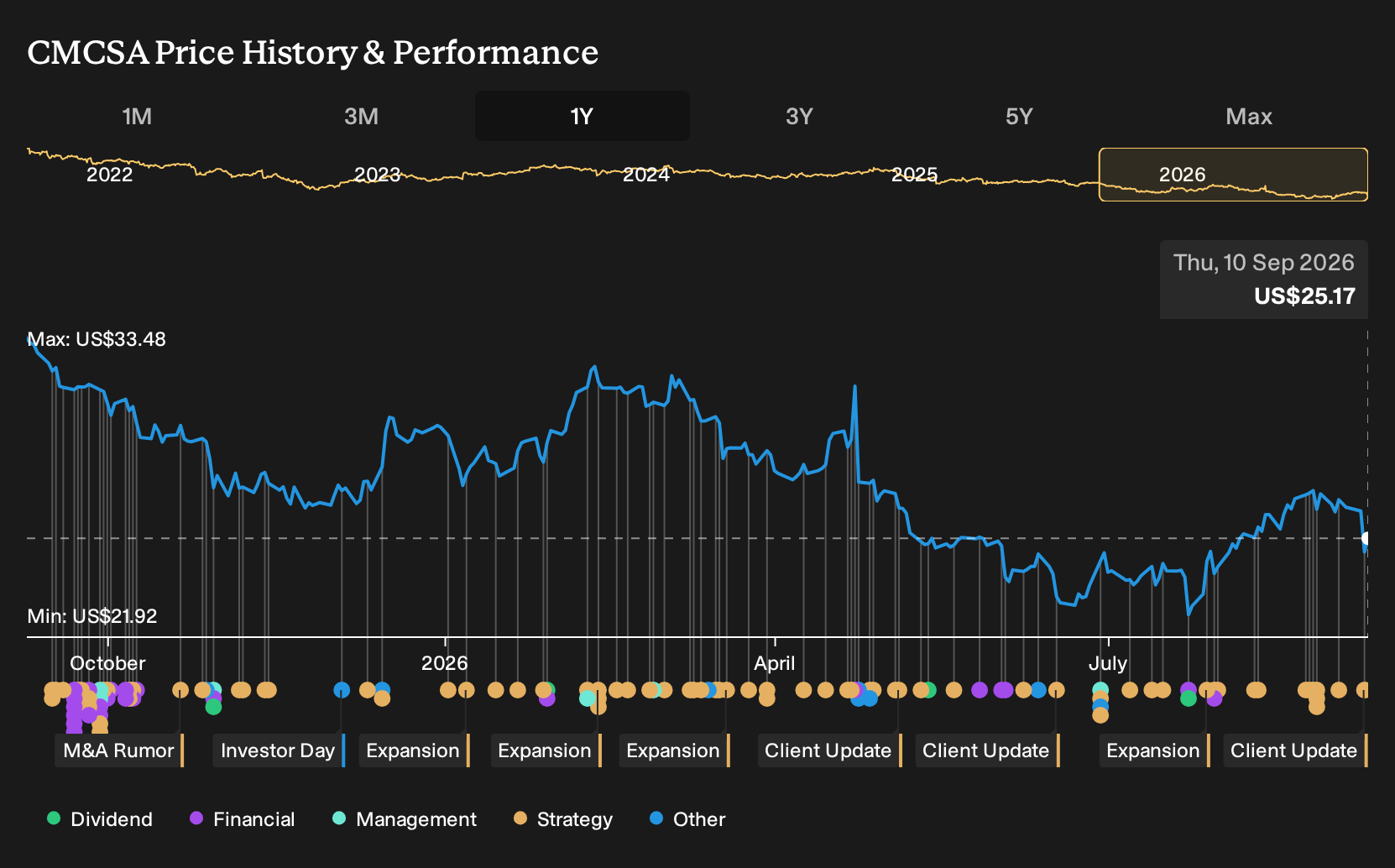
To own Comcast today you need to believe its connectivity engine can offset broadband subscriber erosion and softer pricing with new services, better bundles and tighter cost control. The sharp share pullback and management’s warning on continued broadband pressure keep that risk front and center. Recent expansion projects in places like Glades County and Jackson County show Comcast still putting real money into its network footprint, which supports the case for long term relevance. In the near term, the key swing factor remains whether broadband losses stabilize before higher content costs and heavy capex put more stress on margins.
The Comcast and Fastly edge partnership is the announcement that lines up most directly with the broadband story. Integrating Fastly’s software into more than 200 AI powered edge compute centers gives Comcast a way to improve video quality, gaming performance and emerging AI services without relying on distant data centers. That can turn raw network investment into a differentiated product experience, which matters when fiber rivals are pushing aggressive gigabit offers. Execution risk sits in the details. Comcast still has to prove these technical gains translate into lower churn and better economics for connectivity and streaming.
Even so, the picture changes once you factor in one quieter pressure point that could still reshape how this all plays out...
Read the full Comcast narrative to see the case behind these numbers.
Comcast's consensus narrative points to revenues of US$120.8b and earnings of US$11.0b by 2029, based on analyst models that assume revenue will decline by 1.1% per year and profit margins will edge slightly higher from 9.0% today to 9.1% in 3 years. This path implies that earnings today of US$11.2b would need to decrease by US$0.2b to reach the 2029 forecast level.
Comcast's forecasts set fair value at $30.08 versus a $24.59 share price, indicating a 22% upside to its current price that could narrow quickly.
Exploring Other Perspectives
One alternate view treats broadband saturation as the main risk for Comcast. The most cautious analysts were already penciling in revenue of US$118.9b and earnings of US$9.7b by 2029, which is below consensus. Those forecasts came before this edge partnership news, so opinions may shift and investors may want to compare several narratives.
If you want to see how other investors are thinking about Comcast’s valuation, compare the 7 other fair value estimates for Comcast.
Decide For Yourself
Disagree with existing narratives? Extraordinary investment returns rarely come from following the herd, so consider forming your own view.
- A great starting point for your Comcast research is our analysis highlighting 3 key rewards and 2 important warning signs that could impact your investment decision.
- See our latest analysis for Comcast. The report includes a comprehensive fundamental analysis summarized in a single visual, the Snowflake, making it easy to evaluate Comcast's overall financial health at a glance.
Looking For More Investment Ideas Beyond Comcast?
If the Comcast story has sharpened your thinking on connectivity, it can help to widen the lens and compare it with other opportunities that share some of the same themes around pricing power, balance sheet strength and reliability of cash flows.
- For investors who care most about quality at a sensible entry point, scan a focused set of companies through the 31 high quality undervalued stocks and see which ones match your risk tolerance.
- If income resilience matters more to you than headline growth, review the 6 dividend fortresses and assess which payouts look most aligned with your goals.
- When capital preservation comes first, filter for sturdier businesses by running the 10 resilient stocks with low risk scores and compare how their profiles differ from Comcast.
This article by Simply Wall St is general in nature. We provide commentary based on historical data and analyst forecasts only using an unbiased methodology and our articles are not intended to be financial advice. It does not constitute a recommendation to buy or sell any stock, and does not take account of your objectives, or your financial situation. We aim to bring you long-term focused analysis driven by fundamental data. Note that our analysis may not factor in the latest price-sensitive company announcements or qualitative material. Simply Wall St has no position in any stocks mentioned.
Have feedback on this article? Concerned about the content? Get in touch with us directly. Alternatively, email editorial-team@simplywallst.com