


ServiceNow (NOW) Stock Still Looks Expensive After Fresh AI Ecosystem News
ServiceNow stock has had a rough 12 months, with the share price falling 29%. Yet on most valuation checks it still screens as expensive rather than a clear bargain. For investors trying to make sense of that gap, the question is whether the recent share weakness has moved the needle enough on price compared with the fundamentals implied by its current market multiples.
- Over the past year, the 29% decline in ServiceNow shares suggests sentiment has cooled sharply after a long period where expectations were high.
- On the supportive side, new collaborations around AI driven workflow and customer experience platforms can help sustain interest in ServiceNow's growth story. However, rising competition from AI native workflow tools may influence how much investors are willing to pay for that potential.
- With a value score of 2 out of 6, the broader valuation checks indicate ServiceNow leans expensive and does not currently screen as a clear value opportunity.
The issue now is whether ServiceNow's current price already reflects the bullish case on its automation and AI ambitions, or if the recent pullback has started to build in enough caution for long term buyers.
Spot opportunities across automation and AI by scanning the hand picked 89 AI infrastructure stocks that could offer a different balance between price, momentum, and potential than ServiceNow.Is ServiceNow Getting Expensive on Earnings?
The P/E ratio matters for ServiceNow because earnings are a key way investors judge how much they are paying for each dollar of profit in a software platform at this scale.
ServiceNow trades on a P/E of about 81.2x, which is almost three times the Software industry average of 29.5x and well above the peer group on roughly 28.0x. On the modelled "fair" P/E of 52.4x, which reflects the company’s mix of growth, margins, size and risk, the current multiple still implies a steep premium. Because of this, the stock appears overvalued on earnings even after the recent share price pullback.
Recent enthusiasm around ServiceNow’s AI integrations and automation capabilities, including fresh ecosystem deals, appears to be reflected in the valuation rather than offering any obvious P/E discount.
On this basis, ServiceNow appears expensive on its P/E ratio, with the market price implying a much richer earnings multiple than either peers or the tailored fair benchmark suggest.
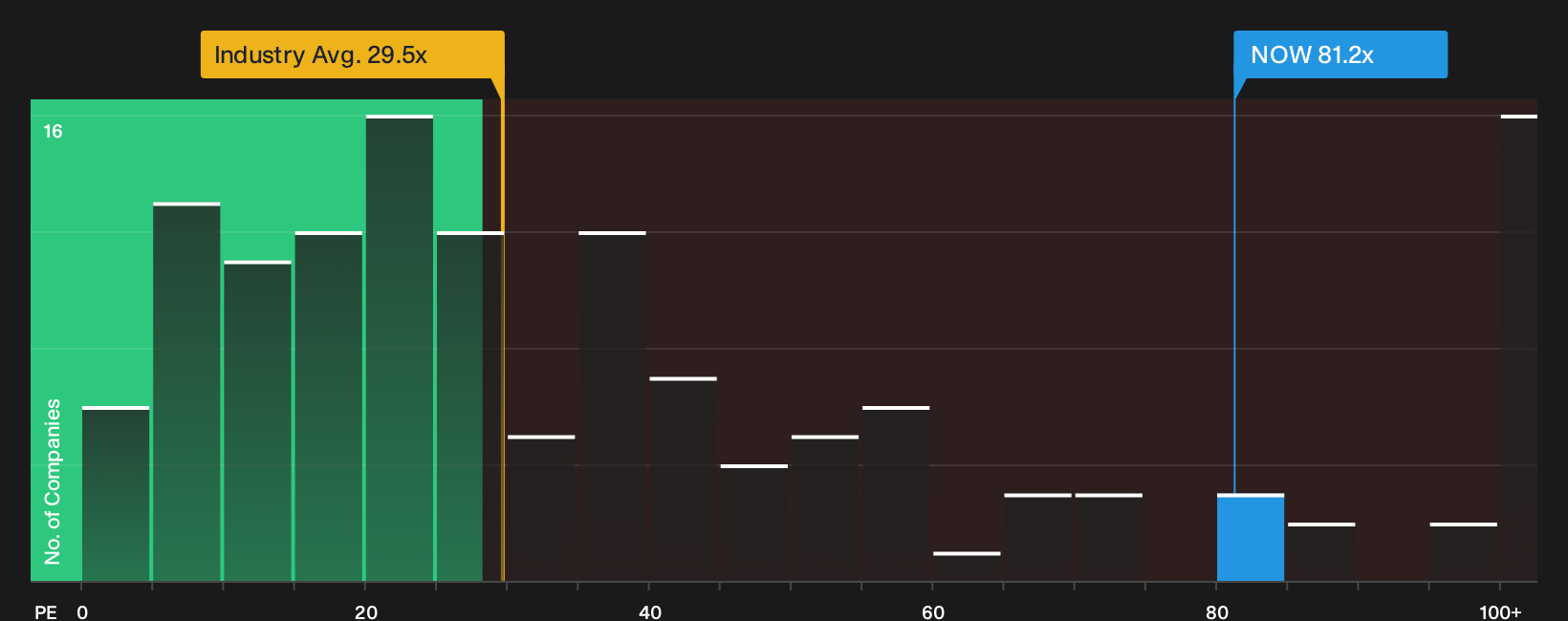
See what the numbers say about this price — find out in our valuation breakdown.
The ServiceNow Narrative: What Would Justify Today's Price?
ServiceNow Narratives on Simply Wall St pick up where the valuation puzzle leaves off by spelling out which future paths for growth, profitability and earnings would need to play out for the stock to be worth meaningfully more or less than today’s price on the Community page. Instead of giving a single number or ratio on its own, these scenarios describe the underlying assumptions so you can watch over time whether the real business is lining up with that story.
Community views on ServiceNow could hardly be further apart, with one camp framing it as digital infrastructure and the other as a richly priced AI bet facing real headwinds.
Bull case: 50% undervalued
"While the market obsesses over who has the smartest model, ServiceNow is quietly building the traffic control system..."
Read the full Bull Case to see why ServiceNow could be undervalued
Bear case: 60% overvalued
"ServiceNow's introduction of a hybrid pricing model combining subscriptions with consumption-based monetization for AI agents could delay initial revenue recognition as consumption ramps up gradually..."
Read the full Bear Case to see why ServiceNow could be overvalued
Do you think there's more to the story for ServiceNow? Head over to our Community to see what others are saying!
The Bottom Line
ServiceNow still looks overvalued on the market multiples, even after a 1 year period where the share price declined 29%. The low value score and rich P/E both point in the same direction, which is that buyers today are paying up for a strong automation and AI story rather than any visible margin of safety. The key issue is whether those AI driven workflows and ecosystem deals can deliver enough earnings power to keep that premium intact, or whether the multiple eventually moves closer to peers if execution or demand disappoints.
This article by Simply Wall St is general in nature. We provide commentary based on historical data and analyst forecasts only using an unbiased methodology and our articles are not intended to be financial advice. It does not constitute a recommendation to buy or sell any stock, and does not take account of your objectives, or your financial situation. We aim to bring you long-term focused analysis driven by fundamental data. Note that our analysis may not factor in the latest price-sensitive company announcements or qualitative material. Simply Wall St has no position in any stocks mentioned.
Have feedback on this article? Concerned about the content? Get in touch with us directly. Alternatively, email editorial-team@simplywallst.com