


Caterpillar (CAT) Stock Looks Fairly Valued Following Fresh AI Automation News
Caterpillar stock has delivered a very strong 332.0% total return over the past 5 years, yet current checks suggest the shares now look closer to fairly valued than clearly cheap, with only a limited margin between the market price and one widely used intrinsic value estimate. At the same time, traditional earnings multiples still screen the company as undervalued, which creates a clear split in how the current price can be read.
- A 332.0% total return over 5 years puts Caterpillar in the very strong performance camp. This raises the bar for any new buyer looking for further upside from here.
- The push into AI enabled equipment and automation, including the FieldAI partnership and investments in tools like the Cat AI Assistant, can support long term cash generation. Any slowdown in demand for heavy machinery or power generation equipment would quickly matter for the valuation case.
- On Simply Wall St’s broader checks, Caterpillar scores 2 out of 6 for value, which leans expensive rather than a clear bargain despite the indication from traditional multiples.
The issue now is whether Caterpillar’s recent gains have already captured most of the value that its current cash flow outlook and AI related initiatives can reasonably justify.
Scan beyond Caterpillar and shortlist other heavy hitters positioned for AI infrastructure demand with our curated list of 56 AI infrastructure stocks.
Is Caterpillar Fairly Priced on Cash Flow?
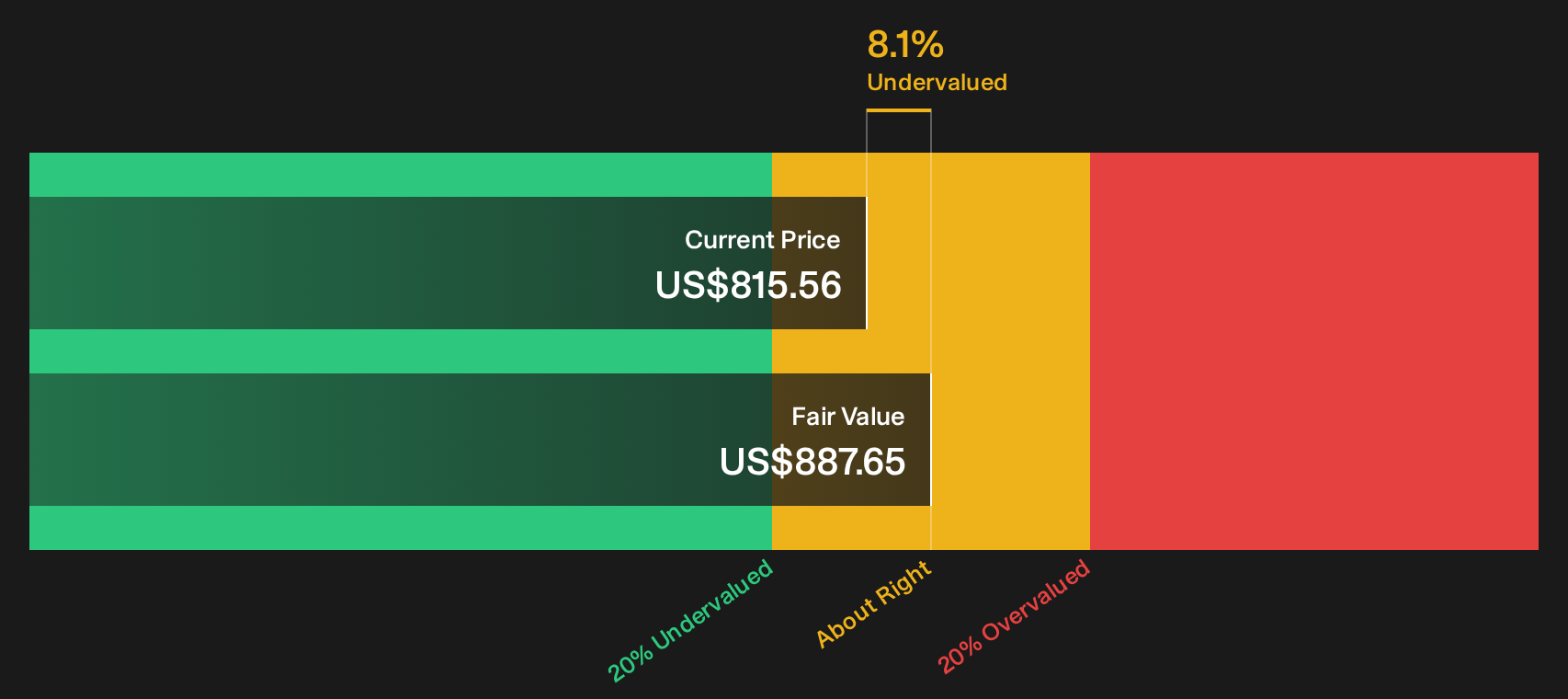
The Discounted Cash Flow (DCF) model here takes Caterpillar’s projected free cash generation and works back to what that cash could be worth today. On the latest numbers, Caterpillar produced about $9.4b in free cash flow over the last twelve months, and the model assumes that this stream keeps growing rather than shrinking. Putting those projections through a 2 Stage Free Cash Flow to Equity framework produces an estimated intrinsic value of about $888 per share.
Set against the current share price, that DCF output implies the stock screens roughly 8.1% undervalued, so the market price and the model are not far apart. Michael Burry’s disclosed short position in Caterpillar helps explain why some traders see more risk around AI related demand or heavy equipment cycles, even as the cash flow model lands close to today’s quote. On this analysis, Caterpillar appears to be trading close to the model’s estimate of fair value, with only a modest gap between the DCF estimate and where the stock currently trades.
Caterpillar is fairly valued according to our Discounted Cash Flow (DCF), but this can change at a moment's notice. Track the value in your watchlist or portfolio and be alerted on when to act.
Does Caterpillar Look Undervalued on Earnings?
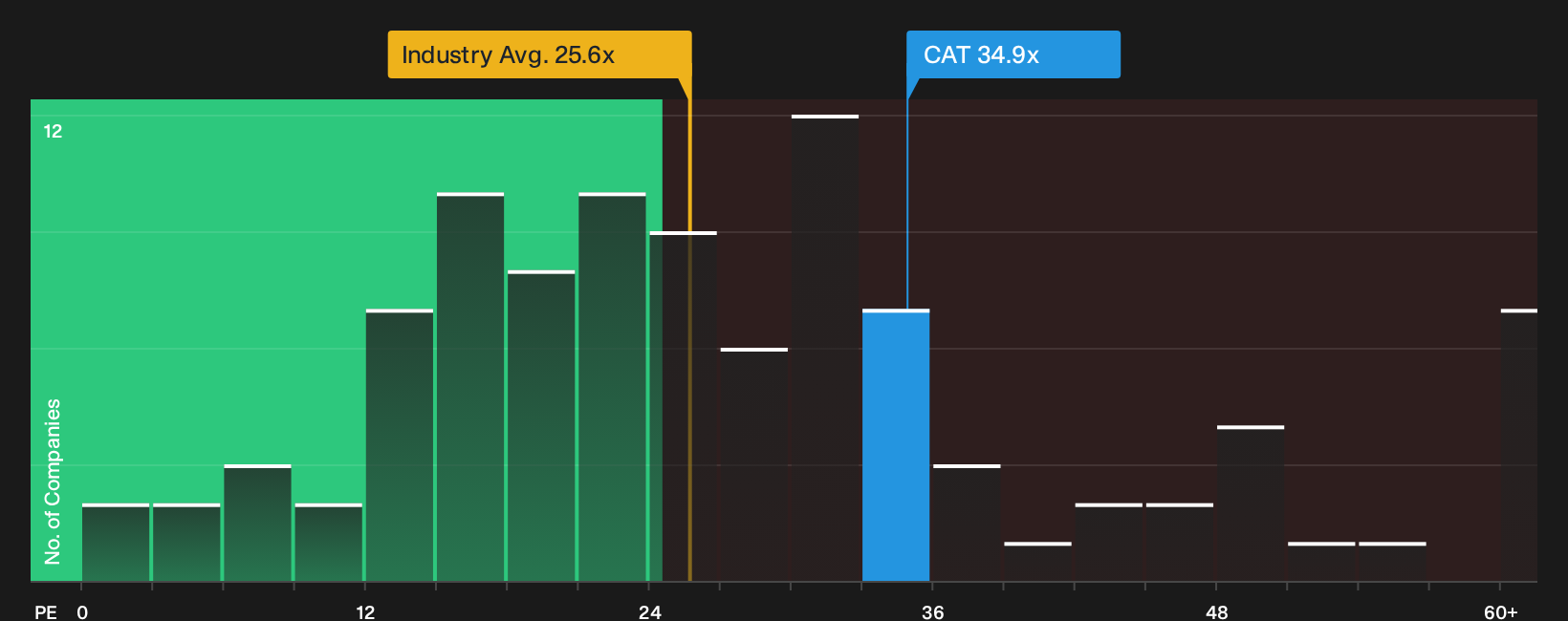
P/E works reasonably well for Caterpillar because earnings power sits at the center of how investors usually value heavy equipment manufacturers. On this yardstick, the stock trades on about 34.6x earnings, which is above the Machinery sector average of roughly 25.6x and also ahead of the peer group on about 29.4x.
The fair P/E multiple implied by Simply Wall St’s model is higher again at around 43.0x. That suggests Caterpillar screens as undervalued on this framework, even though the headline P/E already carries a premium to sector norms. The model is effectively saying that when you factor in the company’s size, profitability profile and risk mix, the current price still does not fully reflect the earnings multiple it could attract in line with those fundamentals.
On the P/E yardstick, Caterpillar stock appears undervalued relative to the earnings multiple the model suggests it could justify.
See what the numbers say about this price — find out in our valuation breakdown.
The Caterpillar Narrative: What Would Justify Today's Price?
Simply Wall St Narratives pick up where Caterpillar's valuation gap leaves you by spelling out which future paths for growth, margins and earnings would need to play out for the stock to be worth materially more or materially less than today’s price on the Community page. Instead of handing you a single number from a ratio or model, they describe the future that number leans on so you can check over time whether Caterpillar’s actual progress still fits that story.
Caterpillar investors are effectively weighing two very different stories on the same set of AI power and infrastructure tailwinds.
Bull case: 16% undervalued
"Robust order activity and continued demand from the data center (cloud/AI) buildout, especially in power generation, are driving capacity investments and throughput gains in Energy & Transportation..."
Read the full Bull Case to see why Caterpillar could be undervalued
Bear case: 48% overvalued
"The current premium reflects optimism about global infrastructure spending and the mining supercycle."
Read the full Bear Case to see why Caterpillar could be overvalued
Do you think there's more to the story for Caterpillar? Head over to our Community to see what others are saying!
The Bottom Line
Caterpillar now screens close to its Discounted Cash Flow (DCF) intrinsic value estimate, so the recent move leaves less obvious mispricing on that lens. The earnings multiple view still flags the stock as undervalued, yet the broader checks lean weak, which suggests the P/E signal sits on shakier ground than it first appears. The gap between the two frameworks reflects a market that is already paying up for growth and AI driven demand, while the cash flow model focuses on funding needs and capital intensity. The key question from here is whether AI linked infrastructure and equipment demand holds up strongly enough to justify that richer earnings multiple.
This article by Simply Wall St is general in nature. We provide commentary based on historical data and analyst forecasts only using an unbiased methodology and our articles are not intended to be financial advice. It does not constitute a recommendation to buy or sell any stock, and does not take account of your objectives, or your financial situation. We aim to bring you long-term focused analysis driven by fundamental data. Note that our analysis may not factor in the latest price-sensitive company announcements or qualitative material. Simply Wall St has no position in any stocks mentioned.
Have feedback on this article? Concerned about the content? Get in touch with us directly. Alternatively, email editorial-team@simplywallst.com