


United Microelectronics Sales Jump 30% in August. UMC Stock Has More Room to Run.
United Microelectronics (UMC) is a leading global semiconductor foundry founded in 1980 and headquartered in Hsinchu, Taiwan. The company specializes in advanced wafer fabrication, offering complementary metal-oxide semiconductor (CMOS) logic, mixed-signal, radiofrequency, embedded memory, high-voltage, and image sensor manufacturing services to a diverse global customer base. The company has increasingly focused on specialty semiconductor solutions spanning power management, connectivity, and advanced packaging, while expanding into silicon photonics to capture emerging demand related to artificial intelligence (AI).
United Microelectronics Stock Underperforms
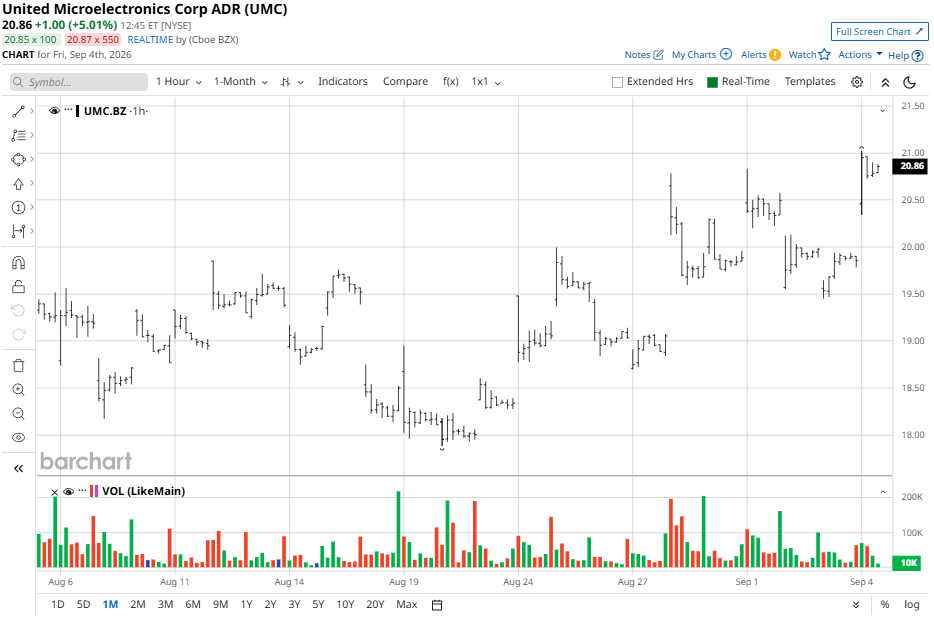
UMC stock currently trades around $22, which is closer to the higher end of its 52-week range of $6.72 to $28.96, reflecting a dramatic rebound from multiyear lows earlier in the year. Shares have been volatile in recent sessions, popping on strong sales figures as investors weigh near-term margin pressures against long-term AI-driven capacity expansion plans.
By comparison, the Philadelphia Semiconductor Index ($SOX) — the benchmark most closely tracking chip stocks like UMC — surged more than 100% from its 2026 lows before pulling back roughly 20% from its June all-time high of $14,655. UMC stock has broadly mirrored this volatile, AI-driven boom-and-pullback pattern seen across the broader semiconductor industry this year.
United Microelectronics Reports Q2 Results
United Microelectronics' second-quarter 2026 results delivered stunning beats on both the top and bottom line. Revenue of $2.18 billion (NT$68.73 billion) climbed 17% year-over-year (YOY) and comfortably topped the $2.06 billion analyst consensus estimate. Earnings per ADS came in at $0.54, crushing the $0.15 estimate and marking one of UMC's largest earnings surprises in recent memory as utilization rates climbed sharply.
Gross margin expanded to 32.5% from 29.2% in the prior quarter, while operating margin reached 21.8% as capacity utilization rose to 85% from 79% in the prior quarter. Net income surged 375% YOY to NT$42.26 billion, and wafer shipments increased 11% sequentially to 1.13 million 12-inch equivalents. UMC's 22/28-nanometer business set a new revenue record, contributing 37% of total wafer revenue, while the company achieved a milestone with first mass-production delivery of its 12-inch silicon photonics IC.
Management raised its 2026 capital expenditures budget to $2 billion to fund expansion in Singapore and a new fab in Tainan, alongside a broader $5 billion 2026 to 2027 capex plan. UMC also guided Q3 utilization to exceed 90%, with wafer shipments rising in the high single digits and gross margin holding in the mid-30% range. CEO Jason Wang said AI-related demand is increasingly spilling into power management and connectivity segments, with AI-linked revenue projected to exceed $1 billion within three years.
United Microelectronics Posts Strong August Sales
United Microelectronics reported a sharp acceleration in monthly sales, with August 2026 unaudited consolidated net revenue reaching NT$25.04 billion, marking a robust 31% YOY surge compared to NT$19.16 billion generated in August 2025.
The strong monthly print reinforces UMC's momentum after its blowout Q2 earnings beat, as rising capacity utilization and expanding demand across its specialty semiconductor and advanced packaging portfolio continue to drive top-line growth. UMC's consolidated net sales for the first eight months of 2026 climbed to NT$178.66 billion on a cumulative basis, up 15% YOY from NT$155.82 billion recorded for the same period last year.
The accelerating August growth rate signals that UMC's foundry business is gaining further traction as AI-related demand increasingly spills into power management, connectivity, and advanced process technology segments.
The Verdict on UMC Stock
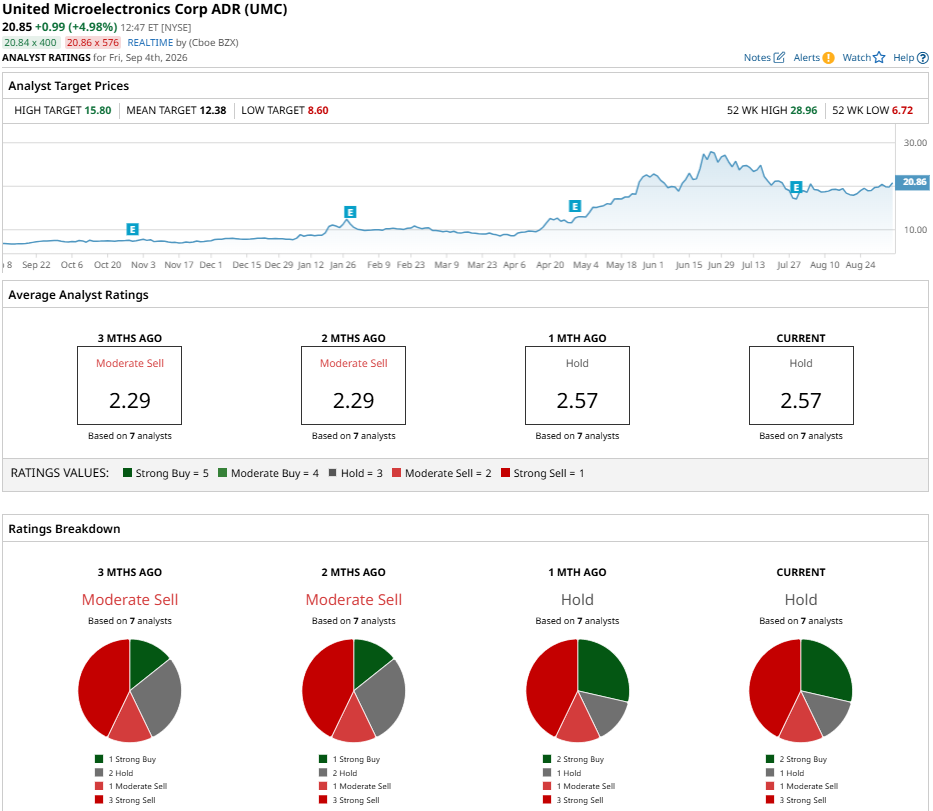
UMC's blistering sales surge in August highlights genuine operational momentum, but Wall Street's outlook tells a far more cautious story. UMC stock has a consensus "Hold" rating based on seven analysts with coverage, with only two "Strong Buy" calls offset by one "Hold," one "Moderate Sell," and three "Strong Sell" ratings. The average price target of $12.38 implies striking potential downside of 45% from current levels, suggesting analysts see the recent rally as running well ahead of its underlying valuation despite the encouraging sales momentum.
On the date of publication, Ruchi Gupta did not have (either directly or indirectly) positions in any of the securities mentioned in this article. All information and data in this article is solely for informational purposes. For more information please view the Barchart Disclosure Policy here.