


The Trade Desk Plans to Cut 15% of Its Workforce. What It Will Take for TTD Stock to Rebound.
Digital advertising platform operator The Trade Desk (TTD) has revealed plans to trim its workforce by up to 15% as part of an organizational restructuring. The company expects to carry out this restructuring in the current quarter. Charges related to this exercise are projected to be around $39 million to $51 million, partially offset by a reduction in stock-based compensation of $4 million to $5 million.
Yet, that was not enough to arrest the wider decline in the stock, with TTD shares correcting by 4.4% in Friday's trading session.
About The Trade Desk
Founded in 2009, The Trade Desk, more popularly known as TTD, describes itself as a self-serve, cloud-based platform through which advertisers can create, manage, and optimize campaigns across digital advertising formats and devices. Essentially, the company offers a software platform that allows advertisers to buy digital advertising programmatically across the open internet.
Valued at a market cap of $6.8 billion, TTD stock is down 62% on a YTD basis.
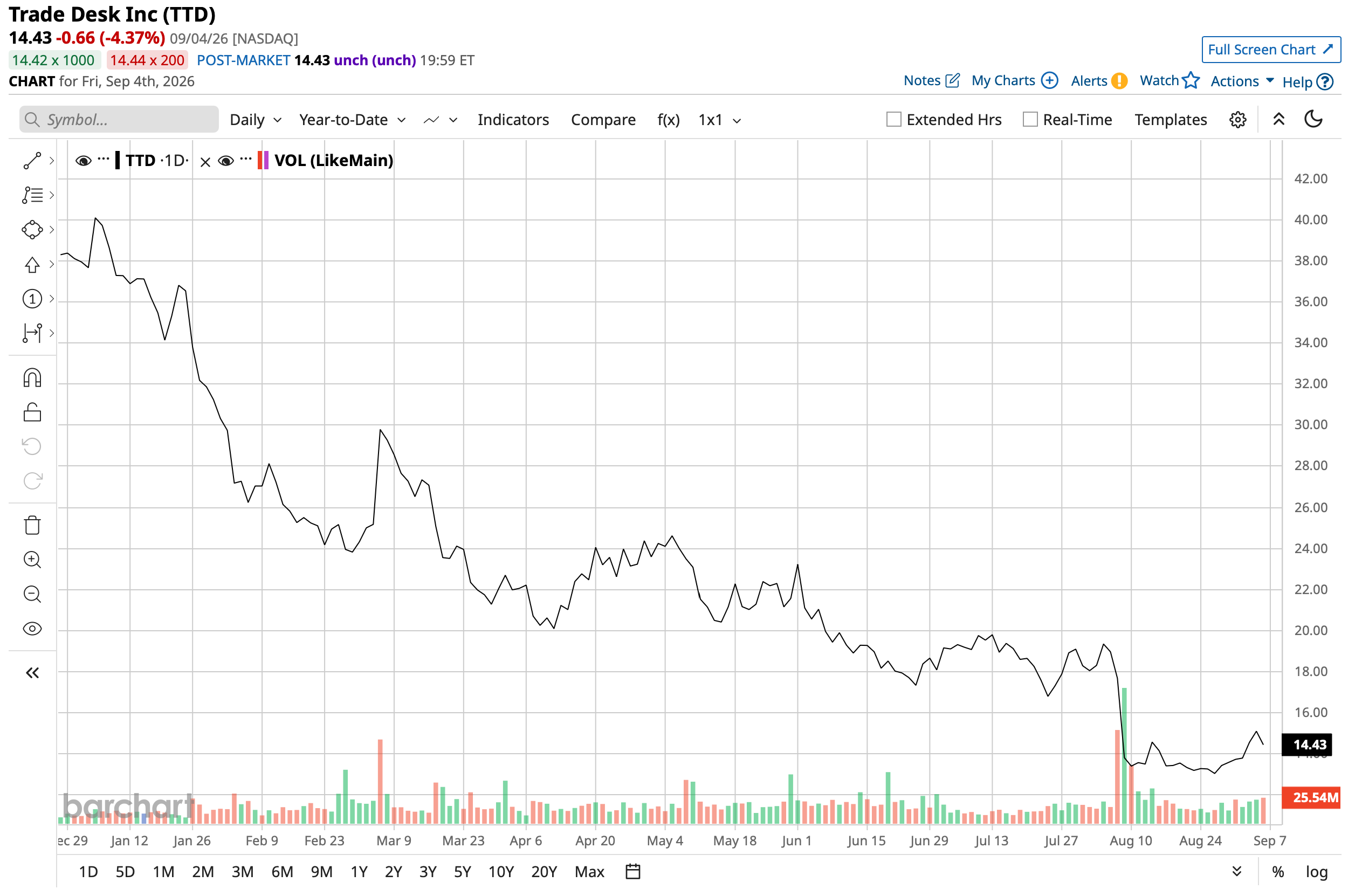
So, can the lightening of the personnel load finally lead to TTD stock changing course? Let's find out.
TTD Is A Tale Of Hits & Misses
Programmatic advertising was not a novel concept when TTD came into being. Where TTD can be considered to be a pioneer, though, is in the development of the independent DSP, or demand-side platform, in advertising. In fact, co-founder Jeff Green developed the world's first online advertising exchange (AdECN), which was acquired by Microsoft (MSFT) in 2007.
Another value proposition for advertisers with TTD was its secular nature. Compared to other platforms such as Google and Meta Platforms (META), which operate within their own ecosystems and have their own inventories, TTD does not have a massive consumer platform of its own, which allows it to offer advertising inventory across connected TV, streaming services, websites, and mobile applications, among others.
However, there is a reason why the stock is trading below its IPO price a decade after its listing.
The proliferation of generative AI platforms has made TTD's moat weaker, as advertisers now have the opportunity to do what TTD does in-house, potentially at a lower cost. And while the likes of Google, Meta, and Amazon (AMZN) may offer walled gardens to advertisers just within their ecosystems, those walled gardens cover almost the entire globe, with quick distribution. With heavy investments in developing its own AI platform and slowing revenue growth, the latest workforce reduction plans suddenly seem like the easiest way to trim costs for the company.
Yet, all is not lost.
TTD has a customer retention rate that exceeded 95% over a decade and operates with high margins. Q2 may have seen revenue coming in below expectations, yet 2025 saw the company's YoY revenue growth of 18% to about $3 billion. Crucially, CEO Green purchased a whopping 6 million shares of the company earlier this year for about $148 million, sounding bullish about TTD's AI investments.
Further, Kokai and UID2 have the potential to be serious growth drivers for the company.
Kokai is TTD's demand side platform for planning, buying, and measuring advertising across the open internet. It was introduced in 2023 and updated in August 2026 with a release called Kokai Zuma. Zuma adds agentic AI features, a redesigned interface, and simpler measurement tools. The company says early results show a 32% average improvement in cost per acquisition across 62 campaigns using the upgraded Koa optimization model. For advertisers, this means more automated campaign management, better forecasting of inventory and outcomes, and clearer reporting on what drives performance. The platform also includes closed beta features such as the Koa AI assistant, dynamic frequency controls, and enhanced conversion lift studies.
Meanwhile, UID2 is TTD's open-source identity framework that uses hashed email addresses instead of third-party cookies. It allows advertisers to target and measure campaigns across websites, apps, and connected TV while complying with privacy rules. UID2 is now supported by many other demand-side platforms and publishers, which gives it broader reach than a proprietary ID system. For advertisers, UID2 provides a way to maintain audience targeting and attribution as cookies are phased out.
A Contentious Q2
There are no two ways about it. TTD's latest results for the second quarter of 2026 grabbed headlines for the wrong reasons and justifiably so.
In Q2 2026, revenues grew by just 3% from the previous year to $715 million, missing the consensus estimate. For Q3, the company projected revenues to be about $650 million, indicating an annual decline of 12%.
Meanwhile, earnings saw a decline to $0.14 per share from $0.18 per share in the year-ago period. This also missed the Street expectations of EPS of $0.18, marking the second consecutive quarter of earnings misses.
Net cash from operating activities for the six months ended June 30 was $545.4 million, up 19.5% from the prior year. Overall, TTD completed the quarter with a cash balance of $1.1 billion, much higher than its short-term debt levels of $80.9 million.
Finally, TTD stock is trading at reasonable levels in comparison to sector medians. Forward P/E of 12.43 is lower than the sector median of 13.52, while the forward P/S and P/CF of 2.47 and 8.18 are not at significant premiums to the sector medians of 1.21 and 7.42, respectively.
Analyst Opinion
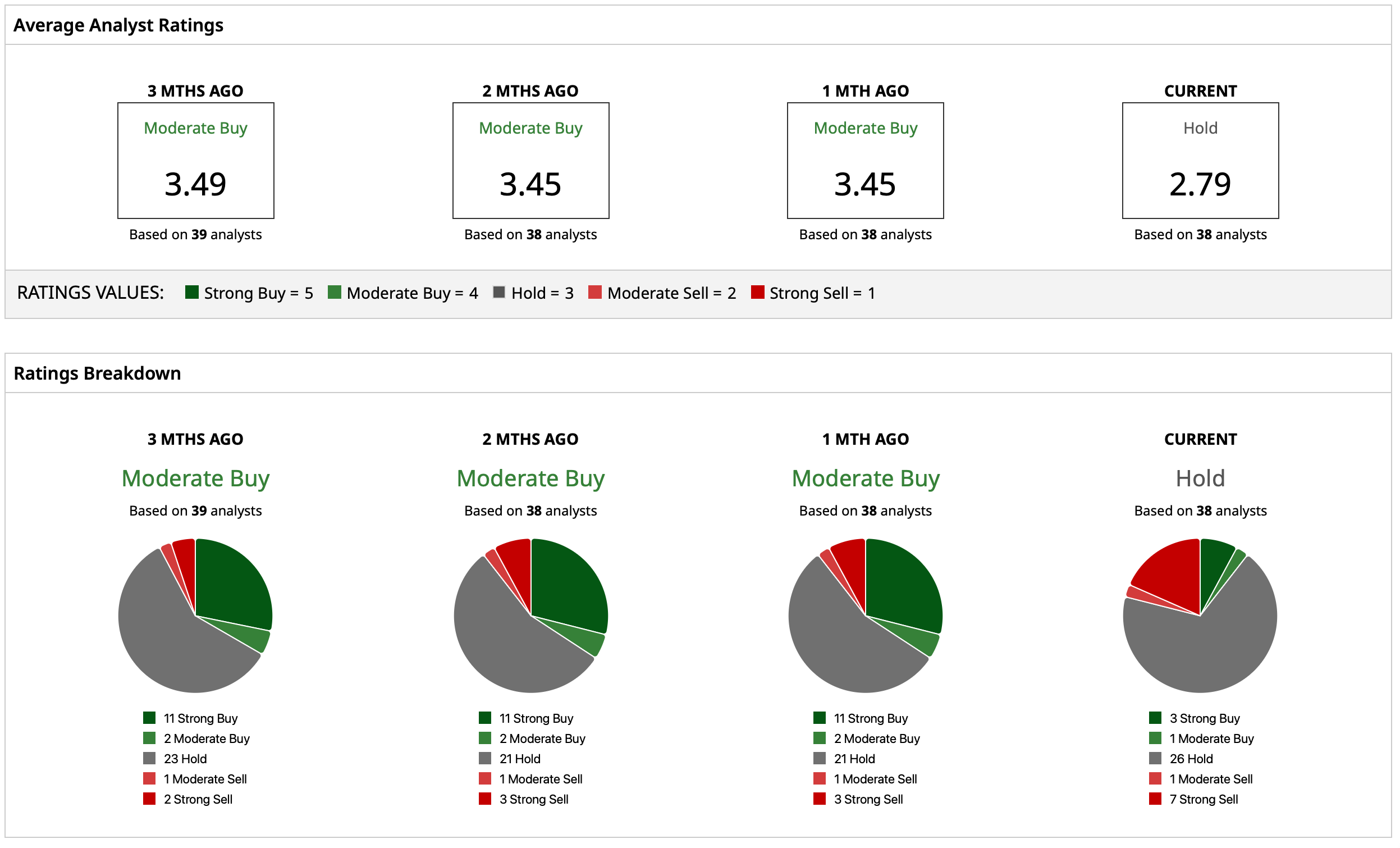
Analysts deem TTD stock to be a “Hold” with a mean target price of $15.05. This denotes a potential upside of 4.3% from current levels. Out of 38 analysts covering the stock, three have a “Strong Buy” rating, one has a “Moderate Buy” rating, 26 have a “Hold” rating, one has a “Moderate Sell” rating, and seven have a “Strong Sell” rating.
On the date of publication, Pathikrit Bose did not have (either directly or indirectly) positions in any of the securities mentioned in this article. All information and data in this article is solely for informational purposes. For more information please view the Barchart Disclosure Policy here.