


United Rentals (URI) Stock May Stay Near Fair Value As AI Tool Expands
United Rentals has delivered a powerful 5 year run in the market, yet current checks suggest the stock now looks close to its intrinsic value on a Discounted Cash Flow, while earnings multiples still screen it as relatively cheap.
- A 218.3% total return over 5 years means long term holders have already captured substantial gains, so fresh buyers need to think harder about valuation support from here.
- New tools such as United Rentals’ AI enabled Equipment Agent can support expectations for future cash generation. In contrast, any slowdown in construction and industrial activity would quickly test how durable those cash flows really are.
- The broader checks lean cheap, with a high value score of 5 out of 6. However, the Discounted Cash Flow intrinsic value points to a share price that is only modestly below the current market level.
For investors, the debate is whether a stock that looks fairly valued on intrinsic estimates but still discounted on multiples offers enough margin of safety after such a strong 5 year climb.
Compare United Rentals with a hand picked list of equipment heavy contractors and industrials screened for 39 power grid technology and infrastructure stocks that could benefit if large projects continue to rely on rental fleets.
Does United Rentals Look Fairly Valued on Cash Flow?
The Discounted Cash Flow model projects future free cash flows for United Rentals and then works back to what that stream could be worth today. On this view, United Rentals is modeled with growing cash generation, built on last twelve month free cash flow of about $2.6b and analyst projections that keep that figure in the multibillion-dollar range over the next decade.
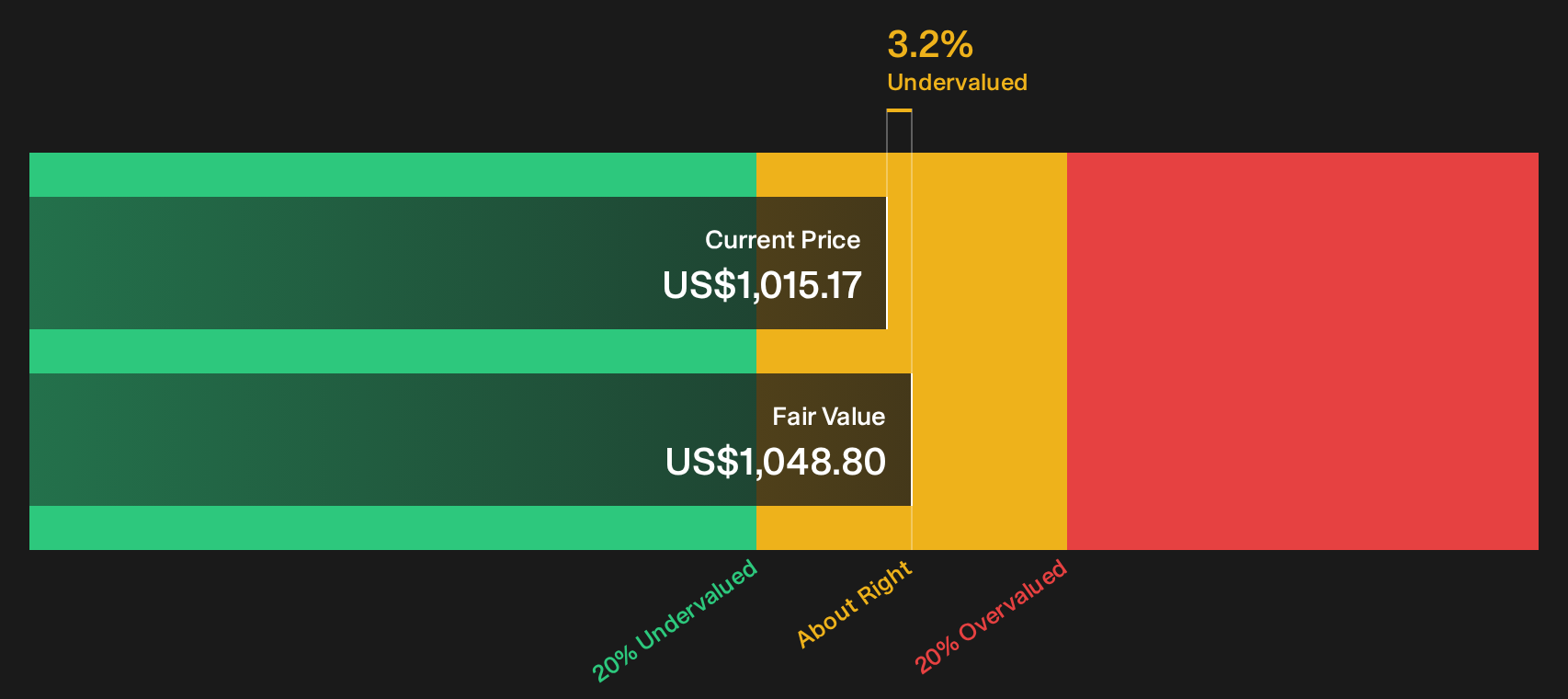
Those inputs feed into an estimated intrinsic value of about $1,049 per share, which implies the current price sits roughly 3.2% below that level, so the stock screens only slightly undervalued on this method. The recent Q2 print, with revenue of $4.41b and a beat on EBITDA guidance, helps explain why the market price already leans close to what the cash flow math supports.
On this DCF view, United Rentals looks about fairly valued, with only a small discount left for investors who rely on intrinsic value estimates.
United Rentals is fairly valued according to our Discounted Cash Flow (DCF), but this can change at a moment's notice. Track the value in your watchlist or portfolio and be alerted on when to act.
Does United Rentals Look Undervalued on Earnings?
P/E fits United Rentals well because earnings are a central benchmark for a mature, cash generative rental platform. The stock trades on about 24.0x earnings, which sits slightly below the broader Trade Distributors industry average of roughly 25.0x and below the peer group on about 29.5x.
The fair P/E that accounts for United Rentals’ size, margins and risk profile is closer to 31.7x. That is a clear gap to the current 24.0x multiple and indicates that investors may be pricing the business at a discount relative to what this framework suggests for a stock with these characteristics.
On the P/E test, United Rentals appears attractively valued, with the current earnings multiple sitting well below the level implied by this fair ratio model.

See what the numbers say about this price — find out in our valuation breakdown.
The United Rentals Narrative: What Would Justify Today's Price?
Narratives on United Rentals pick up where the valuation gap leaves off, spelling out which paths for growth, margins and earnings would need to play out for the stock to deserve meaningfully higher or lower prices than today. Each scenario lays out the assumptions that sit behind its view of fair value, so you can track those expectations against United Rentals' actual results as new quarters arrive. Narratives sit on Simply Wall St's Community page.
Community narratives on United Rentals are pulling in opposite directions, with one camp leaning into large project demand and another worried about margin pressure and cycle risk.
Bull case: 20% undervalued
"United Rentals is positioning itself as the partner of choice with its focus on operational excellence and innovation, which is expected to drive revenue growth in 2025 and beyond…"
Read the full Bull Case to see why United Rentals could be undervalued
Bear case: 5% overvalued
"The continuing shift toward lower-margin ancillary and re-rent revenue streams is diluting underlying rental margins, with management itself signaling that historical incremental EBITDA margin targets may no longer be relevant…"
Read the full Bear Case to see why United Rentals could be overvalued
Do you think there's more to the story for United Rentals? Head over to our Community to see what others are saying!
The Bottom Line
United Rentals now appears roughly aligned with its Discounted Cash Flow (DCF) intrinsic value, so the straightforward valuation case on that measure has largely played out. The earnings view still points to an undervalued multiple, which suggests that sentiment toward the business is more cautious than the fundamentals grid alone implies. That tension leaves the real decision hanging on one factor. The crux is whether rental demand and margins hold well enough to justify a higher P/E, or whether the current discount is the market correctly pricing in cycle risk and cash flow volatility.
This article by Simply Wall St is general in nature. We provide commentary based on historical data and analyst forecasts only using an unbiased methodology and our articles are not intended to be financial advice. It does not constitute a recommendation to buy or sell any stock, and does not take account of your objectives, or your financial situation. We aim to bring you long-term focused analysis driven by fundamental data. Note that our analysis may not factor in the latest price-sensitive company announcements or qualitative material. Simply Wall St has no position in any stocks mentioned.
Have feedback on this article? Concerned about the content? Get in touch with us directly. Alternatively, email editorial-team@simplywallst.com