


Visa (V) Stock Looks Fair On Value But Rich On Earnings
Visa stock has delivered a strong 71.7% gain over the past five years, yet current valuation checks flag it as fairly valued on intrinsic estimates while traditional market multiples lean expensive. For anyone tracking Visa, the gap between the Excess Returns intrinsic value model and the rich market pricing is the crux of the current discussion.
- The 71.7% return over five years highlights that a large part of Visa’s story has already played out in the share price, which can limit room for further re rating without stronger fundamentals.
- Visa’s recent push into areas like AI driven fraud prevention and onchain lending may support expectations for durable cash flows. At the same time, ongoing regulatory scrutiny of its debit business and cyber risk can weigh on how much investors are willing to pay for that profile.
- With a low value score of 2 out of 6, the stock currently leans expensive on the broader set of valuation checks rather than showing up as a clear bargain.
The issue now is whether Visa’s current price already fully reflects its cash flow strengths and payment network advantages, or if there is still a reasonable margin for upside from here.
Spot 82 resilient stocks with low risk scores that pair Visa-like payment strength with lower risk scores if you want more resilience alongside your core holdings.Is Visa Fairly Priced on Excess Returns?
The Excess Returns model looks at how much profit Visa can generate on each dollar of equity above its estimated cost of capital. On this view, the business is treated as a high return engine, not just a stream of cash flows.
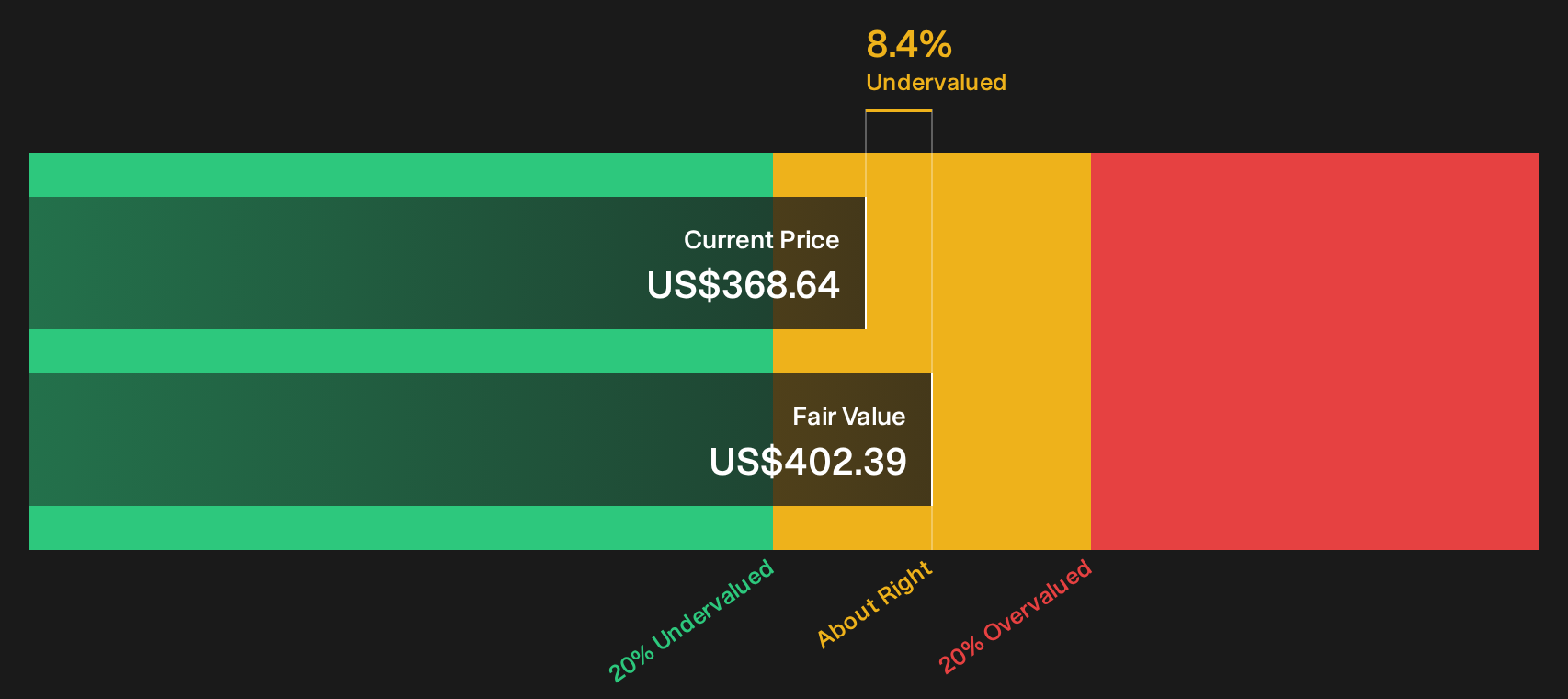
Visa is modeled with book value of $18.87 per share and stable EPS of $15.53 per share, versus an estimated equity cost of $1.57 per share. That gap feeds into an excess return of $13.96 per share, underpinned by an average forecast return on equity of 72.69% and a stable book value estimate of $21.36 per share. Pulling this together, the Excess Returns framework lands on an intrinsic value of $402 per share, which implies the stock screens about 8.4% undervalued relative to the current market price.
News around Visa’s expanded AI driven cybersecurity and fraud tools helps explain why investors may still be willing to pay a premium, even with the shares only modestly below the model’s estimate.
On balance, the Excess Returns work suggests Visa appears roughly fairly valued, with only a small discount to intrinsic value at today’s price.
Visa is fairly valued according to our Excess Returns, but this can change at a moment's notice. Track the value in your watchlist or portfolio and be alerted on when to act.
Is Visa Getting Expensive on Earnings?
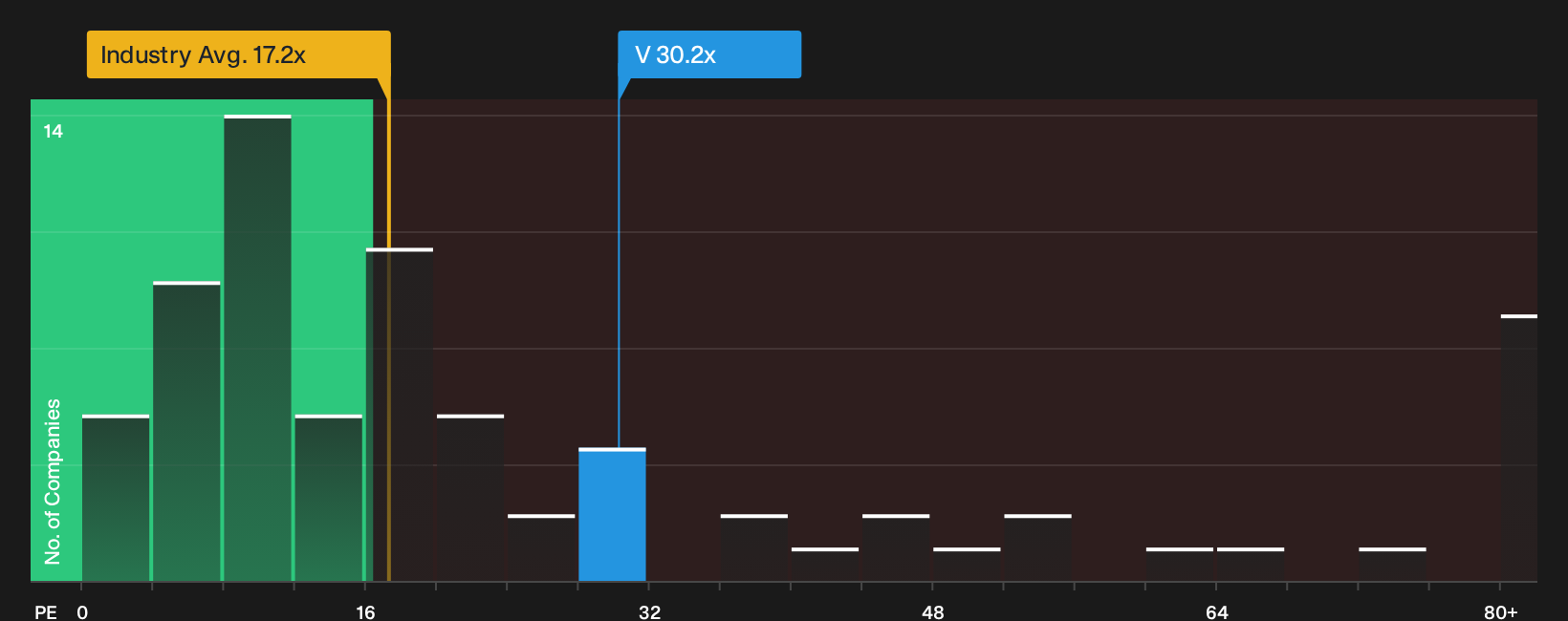
P/E is a straightforward way to think about Visa because it monetises its network primarily through fee based earnings rather than heavy asset leverage. On this metric, the stock trades at about 30.2x earnings, which is higher than the diversified financial industry average of 17.2x and also below a peer group at approximately 49.8x.
The Fair Ratio for Visa is estimated at 22.6x, based on its size, profitability profile and sector risks. That is meaningfully below the current 30.2x P/E, which indicates that investors are paying a premium over what this framework suggests for the earnings stream. In plain terms, the market is assigning Visa a higher valuation than both its tailored fair multiple and the broader sector benchmark.
On the P/E yardstick alone, Visa stock appears overvalued relative to the earnings level implied by this fair multiple model.
See what the numbers say about this price — find out in our valuation breakdown.
The Visa Narrative: What Would Justify Today's Price?
Visa Narratives on Simply Wall St act as the bridge between the valuation gap above and the expectations built into today’s share price. They spell out which paths for growth, margins and earnings would need to play out for the stock to be worth materially more or materially less than it trades for right now. Each scenario links a specific fair value to a clear story about Visa’s possible catalysts and risks, so you can track over time which version is coming through in the results and news flow on the Community page.
Community views on Visa sit far apart, with one camp seeing more room in the tank and the other arguing the quality is already fully priced in.
Bull case: 10% undervalued
"Rapidly accelerating adoption of value-added services (VAS), with VAS revenue up 26% year-over-year and expanding into areas such as AI, risk solutions, and open banking, is increasing Visa's mix of higher-margin business lines. This should lift net margins and improve overall earnings quality…"
Read the full Bull Case to see why Visa could be undervalued
Bear case: 32% overvalued
"Like many blue-chip companies, it currently trades at a premium and is likely to deliver relatively predictable, perhaps even “boring,” returns, with modest long-term growth combined with reliable, albeit small, dividend payouts…"
Read the full Bear Case to see why Visa could be overvalued
Do you think there's more to the story for Visa? Head over to our Community to see what others are saying!
The Bottom Line
Visa’s Excess Returns intrinsic value work points to a stock that is only modestly undervalued, while the P/E view flags it as overvalued relative to its tailored fair multiple and sector average. That split reflects a business that screens strong on cash generation and returns on equity, yet carries a rich earnings multiple that already prices in healthy expectations. Broader valuation checks remain weak, so the small intrinsic value discount alone is not a clean green light. The real swing factor from here is whether Visa’s mix of higher margin services and AI driven risk tools can grow into the current premium without compression in that P/E.
This article by Simply Wall St is general in nature. We provide commentary based on historical data and analyst forecasts only using an unbiased methodology and our articles are not intended to be financial advice. It does not constitute a recommendation to buy or sell any stock, and does not take account of your objectives, or your financial situation. We aim to bring you long-term focused analysis driven by fundamental data. Note that our analysis may not factor in the latest price-sensitive company announcements or qualitative material. Simply Wall St has no position in any stocks mentioned.
Have feedback on this article? Concerned about the content? Get in touch with us directly. Alternatively, email editorial-team@simplywallst.com