


Options Flow Alert: Institutional Money Piles Into AMD Stock
Advanced Micro Devices (AMD) has been one of the standout performers of 2026, already up around 136% year-to-date as the market rewards its accelerating push into AI data center chips.
The options flow from today suggests institutional traders are positioning for this AI-driven rally to keep running.
Let's break down the unusual options flow and what it might signal about the stock's potential direction.
Options Volume and Flow Analysis
This options flow data from AMD represents net bullish institutional positioning, with over $30 million in net bullish sentiment and a positive delta imbalance approaching 488,000.
That said, the flow is worth reading carefully. The two largest prints both sit at the $520 strike in January 2028, and once you account for the fact that the big put appears to have been sold rather than bought, they line up as a coherent bullish position rather than a hedged, two-way bet.
Net Trade Sentiment: +$30,388,500 (bullish)
Delta Imbalance: +487,947 (bullish)
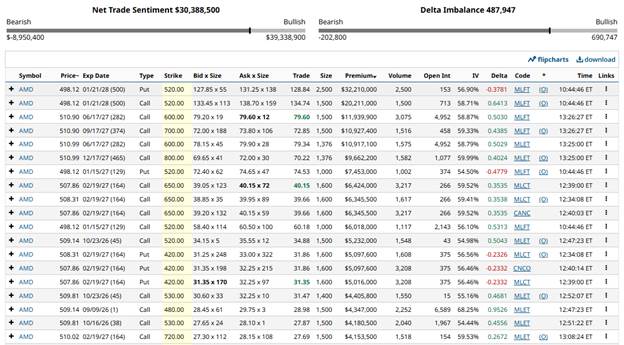
The flow reveals aggressive activity concentrated at a handful of key strikes:
The single largest trade in the flow is a $32.2 million transaction in the $520 put expiring January 2028. Crucially, this print traded on the bid side of the market, which points to a put sale rather than a purchase. Selling a long-dated put is a bullish-to-neutral position: the seller collects a large premium and is willing to own AMD at $520 if assigned. Paired with a $20.2 million call purchase at the same $520 strike and expiration, both of the two largest prints in the flow point in the same direction, giving us a large player expressing a firmly bullish LEAPS-dated view on AMD around the $520 level well into 2028.
Beyond that headline print, the bulk of the seven-figure premium is skewed toward calls. Multiple large call purchases appear at the $600, $700, and $800 strikes across 2027 expirations, demonstrating conviction that AMD can push meaningfully above current levels over the next 12 to 24 months. These are deep out-of-the-money calls, and the willingness to pay premium for them reflects a genuinely bullish longer-term thesis.
There is also notable near-dated activity, including sizeable call buying in the September and October 2026 expirations at strikes clustered around the $480 to $530 zone, closer to where the stock is currently trading. This suggests some players are positioning for a shorter-term move as well as the longer-dated upside.
There is also put activity lower down the strike ladder at $420 and $410. Read alongside the $520 put sale, this is less a wall of bearish bets than a mix of premium selling and modest downside hedging, and on balance it reinforces rather than contradicts the bullish tilt of the flow.
On balance, the net premium and delta imbalance both lean bullish, and once the largest put is read as a sale, the flow is more one-directional than the raw table first suggests. Still, the spread of strikes and expirations points to sophisticated positioning across multiple time horizons rather than a single speculative bet.
Technical Picture
AMD's stock has been in a powerful uptrend throughout 2026, up roughly 136% year-to-date and trading within striking distance of its all-time high of $584.73 set on June 30, 2026. The stock is trading well above its longer-term moving averages, reflecting sustained institutional accumulation.
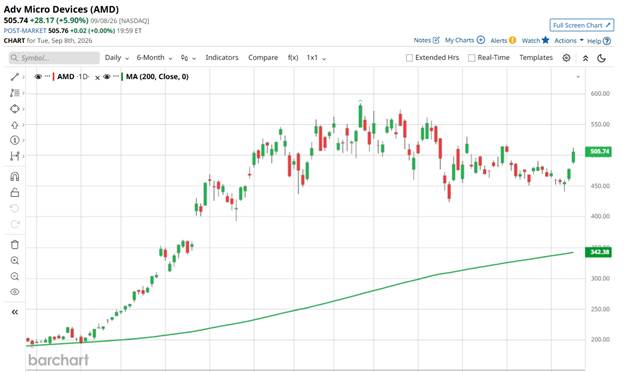
The stock has established a pattern of higher lows through the year, more than doubling from where it began 2026. The move has been driven by a series of positive AI-related catalysts and repeated analyst price target increases.
This technical strength broadly aligns with the net bullish options positioning we observed, where traders are paying up for upside exposure across multiple expirations. At the same time, the protective put activity in the flow is consistent with a stock that has run hard and where some players are locking in gains or hedging against a pullback from elevated levels.
The combination of strong price action, moving average alignment, and heavy options interest suggests the stock remains in an uptrend, albeit one where expectations and valuation have become demanding.
Risk Considerations
Despite the bullish net flow and strong momentum, AMD faces several near-term risks that traders should monitor carefully.
Valuation has become stretched following the enormous run in 2026. After more than doubling year-to-date, the stock prices in substantial future growth, leaving limited margin for disappointment if the AI ramp slows or slips.
Execution risk on the AI roadmap is real. The bull case leans heavily on the MI400 series, Helios, and the ramp of large OpenAI and Meta commitments. Any delays, yield issues, or slower-than-expected deployment could weigh on the stock given how much good news is already priced in.
Competition remains intense. Nvidia continues to dominate AI accelerators and has repeatedly reasserted its lead, and the software gap around CUDA versus ROCm is a persistent hurdle for AMD in winning workloads. Nvidia began outperforming AMD at points earlier in the year, a reminder that leadership in this space can shift quickly.
The two-sided options flow itself is worth respecting as a risk signal. The significant put buying at the $520, $420, and $410 strikes shows that large players are actively hedging downside, which is prudent behavior after a move of this magnitude and a sign that not everyone is positioned purely for further upside.
Finally, the semiconductor group as a whole is sensitive to macro headlines, including potential tariffs on chips and broader shifts in risk appetite. Any rotation out of high-flying AI names could hit AMD disproportionately given its year-to-date gains.
Trading Implications
While the institutional flow highlights potential trading opportunities, traders should consider risk-defined strategies that balance potential upside with downside protection given the elevated valuation and the two-sided nature of the positioning.
A covered call strategy offers an attractive method to generate income while maintaining exposure to AMD's upside. Selling calls against long stock can enhance returns in a sideways to moderately bullish market while providing some downside cushion through premium collection, which is appealing when a stock has already run hard.
More directionally-focused traders could explore bull call spreads as a capital-efficient, risk-defined way to participate. This approach caps maximum loss while still providing meaningful upside if the stock continues its advance, which is often preferable to buying expensive outright calls on a high-volatility name.
Conclusion
The significant options flow in AMD suggests institutional traders are net positioned for continued upside driven by AI data center momentum, major customer commitments, and a strengthening product roadmap.
The combination of strong technical positioning, positive fundamental catalysts, and net bullish institutional flow creates a constructive setup. However, a stretched valuation after 2026’s enormous rally means expectations are high and any disappointment could trigger meaningful volatility.
As with any options trading strategy, careful analysis, disciplined risk management, and a comprehensive understanding of both technical and fundamental factors are crucial.
Please remember that options are risky, and investors can lose 100% of their investment.
This article is for education purposes only and not a trade recommendation. Remember to always do your own due diligence and consult your financial advisor before making any investment decisions.
On the date of publication, Gavin McMaster did not have (either directly or indirectly) positions in any of the securities mentioned in this article. All information and data in this article is solely for informational purposes. For more information please view the Barchart Disclosure Policy here.