


Shake Shack (SHAK) Stock Still Looks Expensive Following A 31% Slump
Shake Shack has given shareholders a rough ride over the past year, yet the valuation checks suggest the stock still trades at a premium to what its cash flows and earnings multiples imply. With both the Discounted Cash Flow (DCF) intrinsic value estimate and the market based ratios pointing to the same conclusion, Shake Shack now looks more like a pricing question than a sentiment story.
- The share price has fallen 31.5% over the past year, which means recent buyers are sitting on clear losses despite the stock still screening as expensive.
- Investor optimism around restaurant expansion and long term sales growth can support a richer valuation, although pressure on store level profitability and cash generation remains a key risk for what investors are willing to pay.
- On a broad set of valuation checks, Shake Shack scores 0 out of 6, which signals it does not screen as a clear bargain on this framework 0 / 6 value score.
The issue now is whether Shake Shack's current share price already bakes in too much optimism compared with what the intrinsic value work suggests.
Broaden your options beyond Shake Shack by scanning 49 high quality undervalued stocks, which combines stronger fundamentals with pricing that aligns more closely with intrinsic value work.
Has Shake Shack Run Too Far on Cash Flow?
The Discounted Cash Flow (DCF) model here values Shake Shack on the cash the business is expected to generate for shareholders over time. Latest twelve month free cash flow sits at about $8.5 million, so the model leans heavily on a recovering and then growing cash flow profile rather than a large existing cash engine.
Based on those projections, the DCF points to an intrinsic value of about $59 per share. That figure compares with a market price that is about 13.5% higher, which means the stock screens as overvalued on this framework. For anyone considering Shake Shack, the key question is whether the optimistic free cash flow ramp that underpins this estimate feels realistic enough to justify paying more than the model suggests.
On this Discounted Cash Flow view, Shake Shack currently looks overvalued relative to its projected cash generation.
Our Discounted Cash Flow (DCF) analysis suggests Shake Shack may be overvalued by 13.5%. Discover 49 high quality undervalued stocks or create your own screener to find better value opportunities.

Does Shake Shack Look Pricey on Earnings?
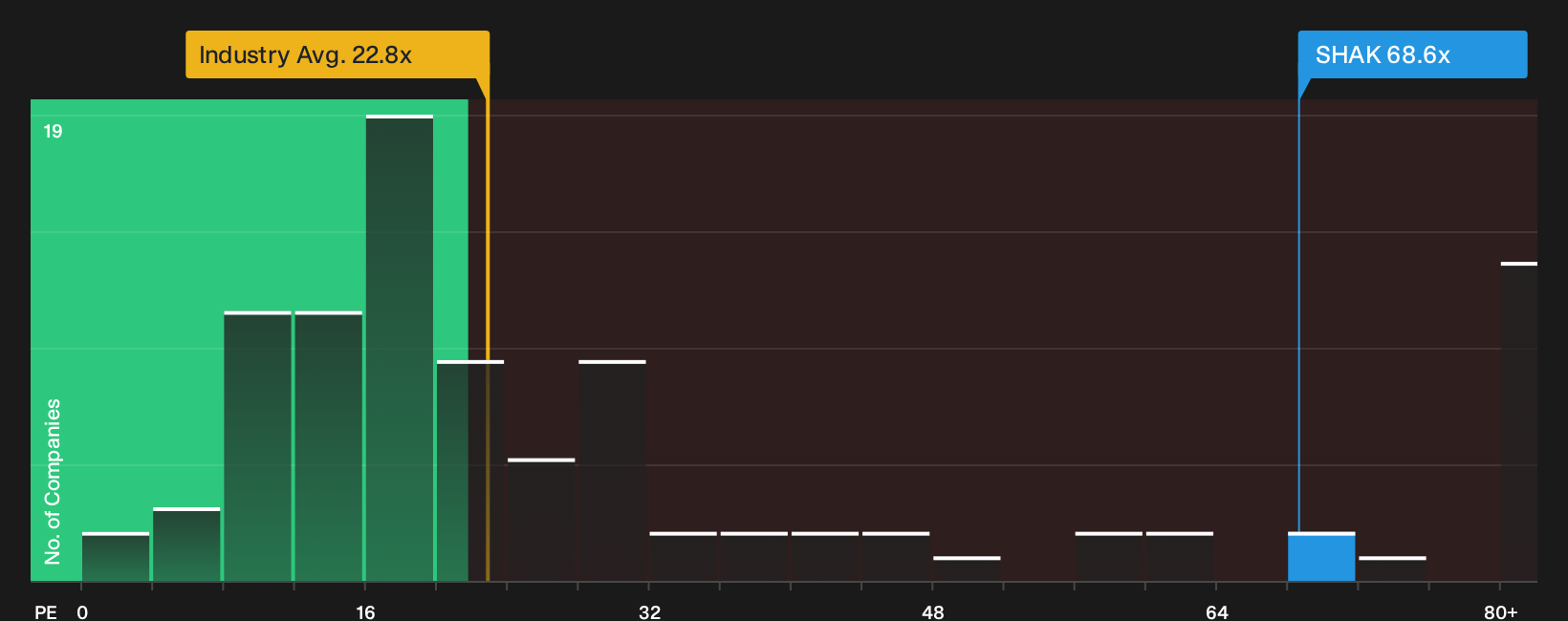
The P/E lens suits Shake Shack because earnings already exist and provide a clear link between what the business earns and what investors are paying. On this measure, the stock trades at about 68.6x earnings, which is far above the hospitality sector average of roughly 22.8x and also above peers around 18.8x.
The fair P/E multiple from this model is about 24.3x, which already factors in Shake Shack's profile, sector, size and risk. The current valuation is almost three times that reference point, so buyers today are paying a steep premium for every dollar of profit compared with what this framework suggests would be reasonable.
On the P/E multiple, Shake Shack stock appears significantly more expensive relative to both its industry and the modelled fair ratio.
See what the numbers say about this price — find out in our valuation breakdown.
The Shake Shack Narrative: What Would Justify Today's Price?
Simply Wall St Narratives for Shake Shack pick up where the valuation puzzle leaves off. They spell out which assumptions on growth, margins and earnings would need to line up for Shake Shack's share price to sit materially above or below where it trades today. This turns a single model output into a set of future checkpoints that you can watch on the Community page to see whether the story behind the numbers still holds.
Community views on Shake Shack are split between a reset that unlocks more upside and a tougher scenario where guidance cuts still are not fully reflected.
Bull case: 15% undervalued
"Operational discipline via a standardized performance scorecard, leadership development, and supply chain optimization has delivered material improvements in labor productivity and cost control…"
Read the full Bull Case to see why Shake Shack could be undervalued
Bear case: 12% overvalued
"Intensifying health consciousness and mounting anti-fast food sentiment threaten to fundamentally erode Shake Shack's long-term traffic and sales growth…"
Read the full Bear Case to see why Shake Shack could be overvalued
Do you think there's more to the story for Shake Shack? Head over to our Community to see what others are saying!
The Bottom Line
Shake Shack looks overvalued on both the Discounted Cash Flow (DCF) work and the earnings multiple checks, so the burden of proof now sits firmly with the growth story. The valuation asks you to pay up today for future gains in cash generation and profits that are not yet visible in the recent numbers. For anyone interested, the key question is whether store level economics and free cash flow can improve fast enough to make that premium feel justified rather than simply expensive optimism.
This article by Simply Wall St is general in nature. We provide commentary based on historical data and analyst forecasts only using an unbiased methodology and our articles are not intended to be financial advice. It does not constitute a recommendation to buy or sell any stock, and does not take account of your objectives, or your financial situation. We aim to bring you long-term focused analysis driven by fundamental data. Note that our analysis may not factor in the latest price-sensitive company announcements or qualitative material. Simply Wall St has no position in any stocks mentioned.
Have feedback on this article? Concerned about the content? Get in touch with us directly. Alternatively, email editorial-team@simplywallst.com