


An AI Stock Launched a Rack-Scale System 30x Faster Than Nvidia’s GPUs. Here’s Why It Is Still a Risky Buy.
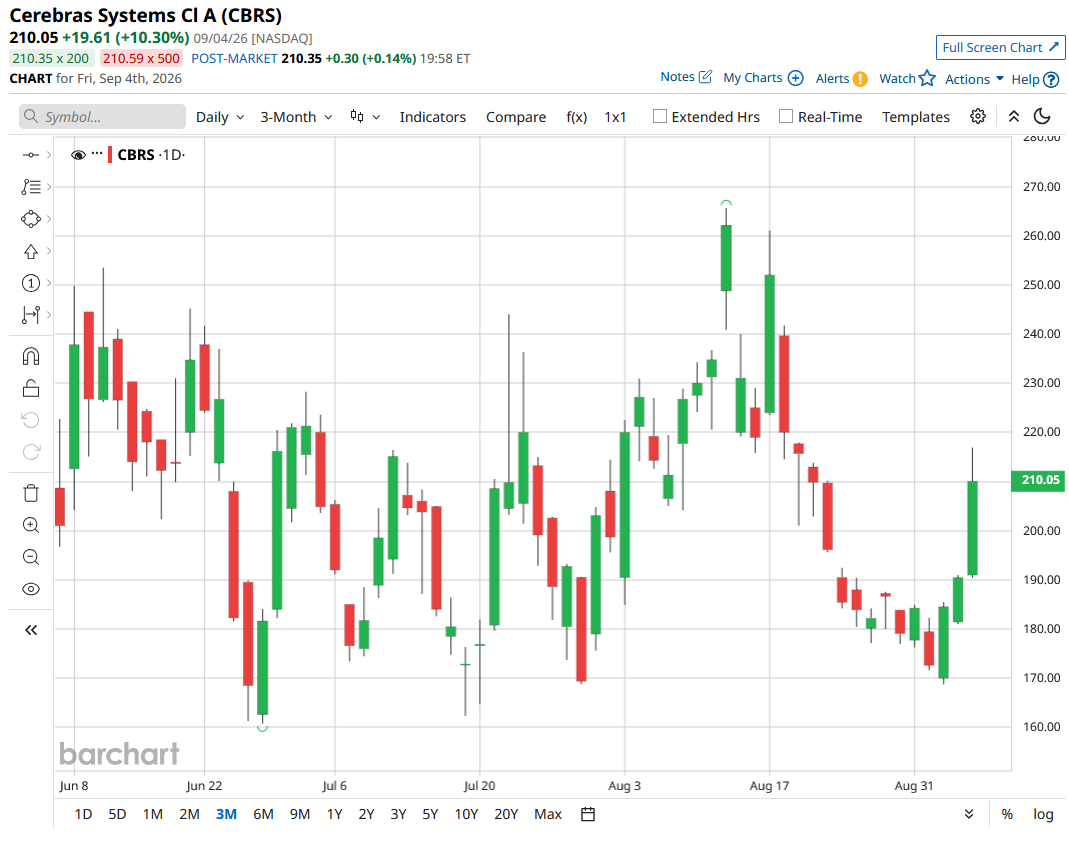
Over the past year, Cerebras Systems Inc. (CBRS) has continued to build a track record of technical milestones and high-profile partnerships, including its relationship with OpenAI and deals with hyperscale cloud customers like Amazon (AMZN), AMD (AMD), Microsoft (MSFT), and IBM (IBM). Adding to that momentum, the company recently introduced what it describes as the fastest AI accelerator currently available. It is the kind of product announcement that could normally trigger a strong rally in a semiconductor stock. Yet investors responded in the opposite direction, sending the shares sharply lower. The reaction contrasts with the stock’s bullish technical setup and suggests that institutional concerns may run deeper than the headline implies.
On August 19, Cerebras introduced the CS-4, a rack-scale AI accelerator powered by three new WSE 3 Turbo chips. The company claims CS-4 is the industry’s fastest AI accelerator and can deliver up to twice the performance of its CS-3 processor. It is also the first product to use Cerebras’ new Nexus rack-scale architecture. On GPT-OSS-120B, the accelerator can deliver more than 4,400 tokens per second per user. That makes it up to 30 times faster than GPU-based solutions (such as those from Nvidia (NVDA)) while delivering up to 10x higher throughput per watt.
The technology is fascinating, but investors are finding it hard to understand why the stock has done poorly since the launch. After all, if Cerebras is such a great AI inference play, the launch of a new product should cause the CBRS stock to skyrocket. We know that’s not what happened, and the reason may have everything to do with the stock's valuation. The company’s stock is priced for perfection, so when something unexpected happens, it is bound to tank. This unexpected development was the August 12 earnings report, where the company failed to meet Wall Street expectations. So a 30x performance improvement didn’t merit a higher multiple when the company was failing to meet revenue targets.
I believe this is only a temporary hiccup, and therefore the stock was worth adding on the dip. The CS-4 launch adds to the company’s case as a leader in high-speed AI inference, but the market response remains mixed. A post-launch price target reduction, along with continued concerns about HBM dependency, suggests institutional investors are still divided. It has recovered its one-month losses, but it is still down 19% from the peak, so worth adding to the portfolio at current rates.
About Cerebras Systems
Cerebras Systems is an artificial intelligence infrastructure company, known primarily for its large-sized computer chips that are especially beneficial in AI inference. It serves hyperscalers, AI labs, and other businesses utilizing AI in their workflows. The firm is headquartered in Sunnyvale, Calif.
The stock initially saw little movement in premarket trading following the CS-4 announcement. But the stock later came under heavy pressure, falling nearly 13%. A day later, Citi analyst Atif Malik took a more cautious stance, cutting his price target on the stock from $340 to $320. Despite the reduction, Malik maintained a Buy rating on the shares. Concerns around high-bandwidth memory (HBM) dependency have also emerged among bullish investors, with Cathie Wood’s ARK Invest continuing to buy shares despite those risks.
An Earnings Miss Questions the Rich Valuation
The company reported its second-quarter fiscal 2026 earnings on August 12, delivering record core revenue. Core revenue for the quarter came in at $209.9 million, exceeding analysts’ estimate of $193.55 million. Core hardware generated $82.1 million in revenue, while core cloud and other services delivered $127.7 million. Core gross margin declined sequentially from 46.5% in the first quarter to 40.6% in the second quarter. Cerebras posted a core operating loss of $33.6 million.
Looking ahead, management guided for third-quarter revenue of $214 million to $216 million. Core gross margin is projected to range from 38% to 40%, while core operating margin is expected to be between -25% and -23%. The company raised its full-year core revenue guidance to $880 million to $890 million and core gross margin guidance to 41% to 43%.
What Are Analysts Saying About Cerebras Systems?
Mizuho Securities, Morgan Stanley, Rosenblatt Securities, and Needham have all reiterated or assigned Buy ratings on the stock, with price targets ranging from $279 to $300. Craig Hallum also reaffirmed a Buy rating without assigning any price target. The broad analyst consensus points to strong confidence in the stock’s growth prospects.
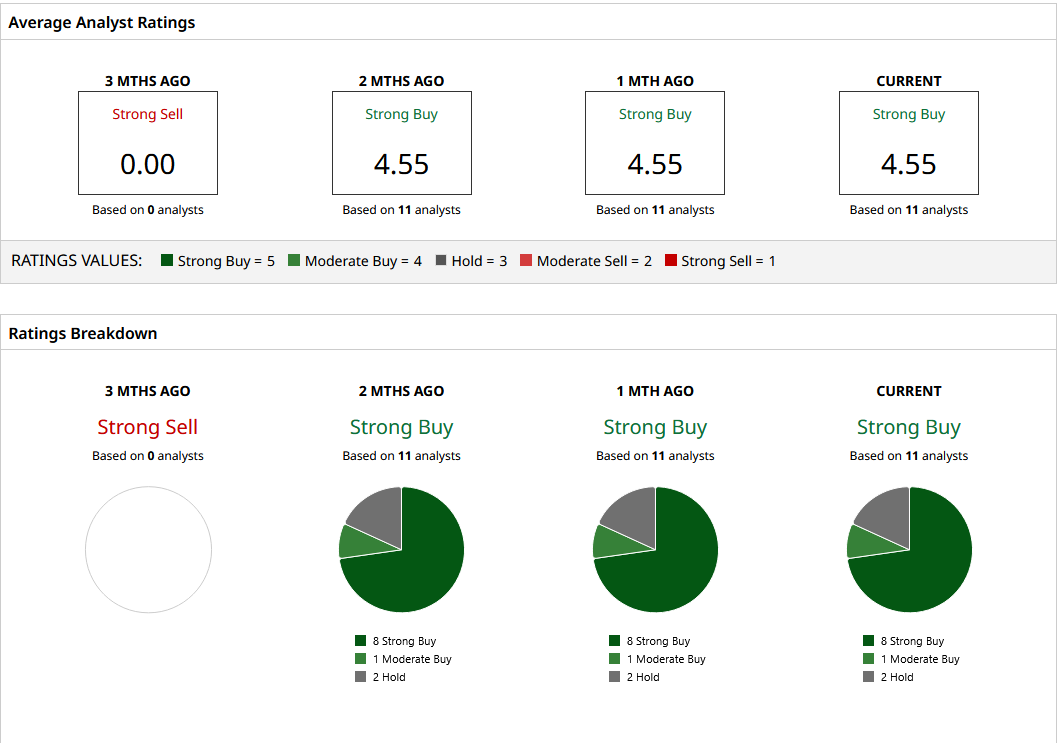
Overall, 11 Wall Street analysts covering the stock rate it a Strong Buy. Based on their estimates, it has an average price target of $283.91, reflecting a further 53% upside from current levels. In addition, the highest price target of $330 implies roughly 78% upside from the current share price.
On the date of publication, Jabran Kundi did not have (either directly or indirectly) positions in any of the securities mentioned in this article. All information and data in this article is solely for informational purposes. For more information please view the Barchart Disclosure Policy here.