


Altria Is Spending More on Capex Than Any Other Consumer Staples Name. It’s a Calculated Sign of Strength.
With the second-quarter earnings season mostly over, investors are watching how consumer staples companies are spending their cash. Capital expenditures serve as one useful clue, and Altria (MO) stands out. The tobacco company reportedly leads all consumer staples stocks with a 100% increase in capital expenditures, ahead of Kimberly-Clark (KMB) at 96.49% and Darling Ingredients (DAR) at 71.17%.
In its Q2 report on July 30, Altria raised its 2026 capex forecast to between $375 million and $450 million, from a prior range of $300 million to $375 million. The company tied the increase to its manufacturing-consolidation plans.
That makes the higher spending worth watching, especially after Altria’s Q2 results sent MO stock down 9.3% in one session. Adjusted EPS still rose almost 3% year-over-year (YOY) to $1.48, while the company returned nearly $3.9 billion to shareholders through dividends and buybacks in the first half of 2026.
Is Altria spending from a position of strength? Or is protecting its cash flow becoming more expensive? Let’s take a closer look.
The Numbers Behind the Investment
Altria makes most of its money from U.S. cigarettes, although it is also investing in smoke-free nicotine products. MO stock has gained more than 3% over the past 52 weeks and more than 19% year-to-date (YTD).
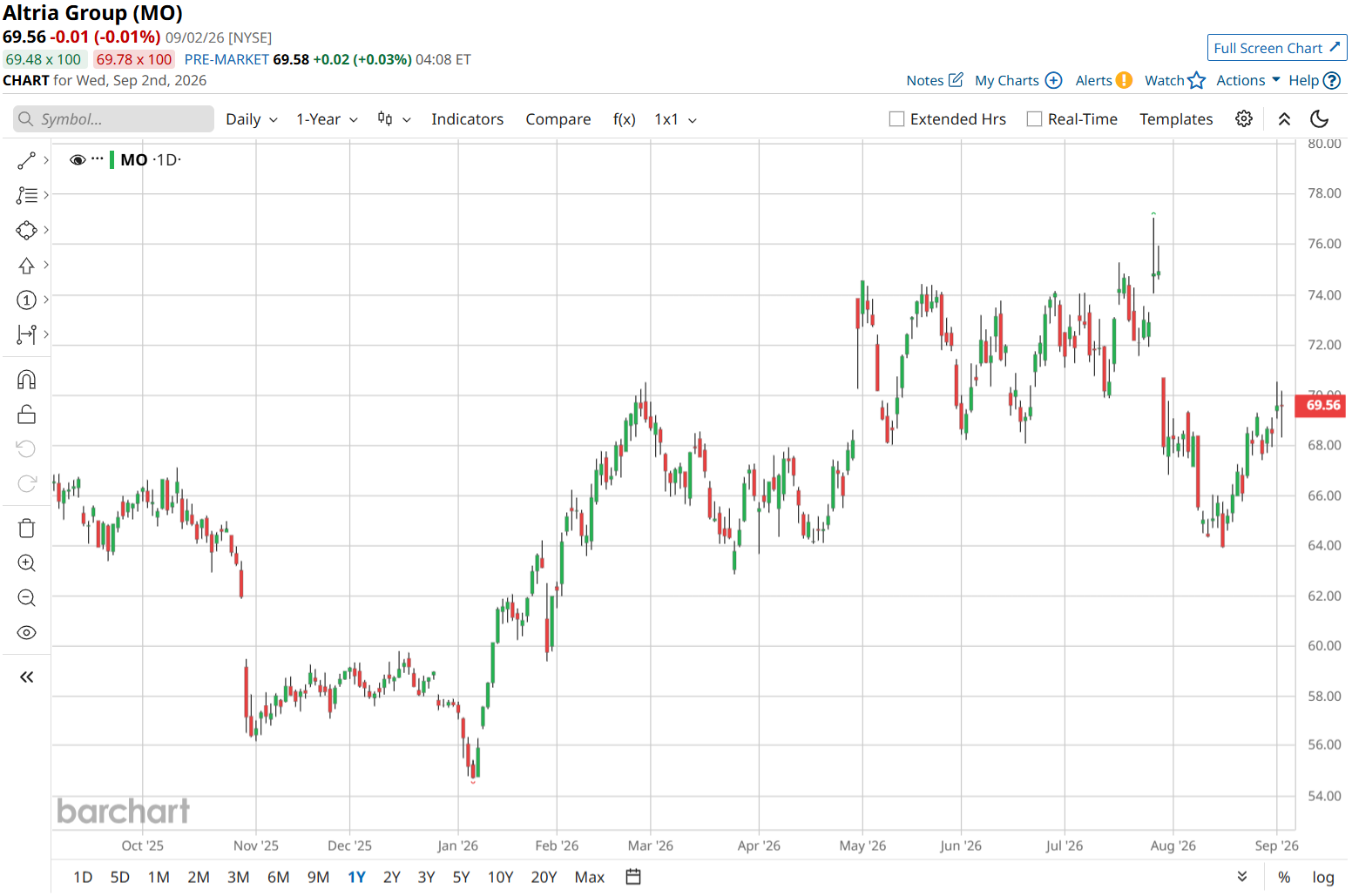
Even after that run, MO stock trades at 12.2 times forward earnings, which is below the consumer staples sector average of roughly 15 times.
The dividend is still a major reason investors own Altria. Its annual dividend is $4.24 per share, giving the stock a 6.1% yield. The latest quarterly payment was $1.06 per share, paid on July 10. Altria has raised its dividend for 57-straight years and pays it every quarter. Still, the 76.15% forward payout ratio means a large share of earnings already goes to the dividend, leaving less room when spending needs rise.
Q2 results showed why Altria can still afford to invest. Revenue rose 0.1% year-over-year (YOY) to $6.11 billion, while revenue excluding excise taxes increased 1.2% to $5.36 billion. Reported diluted EPS fell 2.8% to $1.37, but adjusted EPS rose 2.8% to $1.48. Meanwhile, first-half adjusted EPS climbed 4.9% to $2.80. Smokeable-products revenue excluding excise taxes rose 2% to $4.66 billion during Q2, while adjusted operating income increased 2.4% to about $3.02 billion. Altria's 64.8% margin helped offset a 3.2% drop in domestic cigarette shipments, or about 4.5% after adjusting for inventory.
Altria paid $1.8 billion in dividends during the quarter and $3.6 billion in the first half of the year. The company also spent $335 million on buybacks, bringing total first-half shareholder returns to nearly $3.9 billion. At the same time, the company raised its 2026 capex forecast to $375 million to $450 million from $300 million to $375 million, mainly to consolidate U.S. Smokeless Tobacco Company (USSTC) manufacturing operations. Management still expects 2026 adjusted EPS of $5.61 to $5.72, up 3.5% to 5.5% YOY.
Why Altria’s Capex Surge Signals Strength
Altria has seen its capex rise faster than any other consumer staples stock. Data shows capex rose about 100% YOY. Still, the actual dollar amount is not huge for a company of Altria’s size. Capital expenditures increased 52% to $216 million in 2025 from $142 million in 2024. For 2026, management first guided for $300 million to $375 million in capex, then lifted that range to $375 million to $450 million.
The spending has a clear purpose. Altria is putting money into contract manufacturing with Philip Morris International (PM), as well as import and export operations. The arrangement could help Altria capture duty-drawback benefits and support future product plans. The bigger reason for the higher capital expenditures, though, is USSTC's plan to move work from its older Nashville, Tennessee facility to a new site at its Hopkinsville, Kentucky campus. The company expects Nashville production to end in early 2028. By putting more processing, production, and packaging in one place, Altria aims to cut costs and simplify operations.
For now, this looks more like planned spending than a sign of trouble. Altria still produces roughly $9 billion in annual operating cash flow and continues to return billions of dollars through dividends and buybacks. The real test is whether the spending leads to lower costs and stronger growth in oral tobacco over time.
Analysts Debate Altria’s Upside
Altria is set to report Q3 results before the market opens on Oct. 29. Analysts expect earnings of $1.50 per share for the September quarter, up more than 3% from $1.45 a year ago. For full-year 2026, the average estimate is $5.67 per share, which would be roughly 5% higher than the $5.42 reported in fiscal 2025.
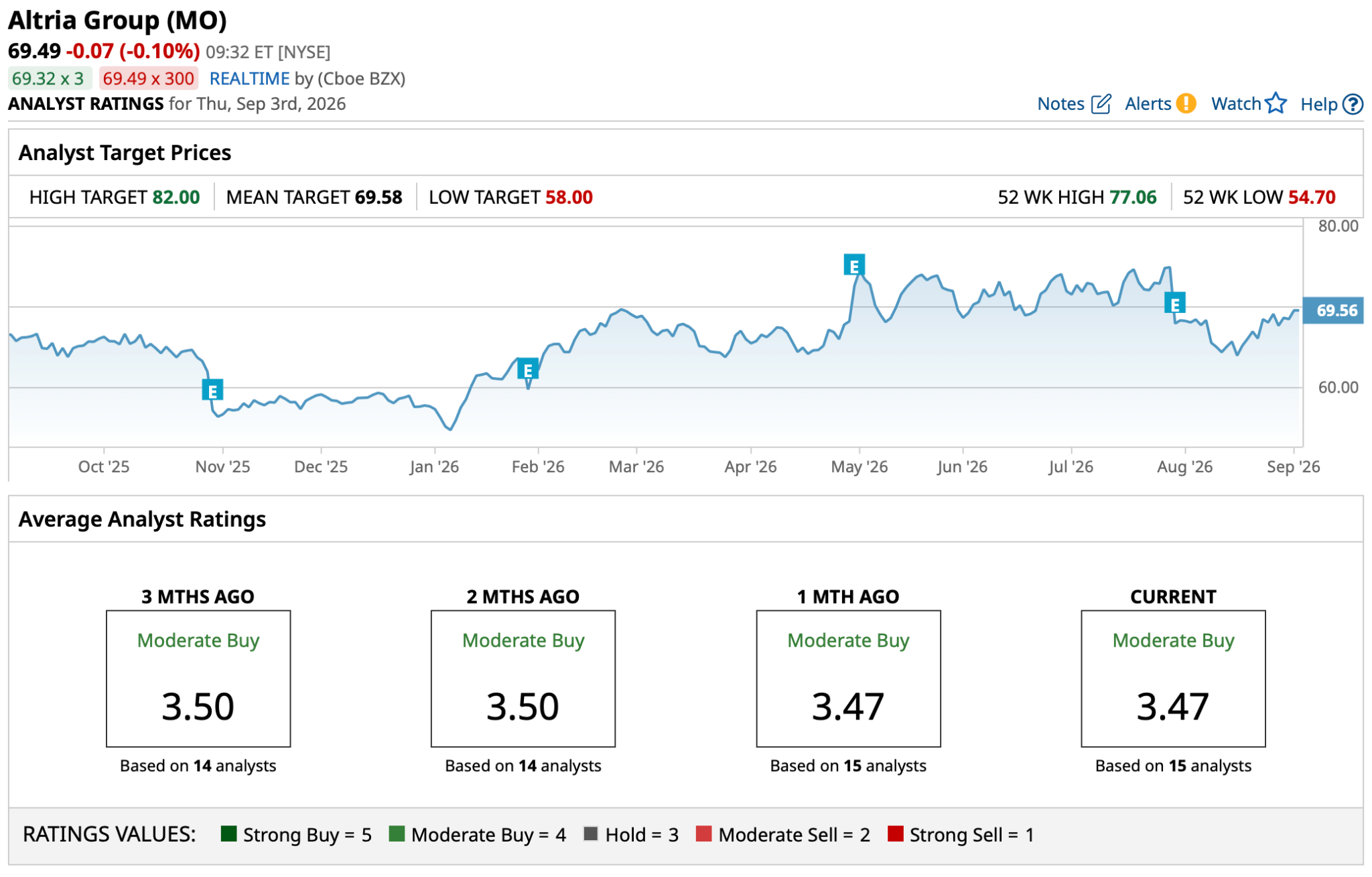
UBS analyst Faham Baig is bullish on MO stock. On July 7, Baig kept a “Buy” rating on Altria and raised his price target to $79 from $76. Barclays sees less upside, however; analyst Pallav Mittal kept an “Underweight” rating while lowered the price target to $58 from $64 on Aug. 11.
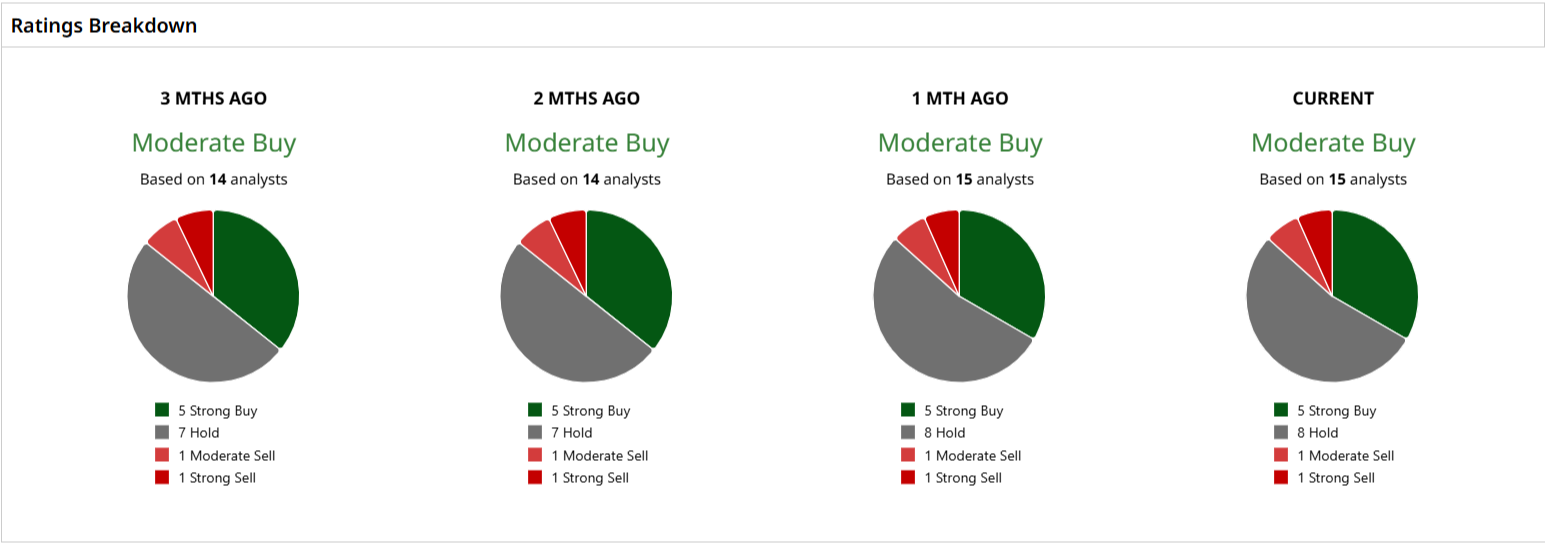
Overall, Altria stock has a consensus “Moderate Buy" rating on Wall Street. The average price target of $69.58 points to potential upside of just 1% from current levels.
Conclusion
Altria’s higher capex looks more like a calculated sign of strength than a warning, at least for now. The investment is targeted at modernizing smokeless-tobacco manufacturing rather than a broad, speculative spending push, while the core cigarette business still produces the margins and cash flow needed to fund dividends, buybacks, and growth initiatives. The caution is that cigarette volumes continue to decline and next-generation nicotine competition is intensifying, so the payoff must show up in better efficiency and smoke-free growth. With MO stock near analysts’ average target, shares will most likely trade sideways in the near term, with dividend income providing the main support.
On the date of publication, Ebube Jones did not have (either directly or indirectly) positions in any of the securities mentioned in this article. All information and data in this article is solely for informational purposes. For more information please view the Barchart Disclosure Policy here.