


President Trump Bought BA Stock the Same Day Boeing Won an $880M U.S. Navy Contract
Presidential investment portfolios are usually incredibly boring and risk-averse. While Barack Obama was in office, his asset mix was pretty much limited to U.S. Treasury Notes and index funds. But everybody knows Donald Trump likes to do things differently.
Across the first year of Trump's second term, his financial advisors made more than 21,000 trades on his behalf. The president chalked up more than 1,000 securities transactions in the month of June alone. And while some of those trades are simply following conventional wisdom, others are a bit harder to explain. That’s why everybody’s zooming in on one particular purchase.
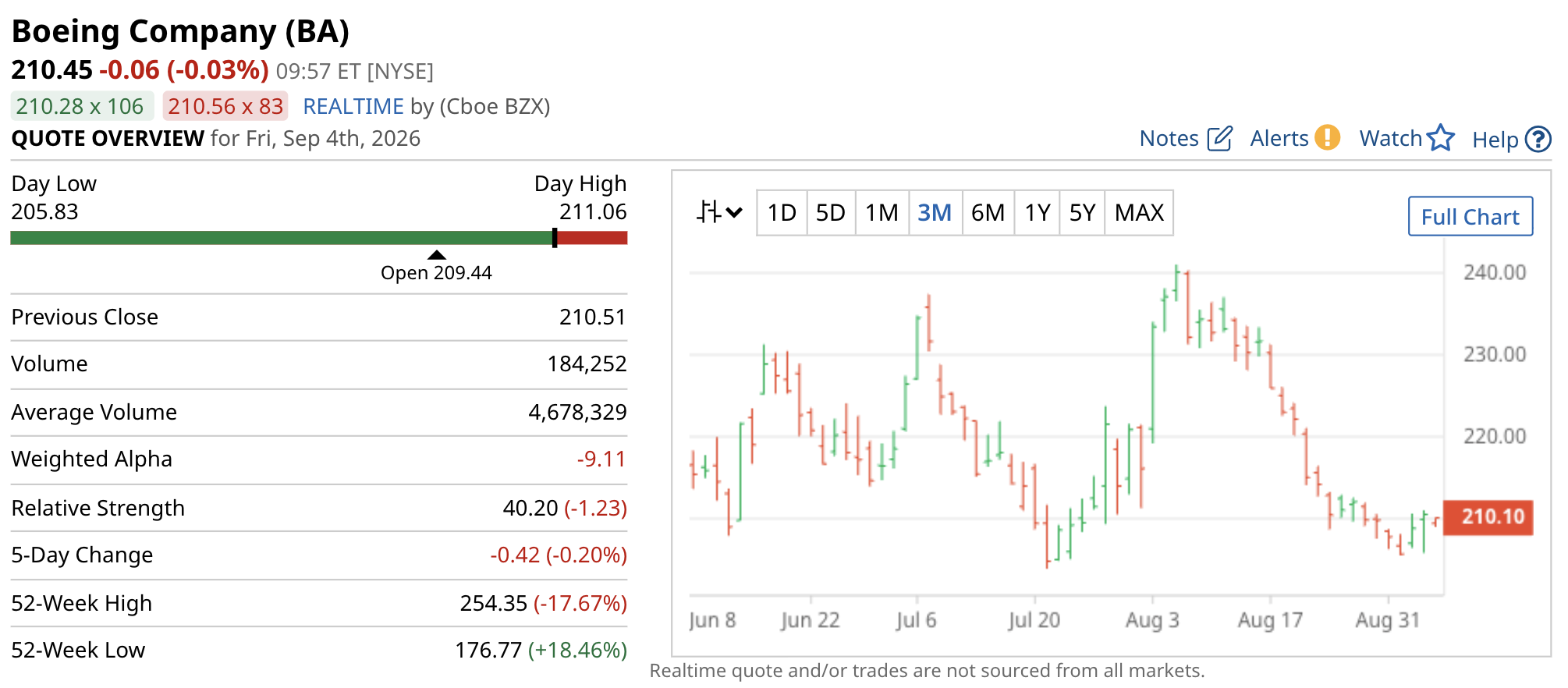
According to his latest federal financial disclosure, Trump purchased between $250,001 and $500,000 shares of Boeing (BA) on June 18. Why is that interesting? Because on that very same day, the U.S. Navy awarded Boeing an $880 million contract.
The term “insider trading” gets thrown around a lot these days, and this trade certainly looks suspicious. But at this point, nobody’s alleging the president did anything illegal, and there’s no proof he had any clue what the Navy was doing. If you really crunch the numbers, this Navy contract isn’t actually as big and impactful as it sounds either.
Even so, you can’t deny the optics on this are pretty bad. So, it’s worth breaking this one down into bite-sized chunks. What really happened, and did any rules actually get broken?
A Tale of Two Transactions
First, let’s look at the numbers. Trump’s latest federal disclosure was published at the end of August, and it outlined all 1,051 trades that were made on his behalf over the course of June. One of those trades was a purchase of Boeing stock dated June 18 in a range of $250,001 to $500,000. The filing doesn’t disclose the exact dollar amount (because it doesn’t have to under federal disclosure rules), which is why the media has jumped on this $500,000 figure. We don't know how big his stake is, so a lot of the coverage of this you’ve seen floating around on social media is probably overstating the facts.
Another important distinction is that this transaction wasn’t made public until two months later, and so investors couldn’t have known the president had bought this stock.
Then there’s the Navy's Boeing transaction. On the exact same day that an account representing Trump bought shares of Boeing, the Naval Air Warfare Center Training Systems Division awarded the company a sole-source indefinite-delivery/indefinite-quantity (IDIQ) contract for the procurement, modernization and sustainment of P-8A aircrew and maintenance training systems.
The contract’s total potential value is $880 million, which has definitely raised some eyebrows when placed beside the president’s purchase. But this navy contract only establishes a potential $880 million ceiling over five years. The money is committed through individual orders later, and no funds were obligated at the time of the award.
There’s also no evidence the date is a causal link. But the controversy in all this stems from Trump’s unique position. As a normal investor, you study the fundamentals and then buy Boeing stock in the hopes that the company’s government business ends up growing. As president, you have direct influence over that growth. The federal government is one of Boeing’s top customers, and the Trump administration has a huge say on defense spending, procurement, and military policy. It doesn’t take a lawyer to spot a potential conflict of interest here.
Even so, the White House has said on numerous occasions that Trump’s investments are all made by independent third-party financial institutions. The official line is that Trump doesn’t direct individual trades. If that’s true, it looks like the president’s financial advisors have incredible instincts.
Then again, this Navy contract shouldn’t have come as a surprise to anyone in the know. After all, Boeing is the original designer and manufacturer of the P-8A. So if the Navy needed a company to come in and modernize it, why would they hire anyone other than Boeing?
The Law Is More Complicated Than You Think
There is this huge misconception that any time we see a financial conflict involving the executive branch, it must violate federal conflict-of-interest laws. But that’s not true at all.
Under federal law 18 U.S.C. § 208, executive branch employees are prohibited from participating personally and substantially in government matters that affect their financial interests. Believe it or not, the president isn’t actually covered by that wording, nor by the STOCK Act that covers Congress. That doesn’t mean Trump is exempt from securities laws. Insider trading rules prohibit trading securities using material nonpublic information, and those rules apply to everybody (even the president). But it’s impossible to prove insider trading occurred in this instance.
We know the trade happened, we know the contract was awarded, and we know they happened on the same day. But there’s no material evidence to tell us that one event caused the other. So, you can’t really call this insider trading.
If you're a big fan of the president, that probably comes as no surprise. If you're on the other side of the political aisle, this probably isn't what you wanted to hear. But if nothing else, markets should treat this as an important lesson in ethics and transparency.
The coincidence here is big enough that it deserves scrutiny, and this might be the perfect time to kick-start a fresh debate on whether the president should be able to own shares in companies that have significant dealings with the government. After all, it's hard to place faith in the system when it doesn't look like the system works the same for everybody.
On the date of publication, Nash Riggins did not have (either directly or indirectly) positions in any of the securities mentioned in this article. All information and data in this article is solely for informational purposes. For more information please view the Barchart Disclosure Policy here.