


Tesla’s Mixed European Sales Send Clear Signal on Regional Demand
Tesla (TSLA) was once the undisputed king of the global EV market. However, in recent years, it has wrestled with growing competition from new entrants and established legacy players.
New numbers from Europe for August 2026 show Tesla sales surging in some countries and sinking in others. EV sales in Europe continue to grow steadily in 2026 across multiple markets. Let’s see whether Tesla can keep gaining market share in an expanding addressable market.
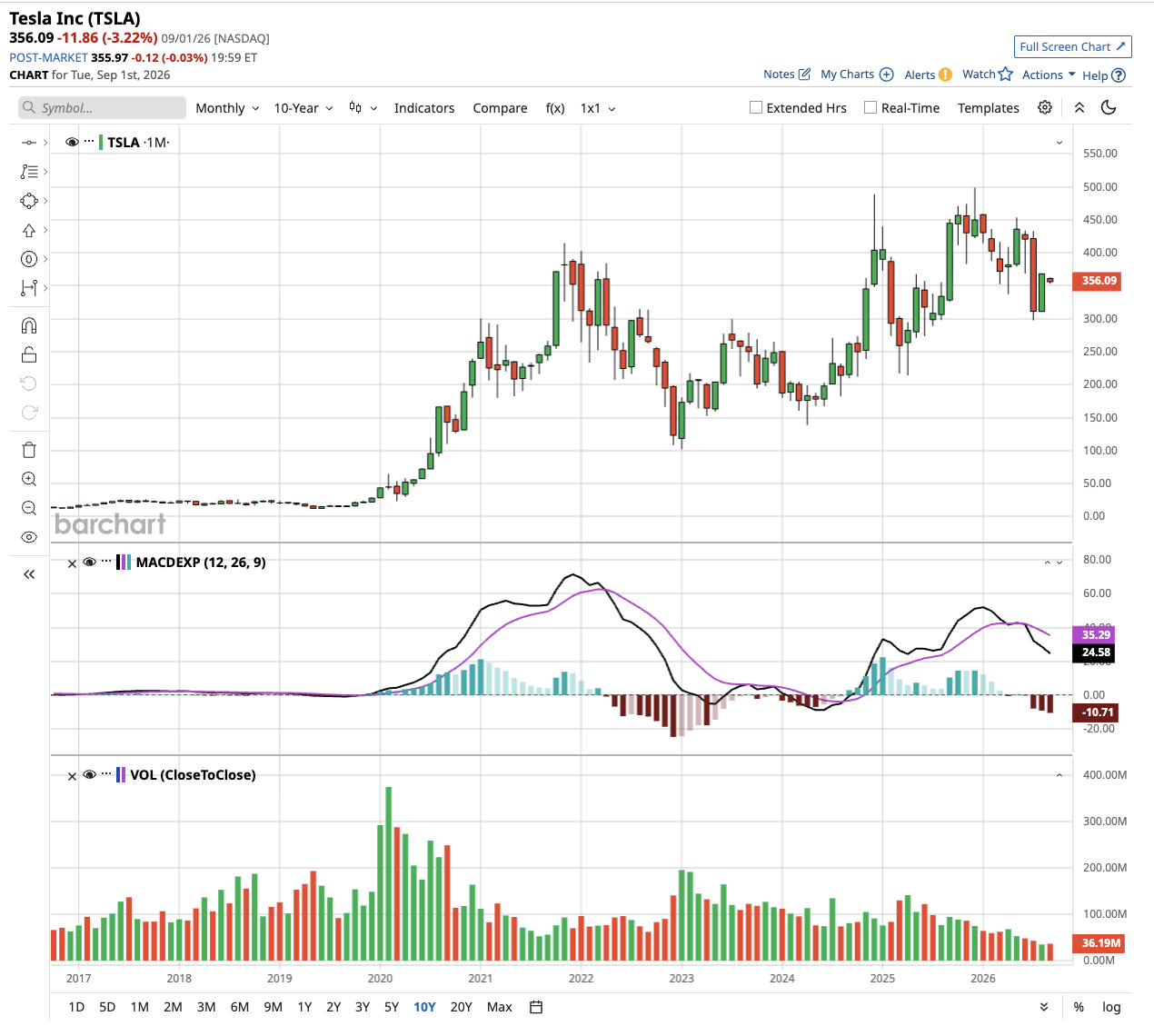
Is Tesla Stock Dependent on EU Sales Numbers?
According to a Reuters report, which cited data from national auto industry groups, Tesla's August vehicle registrations moved in opposite directions depending on the country.
- In France, registrations jumped 279% compared with a year earlier.
- Denmark was also strong, up 104%, according to French car industry body PFA and Danish vehicle data platform bilstatistik.dk.
- Norway and Spain both saw registrations drop 79%.
- Sweden fell 41%, Portugal dropped 37%, and Italy declined 36%, according to figures from Norway's OFV, Mobility Sweden, Spain's ANFAC, Portugal's ACAP, and Italy's Transport Ministry.
Rico Luman, senior economist at ING Research, told Reuters that the French and Danish gains reflect rising EV adoption paired with Tesla's more affordable pricing in those markets. He called the surge remarkable, noting that the pool of EV models keeps growing and that Chinese automakers are now playing a bigger role too.
Matthias Schmidt, an analyst at Schmidt Automotive, told Reuters that last year's Norwegian numbers were inflated by buyers rushing to purchase ahead of a fiscal policy change set for the end of 2025, which made this August's comparison brutally tough.
Zooming out, Tesla's European sales have rebounded in 2026 after two straight years of declines, helped by easier comparisons, higher fuel prices, government incentives, and growing interest in electric cars, Reuters reported.
EV Stocks Ride a Broader European Shift
New battery electric vehicle registrations reached a 24% share of all new vehicles sold in Europe in July 2026, according to a report from the International Council on Clean Transportation.
The ICCT report stated:
- Averaged across January through July, battery electric vehicles made up 22% of new registrations, three percentage points above the full year 2025 average.
- Plug-in hybrids grew more slowly, reaching a 10% average share for the same seven-month period, up just one percentage point from a year earlier.
- Traditional gas-powered vehicles fell to 29% of new registrations, down nine percentage points from the same period in 2025.
- Germany and France, Europe's two largest car markets, posted battery electric shares of 26% and 29%, respectively, in the January through July window, gains of eight and eleven percentage points from a year earlier.
- Norway led the continent with a battery electric share of 98%, followed by Denmark at 80%, according to the data.
On emissions compliance, the ICCT found Tesla was running eight grams of CO₂ per kilometer below its regulatory target as a manufacturer pool for 2025 through 2027, putting it among the automakers on track to meet European Union rules.
Individually, Tesla's brand-level performance was 92 grams below its projected target, the widest margin of any major brand tracked, according to the report.
What It Means for TSLA Stock Going Forward
None of this data exists in a vacuum for Tesla. In its Q2 earnings call, led by CEO Elon Musk and CFO Vaibhav Taneja, the company described a business leaning hard into Robotaxi expansion, Optimus robot production, and new chip development alongside core vehicle sales.
Taneja told investors on that call that Tesla achieved record second-quarter deliveries globally, with sequential growth of 60% in the Americas, 27% in the Asia Pacific region, and 12% in Europe, the Middle East, and Africa.
He also noted that automotive margins, excluding regulatory credits, slipped from 19.2% to 16.3% sequentially, partly as a warranty benefit from the prior quarter did not repeat. Tesla is investing heavily in future bets like autonomous driving and robotics, while its traditional car business still has to prove it can grow steadily market by market.
For now, investors watching Tesla's stock will likely keep one eye on Robotaxi mileage updates and one eye on monthly European registration data, since both are shaping how Wall Street values the company's next chapter.
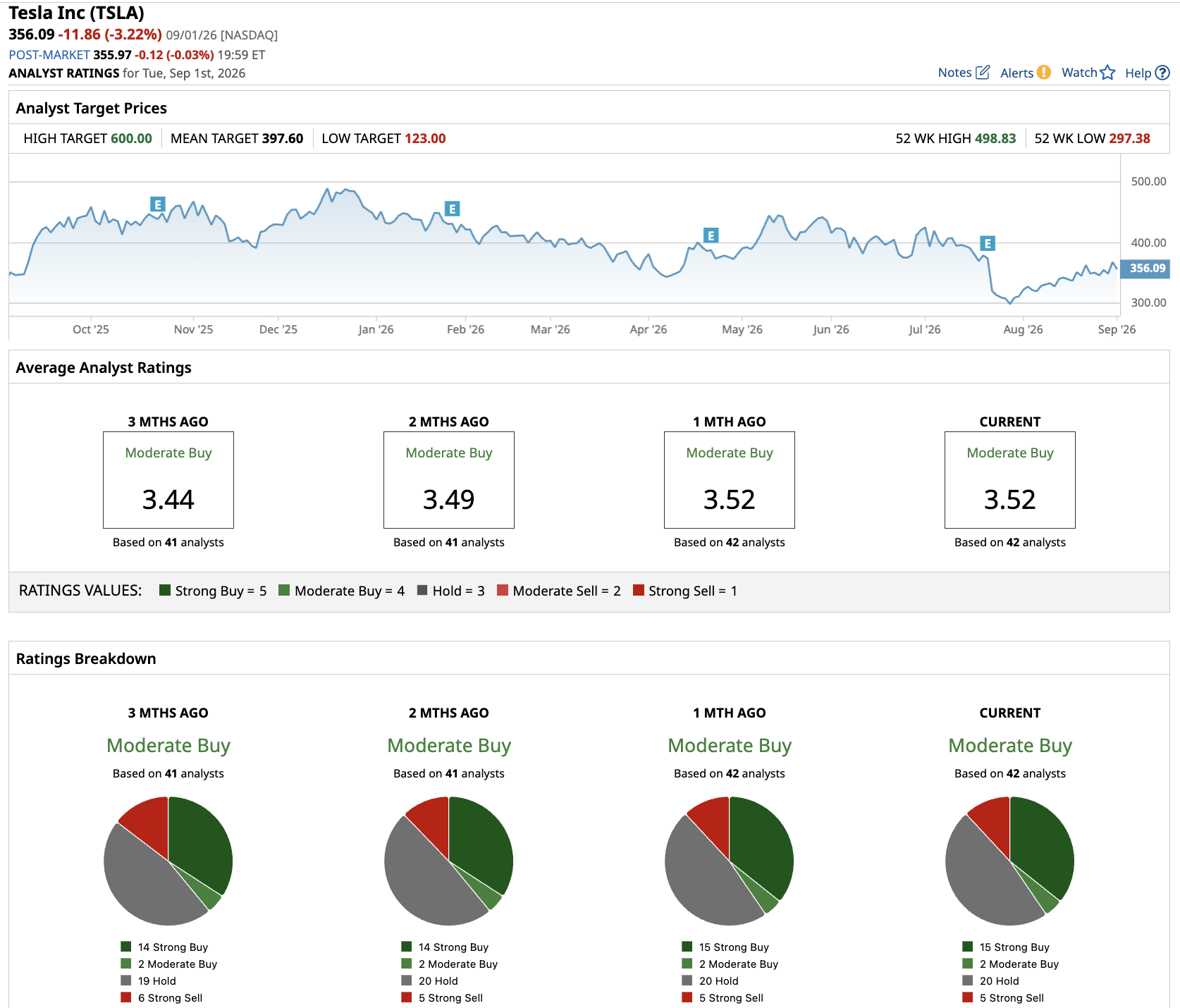
Out of the 42 analysts covering TSLA stock, 15 recommend “Strong Buy,” two recommend “Moderate Buy,” 20 recommend “Hold,” and five recommend “Strong Sell.” The average TSLA price target is $398, above the current price of $356.
On the date of publication, Aditya Raghunath did not have (either directly or indirectly) positions in any of the securities mentioned in this article. All information and data in this article is solely for informational purposes. For more information please view the Barchart Disclosure Policy here.