


Tencent Claims Its New Model Outshines Moonshot and Z.AI. What That Means for TCEHY Stock Here.
Chinese diversified technology conglomerate Tencent (TCEHY) recently reported that its new artificial intelligence (AI) model performs better than models belonging to relatively newer labs like Z.AI and Moonshot. While Z.AI is known for its General Language Model (GLM), Moonshot's Kimi models have grabbed headlines following the release of its flagship K3 model.
Now, Tencent claims its Hy4 Preview has reportedly outperformed the models of these newer AI upstarts. Primarily aimed toward coding, game development, and scientific research, the model works on 770 billion parameters, has 49 billion active parameters per token, and a token context window exceeding 1 million.
About Tencent Stock
A comparison of these models across some key parameters is warranted, but before doing that we should take a look at Tencent's scale of operations.
Founded in 1998, Tencent is currently one of the world's most diversified internet platforms. Over the years, the company has evolved into a social network, a gaming powerhouse, an advertising platform, a fintech and payments firm, a cloud company, an AI developer, and an investment holding company.
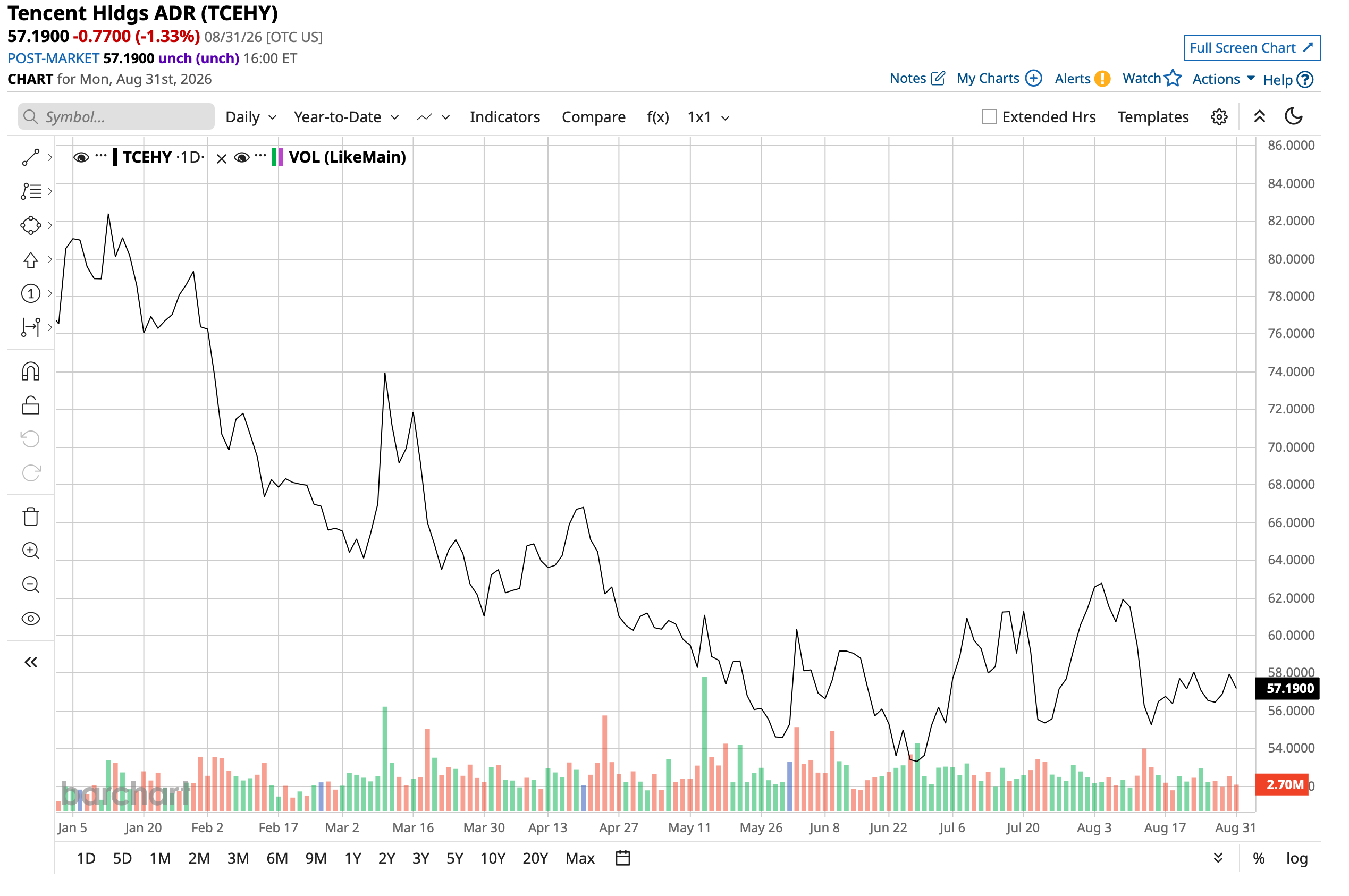
With a total market capitalization of $510.5 billion, TCEHY stock is down 27% on a year-to-date (YTD) basis. The ADR also has a dividend yield of 1.06%.
A Look at Hy4, Kimi K3, and GLM 5.2
So, how does Tencent's new model fare against both Z.AI and Moonshot's flagship models?
In terms of parameters, Hy4 seems to sit right in the middle, with Kimi K3 appearing to be ahead of the others. While the Kimi K3 runs on 2.8 trillion parameters, Z.AI's GLM 5.2 works on just 744 billion, lower even than Tencent's Hy4. In terms of active parameters, Kimi K3 is also ahead at 104 billion per token, compared to Hy4's 49 billion and GLM 5.2's 40 billion.
In terms of reasoning and coding, the picture is a bit more unclear, as Hy4's test was internal and could be biased. However, for Kimi K3 and GLM 5.2, the difference is minimal, with Kimi K3 slightly ahead. Notably, Kimi K3 has a GQPA Diamond score of 93.5 on Hugging Face, while GLM 5.2's score stands at 91.2.
Meanwhile, when it comes to multimodality, Kimi trumps the Hy4 and GLM 5.2. Kimi K3 has native vision through its vision encoder MoonViT-V2, which allows it to work with text, images, and video. On the other hand, Hy4's public model documentation primarily emphasizes text-based productivity capabilities, while GLM-5.2 is mainly a language/coding model.
However, distribution is where Tencent enjoys a competitive advantage over Z.AI and Moonshot. Tencent can immediately distribute the Hy4 through Tencent Cloud, the WeChat ecosystem, WorkBuddy/CodeBuddy, and its entire enterprise ecosystem. This large real-world deployment will enable the firm to assess how Hy4 performs in the field and improve its next iterations accordingly.
Tencent Reports Stable Q2
Tencent's most recent quarter was marked by revenue growth as well as a slight decline in earnings. Revenue increased 11% from the previous year to RMB204.8 billion, with the fastest-growing segment remaining Marketing Services. The segment, which houses the company's advertising business, grew 22% on a year-over-year (YOY) basis to RMB43.6 billion. Gross margins improved slightly to 58% from 57% in the year-ago period.
However, operating margins corrected to 33% from 34% in the prior quarter due to a rise in key operating expenses. Overall, earnings rose 2% YOY but slipped sequentially to RMB6.104 per share from RMB6.302 per share in Q1.
Tencent's net cash position fell 22% YOY to RMB52.8 billion. This was due to the massive 176% YOY growth in capital expenditures to RMB52.8 billion. Overall, Tencent ended the quarter with a cash balance of RMB206.9 billion, with no short-term debt on its books, reflecting strong liquidity.
Meanwhile, growth in some key operating metrics stagnated or even corrected, which is concerning. WeChat continues to be the exception, with users now standing at 1.44 billion, up 2% YOY. However, numbers for both social media platform QQ and Value-Added Services (VAS) witnessed 2% declines to 520 million monthly active users (MAU) and 259 million subscriptions, respectively.
Finally, Tencent's valuation multiples are projecting mixed signals, even with a fall in the ADR price. The forward price-to-earnings (P/E) ratio of 14.2 times and price-to-sales (P/S) ratio of 4.9 times both come in above the respective sector medians.
What Do Analysts Think of Tencent?
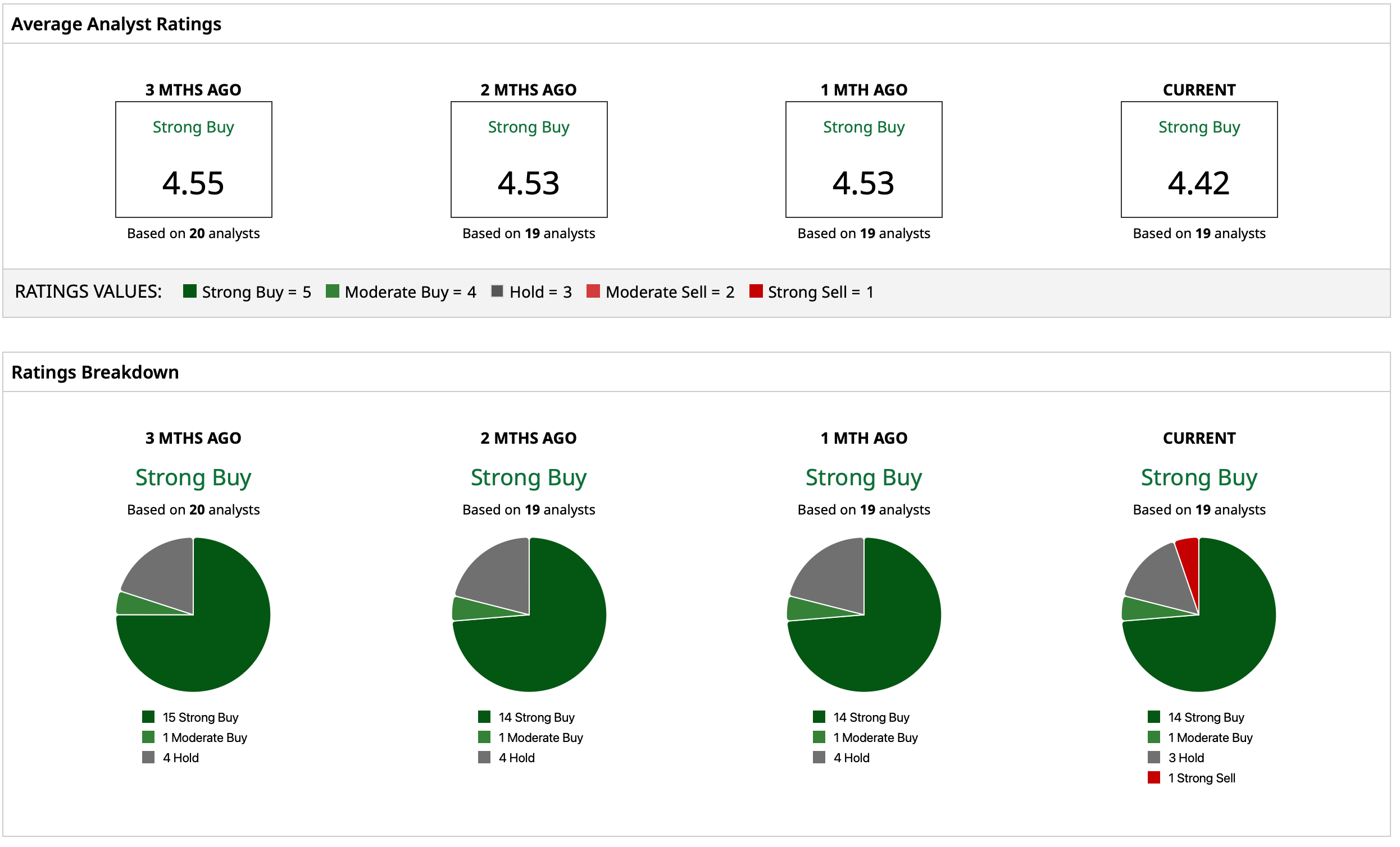
Overall, analysts still have a consensus “Strong Buy” rating for TCEHY stock. Out of 19 analysts covering the stock, 14 have a “Strong Buy” rating, one has a “Moderate Buy” rating, three have a “Hold” rating, and one has a “Strong Sell” rating. The mean target price of $106 indicates potential upside of 89% from current levels.
On the date of publication, Pathikrit Bose did not have (either directly or indirectly) positions in any of the securities mentioned in this article. All information and data in this article is solely for informational purposes. For more information please view the Barchart Disclosure Policy here.