


Commonwealth Bank Stock And 2 More Dividend Powerhouses For Higher Income
Government bond yields across the US, Europe and Japan are moving higher, which keeps pressure on income investors who rely on predictable cash flow. In a world where bond prices can swing with every policy speech, a well covered 5%+ dividend that has a record of stability and growth can look especially attractive. This article discusses three Dividend Powerhouse stocks from the screener that fit that description.
The three stocks discussed below are a sample of what this Dividend Powerhouses idea can look like in practice, while the full screen surfaced 30 more companies with similarly solid yield, coverage and stability profiles that are not covered here. If you want to quickly focus on the ones that best fit your income goals, head straight into the Dividend Powerhouses (3%+ Yield) screener to identify opportunities, analyze fundamentals and prioritize your highest conviction dividend plays.
Computershare (ASX:CPU)
Computershare is best known for its issuer services and share registry business, which keeps shareholder records up to date and handles dividend payments and corporate actions for listed companies, making it a direct operational link in the dividend powerhouse theme. The company also earns meaningful revenue from Corporate Trust, employee share plans, and communication and technology services, with Issuer Services at about US$1.3b and Corporate Trust at about US$1.0b out of total reported segment revenue. Computershare has a market value of roughly A$22.6b, reflecting its global footprint across North America, Europe, Asia and the Pacific.
Income focused investors may find Computershare interesting because it both pays dividends and runs the infrastructure that helps hundreds of other companies pay theirs. Solid recent results, with management revenue and earnings moving higher and a sizeable ordinary dividend declared in August 2026, point to a business that is still generating healthy cash flows. At the same time, the group’s heavy exposure to interest rate sensitive margin income and recent client losses in registry services mean the dividend is not a set and forget story. The real opportunity lies in how confidently you view its digital investment push, strong balance sheet and buyback capacity compared with those risks. That is where the deeper analysis becomes critical.
Computershare’s rising management revenue and fresh August 2026 dividend headline tell only half the story. Get the fuller income and risk picture through the 3 key rewards and 1 important warning sign that could shift how you view its registry engine and rate exposure

QBE Insurance Group (ASX:QBE)
QBE Insurance Group is a global general insurer and reinsurer that covers everything from commercial and domestic property to motor, liability, crop and specialty risks. It regularly returns capital to shareholders through a high, earnings supported dividend policy that fits the Dividend Powerhouses theme. Revenue is well diversified, with about US$12.2b from International operations, US$8.3b from North America and US$5.8b from Australia Pacific, plus a small Corporate and Other segment. The company has a market value of roughly A$32.8b.
Income investors looking at QBE Insurance Group will likely be drawn to its long history of paying meaningful dividends that are backed by underwriting profits, investment income and a solid capital position, recently affirmed by strong credit ratings and H1 2026 results that supported an ordinary A$0.33 interim dividend and a A$450m buyback. At the same time, pressures from softer premium rate growth, higher catastrophe and large loss volatility and the need to keep investing in technology mean future margins and dividend capacity cannot be taken for granted. The interest lies in whether QBE’s diversification across regions and product lines, along with its focus on cyber insurance and capital efficiency tools such as cat bonds and sidecars, can keep turning that risk into a steady income stream for shareholders without unwelcome surprises on claims or costs.
QBE Insurance Group’s capital returns story is gaining momentum, but the real question is how secure that income stream looks when the next round of claims volatility hits. Tackle that puzzle with the 3 key rewards and 1 important warning sign

Commonwealth Bank of Australia (ASX:CBA)
Commonwealth Bank of Australia is one of the country’s largest retail and commercial banks, paying sizeable dividends that are mainly funded by interest and fee income from everyday banking products like home loans, business lending and deposits. The biggest revenue contributors are Retail Banking Services, including Bankwest, at about A$13.4b and Business Banking at about A$9.7b, followed by New Zealand at about A$3.0b and Institutional Banking and Markets at about A$2.9b. The bank has a market value of roughly A$262.3b.
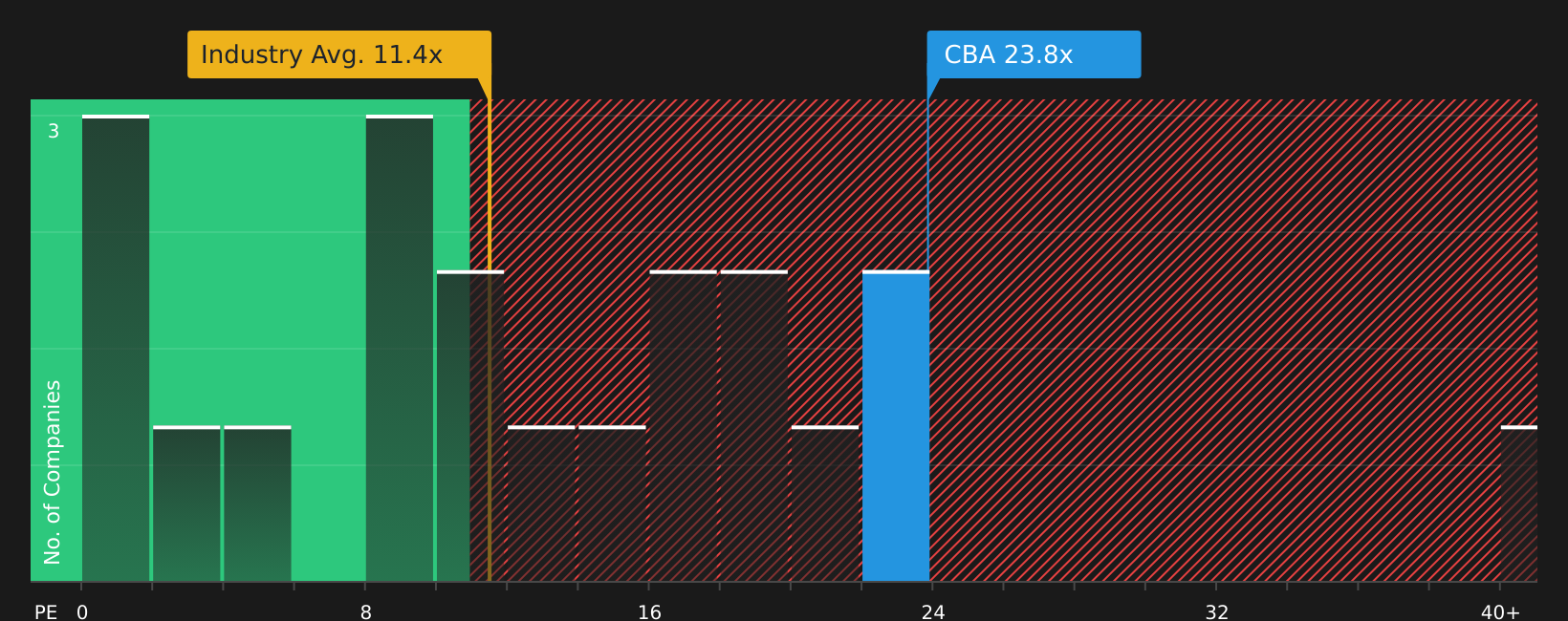
Commonwealth Bank of Australia is built around the kind of steady retail and business banking earnings that can support large, regular dividends, as seen with its recent fully franked A$2.70 final dividend and A$10.9b net income for FY 2026. Yet the picture is more complex, with an elevated P/E, slower forecast revenue and earnings growth, and a low allowance for bad loans that could matter if credit losses rise. Heavy investment in technology, new AI driven efficiency measures and fresh digital leadership hires could help protect margins and keep cash flows strong, but recent insider selling and an unstable dividend history mean income investors need to look under the hood before relying on CBA as a long term dividend anchor.
Commonwealth Bank of Australia’s big dividends and technology push could be masking a more complex story on risk, valuation and growth. Get the full context through the analysis report for Commonwealth Bank of Australia
Curious To Explore Dividend Alternatives
Fresh opportunities do not sit still. While attention lingers on today’s dividend heroes, other ideas can build momentum under the radar for now. Do not get caught reacting late; look for ways to position yourself earlier in the process.
- Shift your focus toward resilient balance sheets and consistent fundamentals by scanning the curated list of solid balance sheet and fundamentals (22 results) that puts financial strength at the center of your watchlist.
- Spot potential breakout stories in under-followed companies by running the hand picked 11 high quality undiscovered gems to monitor changes in investor interest and trading activity.
- Monitor structural demand trends in electricity and grid upgrades by checking the focused 38 power grid technology and infrastructure stocks while these infrastructure stocks are still receiving relatively limited attention.
This article by Simply Wall St is general in nature. We provide commentary based on historical data and analyst forecasts only using an unbiased methodology and our articles are not intended to be financial advice. It does not constitute a recommendation to buy or sell any stock, and does not take account of your objectives, or your financial situation. We aim to bring you long-term focused analysis driven by fundamental data. Note that our analysis may not factor in the latest price-sensitive company announcements or qualitative material. Simply Wall St has no position in any stocks mentioned.
Have feedback on this article? Concerned about the content? Get in touch with us directly. Alternatively, email editorial-team@simplywallst.com