


Charter (CHTR) Stock May Be Reasonable As Cox Deal Closes
Charter Communications stock has had a rough run over the past few years, yet the broader valuation checks still point to a company that screens cheap on several measures. That contrast is coming back into focus after the completion of the US$34.5b Cox Communications acquisition and a sharp reset in expectations.
- Over the last 5 years, Charter Communications has declined about 81.5%, which puts a spotlight on whether the current share price already reflects a lot of bad news.
- The completed Cox Communications deal can support scale and revenue opportunities, while rising broadband competition and cost pressures may keep investors cautious about how much to pay for that bigger footprint.
- Charter Communications scores highly on valuation checks, with 5 out of 6 signals suggesting the shares trade at a discount to key fundamentals.
The issue now is whether the market is correctly pricing Charter Communications after such a steep multi year decline or if the current level still undervalues the business.
Find out why Charter Communications' -45.0% return over the last year is lagging behind its peers.
Is Charter Communications Still Cheap on Earnings?
The P/E multiple is a useful way to look at Charter Communications because earnings remain a key focus for many investors in mature telecom and media businesses.
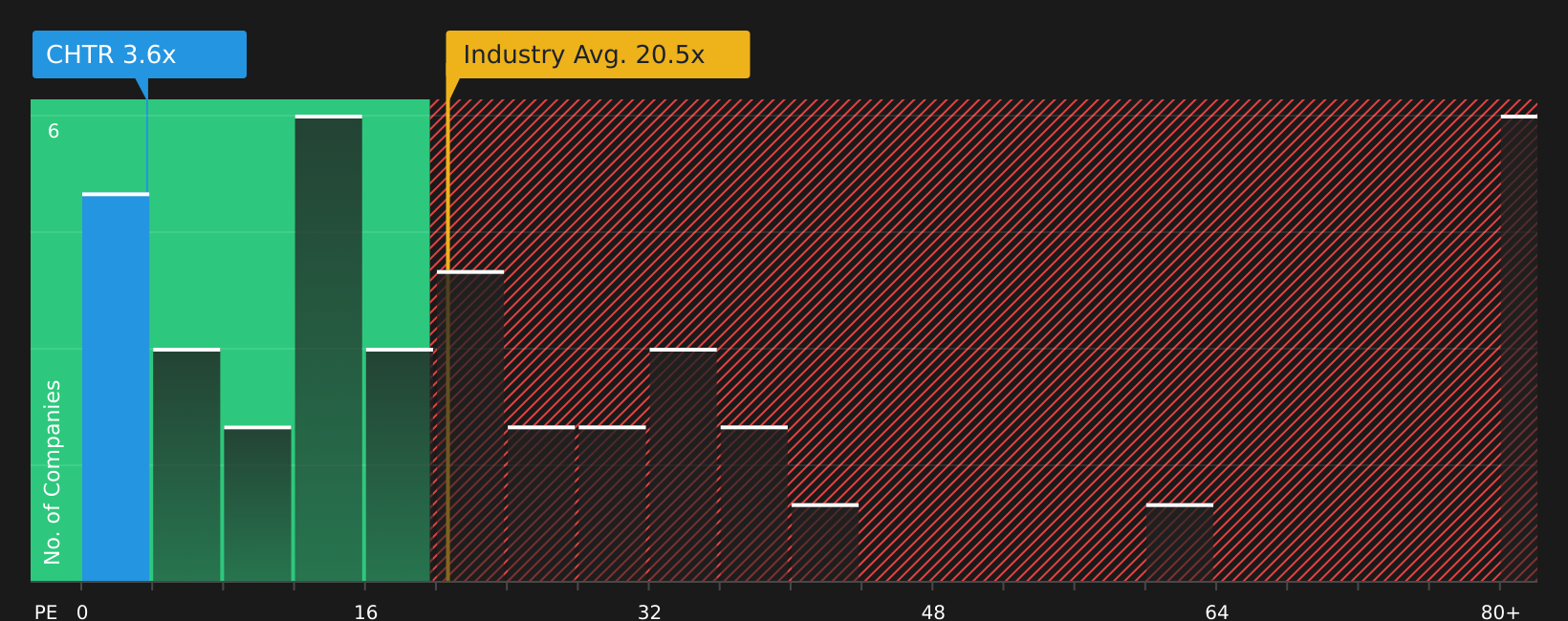
On this measure, Charter Communications currently trades on a P/E of about 3.5x, which is far below the Media industry average of 21.2x and well under the broader peer group on roughly 24.5x. The fair P/E ratio implied by Simply Wall St's model, which aims to reflect the company’s growth profile, margins, size and risk, is about 17.5x. That indicates a large gap between where the stock trades and where this model suggests it might sit if it were valued closer to its fundamentals.
Despite the Cox Communications deal making Charter a larger broadband and video provider, the stock still trades on a P/E that is well below both industry norms and this fair P/E estimate.
On the P/E multiple alone, Charter Communications stock appears undervalued compared with both its industry and a tailored fair value benchmark.
See what the numbers say about this price — find out in our valuation breakdown.
The Charter Communications Narrative: What Would Justify Today's Price?
Simply Wall St Narratives are a way to connect Charter Communications' low P/E with the specific assumptions that would need to hold on growth, margins and earnings for the stock to be worth meaningfully more or less than today's price. Rather than relying on a single multiple or one model output, each Narrative lays out the key drivers behind its fair value view so you can compare those assumptions with actual results as they are reported over time on Simply Wall St's Community page.
Charter Communications draws sharply different views from the Simply Wall St community, with some investors focused on cash flow and others fixated on competition and capital needs.
Bull case: 49% undervalued
"CHTR is nearing the end of a large multi-year network upgrade. Capex, which has been coming in at roughly 11.5B for three years, will decline to 9.5B in 2027 and 7.5B in 2028, generating a 4B increase in annual FCF, assuming no growth at all in EPS…"
Read the full Bull Case to see why Charter Communications could be undervalued
Bear case: 21% overvalued
"Charter Communications faces persistent broadband subscriber losses amid heightened competition from 5G and fixed wireless access providers, threatening the company's ability to return to meaningful broadband customer growth and putting long-term revenue expansion at risk…"
Read the full Bear Case to see why Charter Communications could be overvalued
Do you think there's more to the story for Charter Communications? Head over to our Community to see what others are saying!
The Bottom Line
Charter Communications still screens as undervalued on market multiples, even after a difficult 5 year share price run and the Cox Communications acquisition. The key question is whether that discount reflects an overly pessimistic view of broadband competition and capital needs, or if it is the market correctly pricing persistent pressure on growth and earnings quality. For readers, the crux is whether Charter Communications can translate its larger footprint and past investment into resilient cash generation. The answer to that, and whether the P/E gap closes, is likely to decide if today’s valuation is an opportunity or a value trap.
This article by Simply Wall St is general in nature. We provide commentary based on historical data and analyst forecasts only using an unbiased methodology and our articles are not intended to be financial advice. It does not constitute a recommendation to buy or sell any stock, and does not take account of your objectives, or your financial situation. We aim to bring you long-term focused analysis driven by fundamental data. Note that our analysis may not factor in the latest price-sensitive company announcements or qualitative material. Simply Wall St has no position in any stocks mentioned.
Have feedback on this article? Concerned about the content? Get in touch with us directly. Alternatively, email editorial-team@simplywallst.com