


American Airlines (AAL) Stock Looks Cheap On Sales While Debt Clouds Value
American Airlines Group stock has delivered a loss of 29.1% over the past five years, yet the current valuation checks suggest the shares may now be pricing in more caution than the broader metrics imply.
- Over the last five years, American Airlines Group shareholders have seen the stock decline 29.1%. This sets a low bar for what investors may expect from the current price.
- Recent changes to upgrade policies that aim to protect premium business class revenue, alongside higher fuel expenses, can support cash flow in some routes. However, they also highlight cost pressures that may limit how much investors are willing to pay for the stock.
- The company screens as undervalued on 5 of 6 valuation checks, so the broader assessment leans cheap for American Airlines Group according to its value score of 5.
The issue now is whether American Airlines Group's current share price already reflects these risks or if investors are being compensated for them through a genuine valuation discount.
Find out why American Airlines Group's 6.3% return over the last year is lagging behind its peers.
Does American Airlines Group Look Undervalued on Sales?
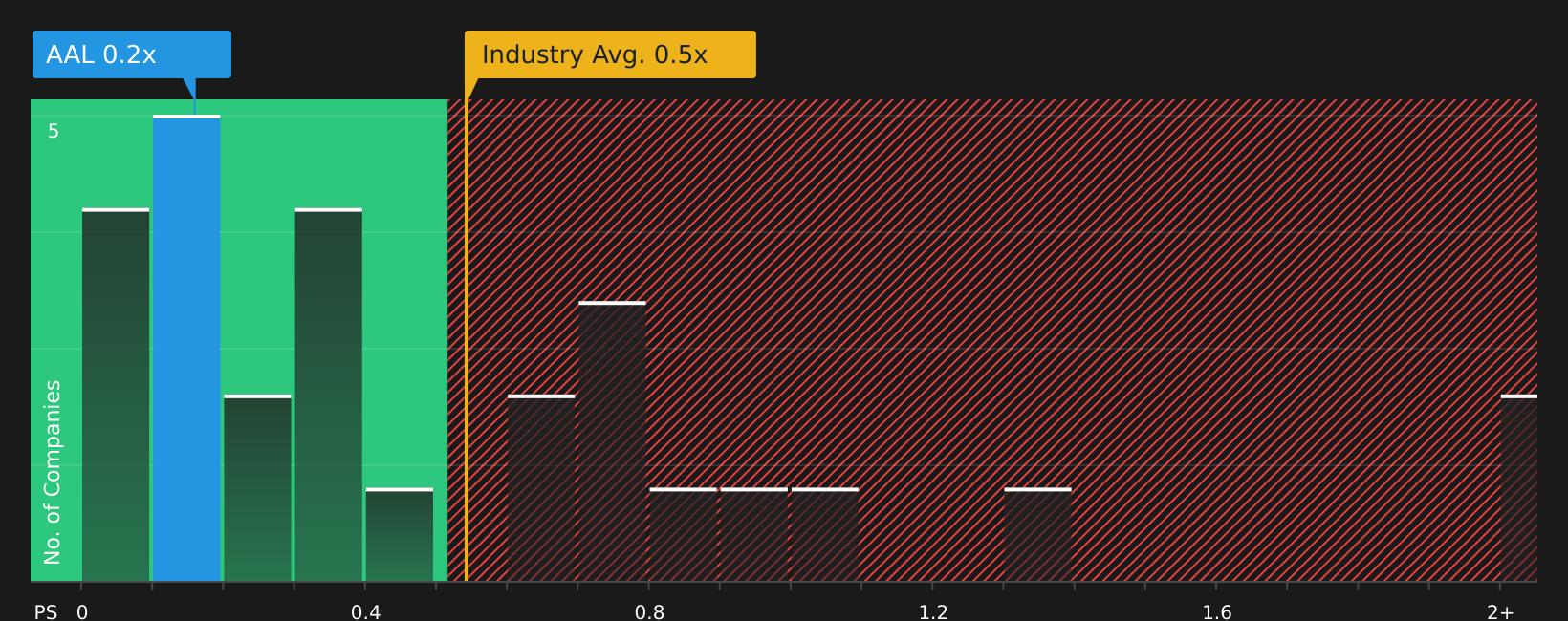
The P/S ratio suits American Airlines Group because revenue is one of the clearest anchors investors have for a carrier with volatile earnings. The stock currently trades on a P/S of 0.2x, which is well below the Airlines industry average of 0.5x and also below the broader peer average of 0.8x. That places American Airlines Group toward the low end of the sector on a sales multiple basis.
The fair P/S ratio that reflects the company’s profile is estimated at 1.1x, which is materially higher than where the stock trades today. Even with recent policy changes aimed at protecting premium business class revenue and managing higher fuel costs, the market price still implies a large discount to this tailored benchmark. This indicates that investors are pricing American Airlines Group with a wide margin of caution relative to both its industry and the fair ratio signal.
On the P/S multiple, American Airlines Group stock appears undervalued compared with both the industry and its own fair ratio benchmark.
See what the numbers say about this price — find out in our valuation breakdown.
The American Airlines Group Narrative: What Would Justify Today's Price?
Simply Wall St Narratives take the valuation puzzle around American Airlines Group and spell out what future paths in growth, margins and earnings would need to look like for the stock to be worth materially more or less than today’s price, using scenarios you can see on the Community page. Instead of a single ratio or model output, they set out the underlying assumptions so you can watch over time whether those conditions still hold.
Community views on American Airlines Group are sharply split, with some investors focused on premium revenue and others fixated on balance sheet risk.
Bull case: 26% undervalued
"The significant growth in engaged AAdvantage loyalty program members and the new 10-year Citi card agreement, launching in 2026, provide structural tailwinds by expanding high-margin partnership revenue, stabilizing earnings, and offering recurring free cash flow benefits over the long-term..."
Read the full Bull Case to see why American Airlines Group could be undervalued
Bear case: 32% overvalued
"If most airlines and certainly those in the US are loaded up to the hilt with debt, American goes so far as to boast negative equity, any startup would go belly-up with a balance sheet such as this one..."
Read the full Bear Case to see why American Airlines Group could be overvalued
Do you think there's more to the story for American Airlines Group? Head over to our Community to see what others are saying!
The Bottom Line
American Airlines Group screens as undervalued on its market multiples, which suggests investors are applying a heavy discount to the stock relative to sales and peers. That discount reflects real concerns over debt, cash flow resilience and how much the balance sheet can flex through different cycles. For you as an investor, the key question is whether American Airlines Group can steadily convert its premium revenue initiatives and loyalty economics into durable cash generation, or whether the current valuation gap is the market correctly pricing in balance sheet risk.
This article by Simply Wall St is general in nature. We provide commentary based on historical data and analyst forecasts only using an unbiased methodology and our articles are not intended to be financial advice. It does not constitute a recommendation to buy or sell any stock, and does not take account of your objectives, or your financial situation. We aim to bring you long-term focused analysis driven by fundamental data. Note that our analysis may not factor in the latest price-sensitive company announcements or qualitative material. Simply Wall St has no position in any stocks mentioned.
Have feedback on this article? Concerned about the content? Get in touch with us directly. Alternatively, email editorial-team@simplywallst.com