


VeriSign (VRSN) Stock Looks Fully Priced With Strong Cash Flow And Rich Earnings
VeriSign stock has delivered a solid 45.0% return over the past three years, yet both the Discounted Cash Flow (DCF) intrinsic value estimate and the market multiple checks currently point to the shares trading at a premium to those fundamentals.
- Over the last three years, VeriSign has returned 45.0%, which puts extra focus on whether today’s price still matches the cash flows investors expect from the business.
- The company’s recurring revenue model can support long term cash generation. However, any slowdown in domain growth or pricing power may weigh on what investors are willing to pay for those cash flows.
- VeriSign passes only 1 of 6 valuation checks, which signals that on the broader measures it currently leans expensive rather than like a clear bargain.
The issue now is whether the current share price already reflects the value of VeriSign’s future cash flows or if the recent three year gain has pushed the stock beyond its intrinsic value.
Find out why VeriSign's 9.0% return over the last year is lagging behind its peers.
Is VeriSign Getting Expensive on Cash Flow?
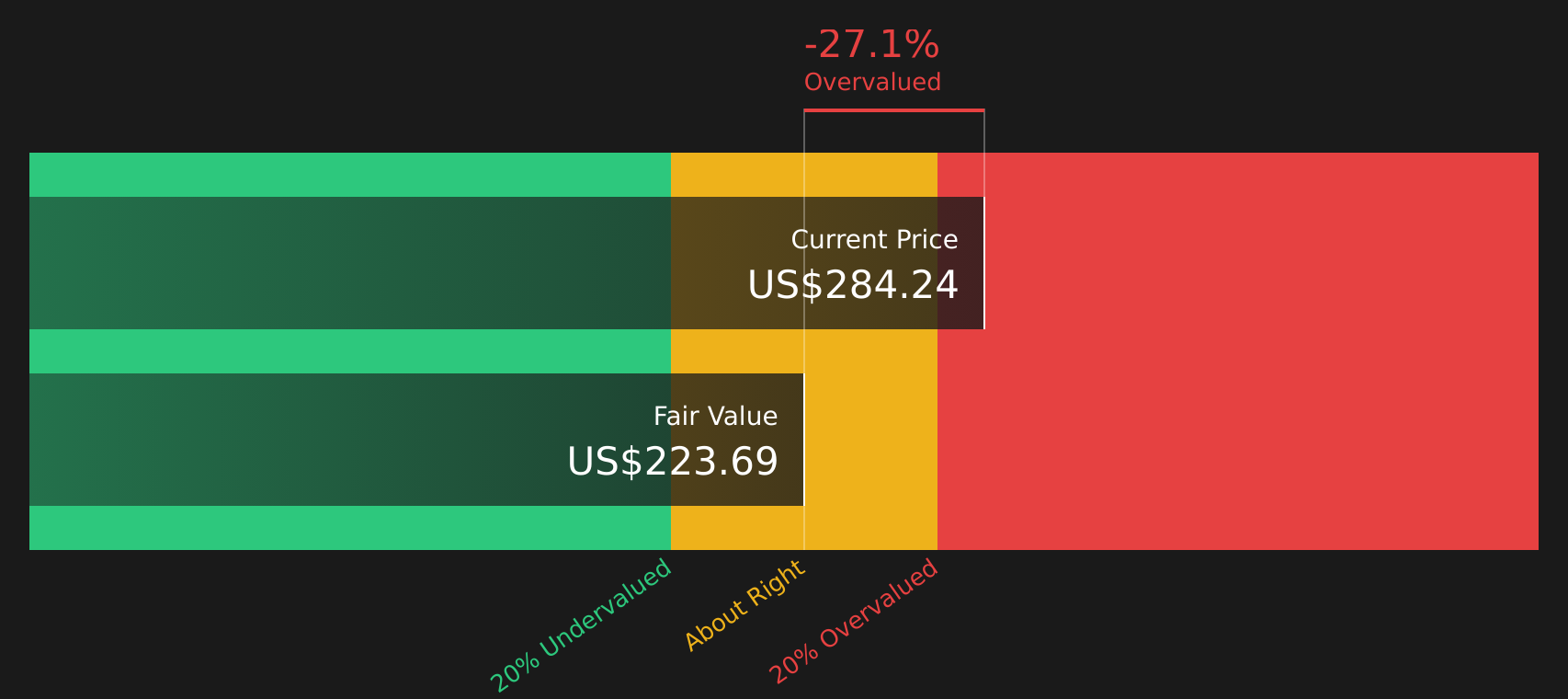
The Discounted Cash Flow (DCF) model here is built around VeriSign’s ability to keep converting its domain business into steady free cash. Over the last twelve months the company generated about $1.1b in free cash flow, and the projection path assumes that these cash flows continue to grow from this base rather than surge or collapse. That profile fits a mature, cash generative business where small changes in long term growth or discount rate can shift the valuation quite a bit.
On these assumptions, the DCF model points to an intrinsic value of about $225 per share. Compared with the current market price, that implies the stock trades at roughly a 27.7% premium to this cash flow based estimate. The current price suggests investors are willing to pay extra for VeriSign’s predictable model beyond what this particular DCF framework supports.
On this cash flow view, VeriSign stock currently screens as overvalued relative to its estimated intrinsic value.
Our Discounted Cash Flow (DCF) analysis suggests VeriSign may be overvalued by 27.7%. Discover 51 high quality undervalued stocks or create your own screener to find better value opportunities.
Does VeriSign Look Pricey on Earnings?
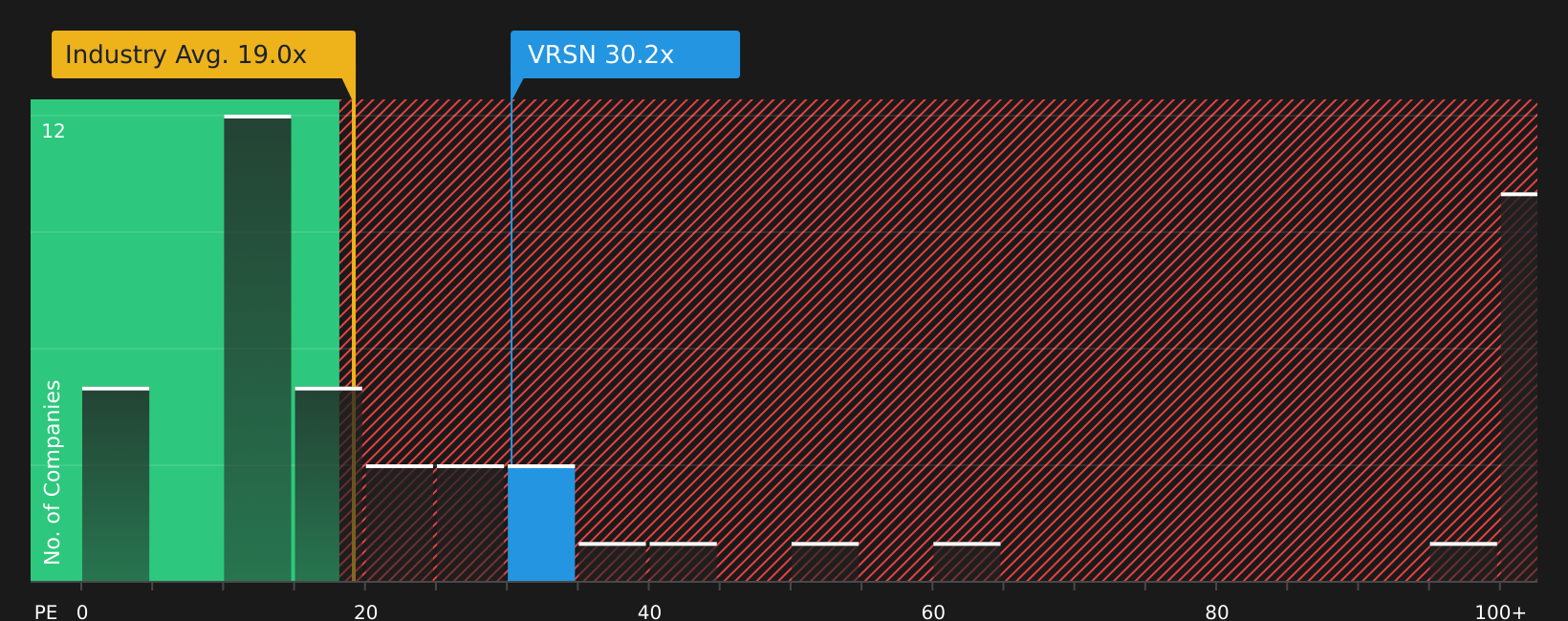
P/E suits VeriSign because it is a profitable, established business where earnings are a key anchor for valuation. On this measure, the stock trades on about 30.5x earnings, which is above the broader IT industry average of roughly 20.8x. That indicates the market is already attaching a premium to VeriSign’s earnings stream compared with many sector peers.
The fair P/E ratio implied by the model is about 26.0x, which reflects what investors might pay given VeriSign’s size, margins, growth expectations and risk profile. The current 30.5x level is above that fair ratio, so the stock appears richer than what this framework suggests would be reasonable.
On the P/E multiple, VeriSign stock appears overvalued relative to both the industry average and this more tailored fair value benchmark.
See what the numbers say about this price — find out in our valuation breakdown.
The VeriSign Narrative: What Would Justify Today's Price?
Simply Wall St Narratives for VeriSign pick up where the valuation puzzle leaves off and clarify which assumptions about VeriSign's future growth, margins and earnings would need to hold for the stock to be worth materially more or less than it is today. Each narrative links its number to a specific view on how VeriSign's growth, profitability and risks might evolve. You can revisit these views as new information comes through on the Community page.
VeriSign investors in the community are split between a steady cash machine story and a much harsher view of concentrated and governance risk.
Bull case: 8% undervalued
"VeriSign is experiencing sequentially improving trends in domain name registrations, with new registrations and renewal rates increasing, potentially boosting revenue growth in the coming quarters..."
Read the full Bull Case to see why VeriSign could be undervalued
Bear case: 74% overvalued
"Overall, while VRSN continues to benefit from exceptionally strong revenue expectations due to the repeatedly renewed monopoly over the .com and .net TLDs, the mismanagement described above non-trivially jeopardizes the continuation of this natural monopoly..."
Read the full Bear Case to see why VeriSign could be overvalued
Do you think there's more to the story for VeriSign? Head over to our Community to see what others are saying!
The Bottom Line
For VeriSign, both the Discounted Cash Flow (DCF) intrinsic value estimate and the P/E based market multiple point to the same conclusion. The stock currently looks overvalued on the cash it is expected to generate and on what investors are paying for each dollar of earnings.
The broader valuation checks are also weak, which supports a cautious read on value rather than a hidden bargain story. The key question from here is whether VeriSign can sustain the cash flow resilience and pricing power that some investors expect, or whether any pressure on domain growth and governance concerns keeps the valuation under strain.
This article by Simply Wall St is general in nature. We provide commentary based on historical data and analyst forecasts only using an unbiased methodology and our articles are not intended to be financial advice. It does not constitute a recommendation to buy or sell any stock, and does not take account of your objectives, or your financial situation. We aim to bring you long-term focused analysis driven by fundamental data. Note that our analysis may not factor in the latest price-sensitive company announcements or qualitative material. Simply Wall St has no position in any stocks mentioned.
Have feedback on this article? Concerned about the content? Get in touch with us directly. Alternatively, email editorial-team@simplywallst.com