


Berkshire Hathaway's CEO Greg Abel Sold $8.1 Billion in Stocks in Q1 ... a Sign He Sees Few Bargains. Did That Change in Q2?
Key Points
Berkshire Hathaway’s quarterly reports disclose how much the company spends on new stock investments and any proceeds collected via the sale of stocks from its equity portfolio.
It’s been a net seller of stocks for 14 straight quarters.
The conglomerate’s sizable amount of idle cash resulting from all this net selling, however, has been and continues to miss out on marketwide bullishness, frustrating shareholders.
It's been one of the bigger narratives regarding Berkshire Hathaway (NYSE: BRKA) (NYSE: BRKB) for a while now. That is, the conglomerate's been piling up more and more idle cash by selling more stocks than it's been buying for its equity portfolio. Through Q1 of this year, in fact, Berkshire's done so for 14 consecutive quarters.
It's a sign that, for a while now, CEO Greg Abel and his predecessor Warren Buffett have seen little worth owning at the price being asked. This, of course, has implications for all investors.
Missed Nvidia in 2009? This Rare Signal Is Flashing Again. In 2009, a "Double Down" signal flashed for a little-known chipmaker called Nvidia. For the first time in years, that same "Total Conviction" signal is flashing for a company 1/100th the size of Nvidia. Continue »
There's a glimmer of hope on the horizon, though. During the company's second fiscal quarter ending in June, Berkshire finally bought more stock for its equity portfolio than it sold, suggesting there are bargains out there worth buying into.

Image source: Getty Images.
The numbers for Berkshire
Don't get too excited. Abel -- with board chairman Buffett's likely guidance -- isn't exactly plowing into every name he had his eye on. In Q2, the company only made net stock purchases of $19.8 billion, buying $23.5 billion of them, while only selling $3.7 billion of its equity holdings.
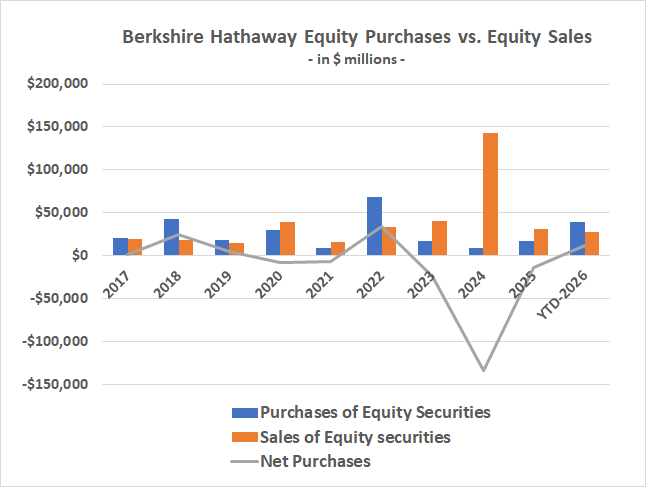
Data source: Berkshire Hathaway. Chart by author.see attached spreadsheet for source links
That's only a fraction of the $397.4 billion in liquidity it started the quarter with, and still only a tiny part of the $365.5 billion in cash and cash equivalents ($6.3 billion of which is spoken for by wholly owned railroad BNSF) it's sitting on now. But it's a start ... maybe.
A subtle but important hint
It's certainly not a splashy dive into the stock market. Then again, it wouldn't be.
Buffett was rarely in a hurry to invest Berkshire Hathaway's idle cash, particularly in the middle part of bull markets when valuations tend to reach above-average levels. Abel isn't likely to be in any hurry either, even if he does appear more willing to proverbially dip his toes into the water than Buffett was shortly before stepping down from his role as CEO -- and chief stock picker -- at the end of last year.
In other words, don't be too discouraged that most of Berkshire's cash that was on the sidelines as of the end of Q1 is still on the sidelines. Also, remember that Berkshire Hathaway only completed its all-cash $6.8 billion acquisition of homebuilder Taylor Morrison in July of this year, after the second quarter had ended.
Perhaps the bigger takeaway for investors is that while the market as a whole may arguably remain overvalued -- the S&P 500's (SNPINDEX: ^GSPC) forward-looking price/earnings ratio right now is near multiyear highs, in fact -- Berkshire's second-quarter net investments suggest there are individual prospects out there still worth considering.
To this end, we don't yet know exactly which stocks Berkshire Hathaway bought in Q2. The conglomerate might have purchased some new names, or it may have merely expanded its existing positions, or it may have combined both. We won't know for sure until the company files its 13F disclosure document, probably sometime later this week. As always, of course, that filing could be a great source of ideas for your own portfolio.
James Brumley has no position in any of the stocks mentioned. The Motley Fool has positions in and recommends Berkshire Hathaway. The Motley Fool has a disclosure policy.